






 Portuguese
  Spanish


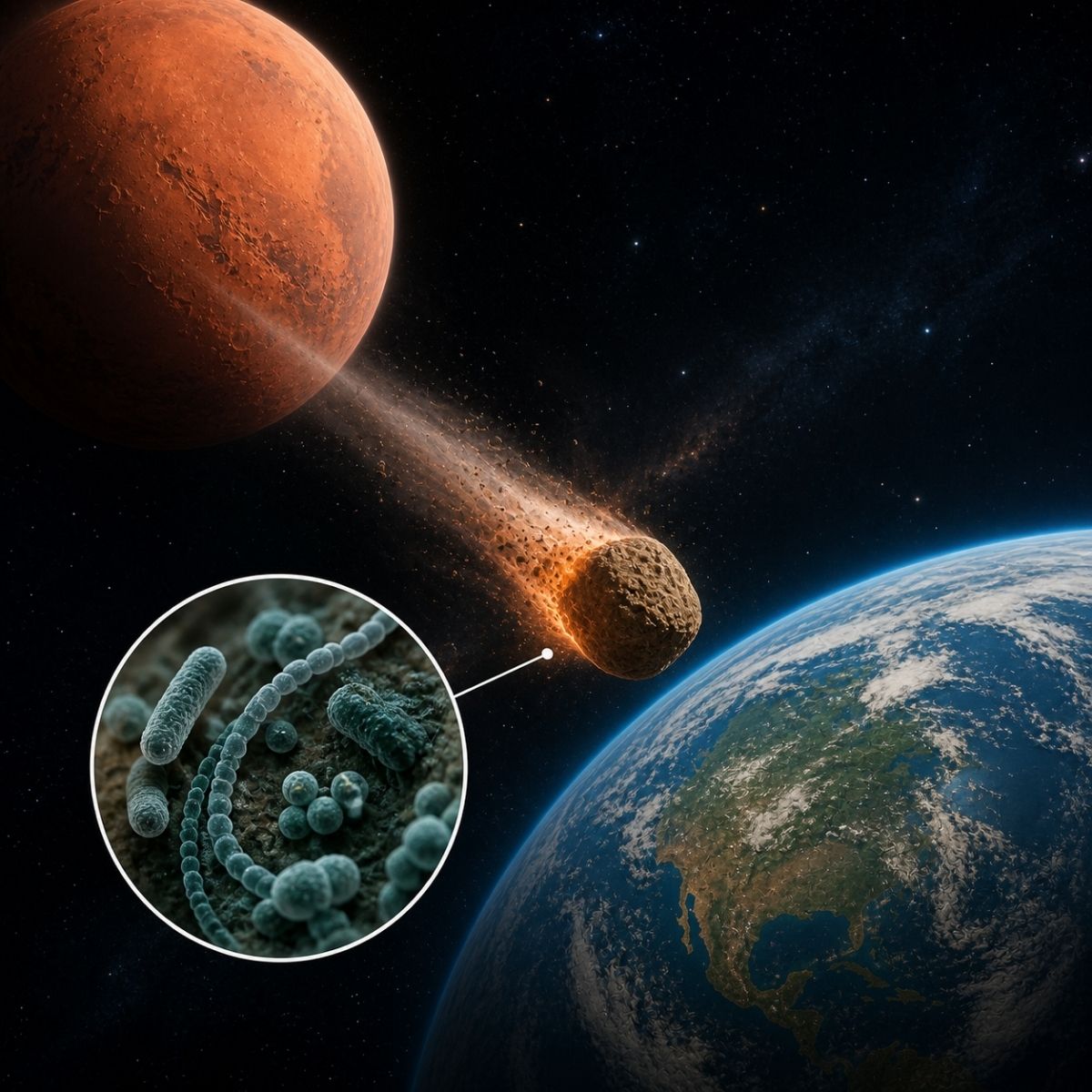

Studies from Johns Hopkins (PNAS Nexus, 2026) and JAXA (Frontiers in Microbiology, 2020) show that Deinococcus radiodurans survives impact pressures and 3 years in space, reinforcing the panspermia hypothesis that meteorites may have transported life between Mars and Earth, without definitive proof.
The question of whether life on Earth may have arrived from another planet inside meteorites spans centuries of philosophy and science, and since 2020, when the bacterium Deinococcus radiodurans survived three years on the exterior of the Space Station in JAXA’s Tanpopo experiment, it has gained renewed momentum. The hypothesis, known as panspermia (from Greek “pan” = all + “sperma” = seed), proposes that microorganisms can travel through space inside meteorites, enduring the impact of planetary ejection, cosmic vacuum, and radiation during the journey, to then establish themselves on another world. The Greek philosopher Anaxagoras suggested the idea in the 5th century BC, the Swedish chemist Svante Arrhenius formalized the scientific version in 1903, and astronomers Fred Hoyle and Chandra Wickramasinghe developed it in the 20th century, but despite becoming increasingly plausible from a physical standpoint, panspermia remains a hypothesis: there is no proof that meteorites have actually transported life between planets.
The distinction between plausibility and proof is what separates rigorous science from sensationalist headlines. Panspermia does not explain the origin of life: it merely shifts the question, because if life came from Mars in meteorites, the question of how it originated there remains unanswered. What recent experiments do is demonstrate that the scenario is physically possible, that extremely resistant microorganisms can survive the conditions that meteorites face during interstellar travel, and that therefore the hypothesis cannot be dismissed due to physical impossibility, but this is very different from proving that it happened.
The bacterium that survives everything and became the protagonist of meteorite research

Deinococcus radiodurans is the organism science has chosen to test the limits of survival in conditions compatible with meteorite travel. Nicknamed “Conan the Bacterium” and listed in the Guinness Book of World Records as the planet’s most radiation-resistant organism, this bacterium withstands 3,000 times the amount of radiation that would kill a human, survives vacuum, resists extreme dehydration, tolerates intense cold, and endures acidity that would destroy most known organisms. The discovery of the bacterium happened unexpectedly: it was first isolated from canned meats that had undergone sterilizing radiation and yet remained contaminated, revealing an organism that science is still trying to fully understand.
-
Pennsylvania Mine Creates Ice in Summer Heat and Melts in Winter, Turning a Mountain Crevice into a Reverse Natural Refrigerator

-
China Accelerates Global Expansion of Robotics: From Smart Vacuums to Industrial and Humanoid Machines, Millions Exported to Over 150 Markets
-
Polar Air Mass to Hit Brazil: Temperatures to Plummet in Nine States, Near Freezing in the South with Frost Risk Until Monday
-
Chinese “dark factories” produce electric cars 24/7 with minimal human intervention, as Zeekr assembles 800 units daily, raising concerns in Brazil.





Microbiologist Michael Daly, from the Uniformed Services University of the Health Sciences, who has been studying Deinococcus radiodurans for over 30 years, describes the bacterium as a very ancient organism that has likely existed for billions of years and whose resistance would be difficult to explain by exposure to radiation on Earth, as there have never been ionizing radiation levels on the planet close to what it can withstand. Researchers suggest that radiation resistance may be a side effect of dehydration resistance, a hypothesis proposed by researcher Valerie Mattimore from Louisiana State University, but regardless of the origin of this capability, Deinococcus radiodurans is a perfect candidate to test whether meteorites can function as vehicles for transporting life between planets.
What JAXA’s Space Station experiment proved about meteorites and life

The most emblematic experiment on the survival of microorganisms in space conditions compatible with meteorite travel is called Tanpopo, Japanese for dandelion. Led by Professor Akihiko Yamagishi, a molecular biologist at Tokyo University of Pharmacy and Life Sciences, the experiment placed samples of Deinococcus radiodurans on external panels of the International Space Station, directly exposed to cosmic vacuum, ultraviolet radiation, and the extreme temperature variations that meteorites face in space. The result, published in the scientific journal Frontiers in Microbiology in August 2020, demonstrated that the bacterium survived three years of exposure on the exterior of the space station.
“The results suggest that radioresistant Deinococcus could survive during the journey from Earth to Mars and vice versa, which lasts several months or years in the shortest orbit,” Yamagishi explained after the study’s publication. Before the ISS experiment, in 2018, Yamagishi’s team found Deinococcus naturally floating at an altitude of about 12 km in Earth’s atmosphere, collected by scientific planes and balloons, a discovery that indicated the bacterium already inhabits atmospheric layers close to the limit where meteorites begin to disintegrate upon entry. The combination of survival in space and natural presence in the upper atmosphere made Deinococcus an ideal model to assess whether meteorites can function as interplanetary biological capsules.
What the 2026 Johns Hopkins study added to the meteorite debate


The most recent study reinforcing the physical viability of panspermia was published in the journal PNAS Nexus in 2026. Led by Lily Zhao, a graduate student at Johns Hopkins University, the experiment tested whether Deinococcus radiodurans survives the shock pressures generated when meteorites are ejected from a planet by asteroid impact, a condition that simulates the moment a fragment of Mars is thrown into space after a violent collision. The result showed that the bacterium survived pressures of up to 3 gigapascals (GPa), a value close to the 5 GPa that real impacts can generate on Mars.
Survival at 3 GPa is significant because not every rock within ejected meteorites experiences the maximum peak pressure. Fragments at the periphery of the impact zone experience lower pressures, and if bacteria can withstand 3 GPa, it is physically plausible that they could have survived in meteorites ejected from Mars where the local pressure did not reach its maximum. Researchers from the same group warned that the study also raises concerns about reverse planetary protection: if terrestrial bacteria survive these conditions, spacecraft we send to other worlds could contaminate extraterrestrial environments with life from Earth, a risk that future missions need to seriously consider.
The case of meteorite ALH84001 and why it still divides scientists today
The most famous meteorite in the history of panspermia was found in Antarctica in 1984 and received the code ALH84001. Analyses confirmed that the rock came from Mars, ejected from there approximately 15 million years ago by an asteroid impact, and in August 1996, NASA scientist David McKay published a study in the journal Science suggesting that microscopic structures found in the meteorite could be microfossils of Martian life. The announcement had such a significant impact that the then-President of the United States, Bill Clinton, made an official statement on the topic.
McKay’s interpretation was challenged in subsequent years by the majority of the scientific community. Researchers demonstrated that the structures found in the meteorite could have an abiotic origin, meaning natural formation without the involvement of living organisms, and the current consensus is that ALH84001 does not constitute proof of Martian life. However, the meteorite reopened the debate about the possibility that Mars may have harbored life at some point in its past, and the presence of organic molecules in Martian meteorites continues to be an active research subject that fuels the discussion about panspermia.
Why the hypothesis of meteorites as vehicles for life has not yet been proven
Despite experimental advances, panspermia faces scientific obstacles that prevent its validation. The estimated time for a meteorite ejected from Mars to reach Earth on the shortest trajectory is about 10,000 years, a period during which accumulated cosmic radiation, the absence of nutrients, and the cold of deep space pose challenges to the survival of any organism, even the most resistant ones. Furthermore, Deinococcus radiodurans shares genetic and biochemical structure with other terrestrial organisms, a similarity that suggests an evolutionary origin on Earth and weakens the hypothesis that it would have come from Martian meteorites.
To date, no extraterrestrial organism has been detected in any meteorite analyzed on Earth. All discussion about panspermia remains in the theoretical and laboratory field, and what experiments demonstrate is physical plausibility, not historical occurrence. As often happens with the big questions of science, the definitive answer will depend on evidence that does not yet exist: perhaps a sample of Martian soil collected by a future mission, perhaps a freshly fallen meteorite with an unequivocal biological signature. Until then, the origin of life on Earth remains one of the most fascinating mysteries that science pursues, and meteorites remain as candidates for messengers of an answer that may literally be falling from the sky.
And you, do you think it’s possible that life on Earth came from Mars in meteorites? Or do you prefer to believe that we originated right here? Leave your opinion in the comments.







