Portuguese
  Spanish


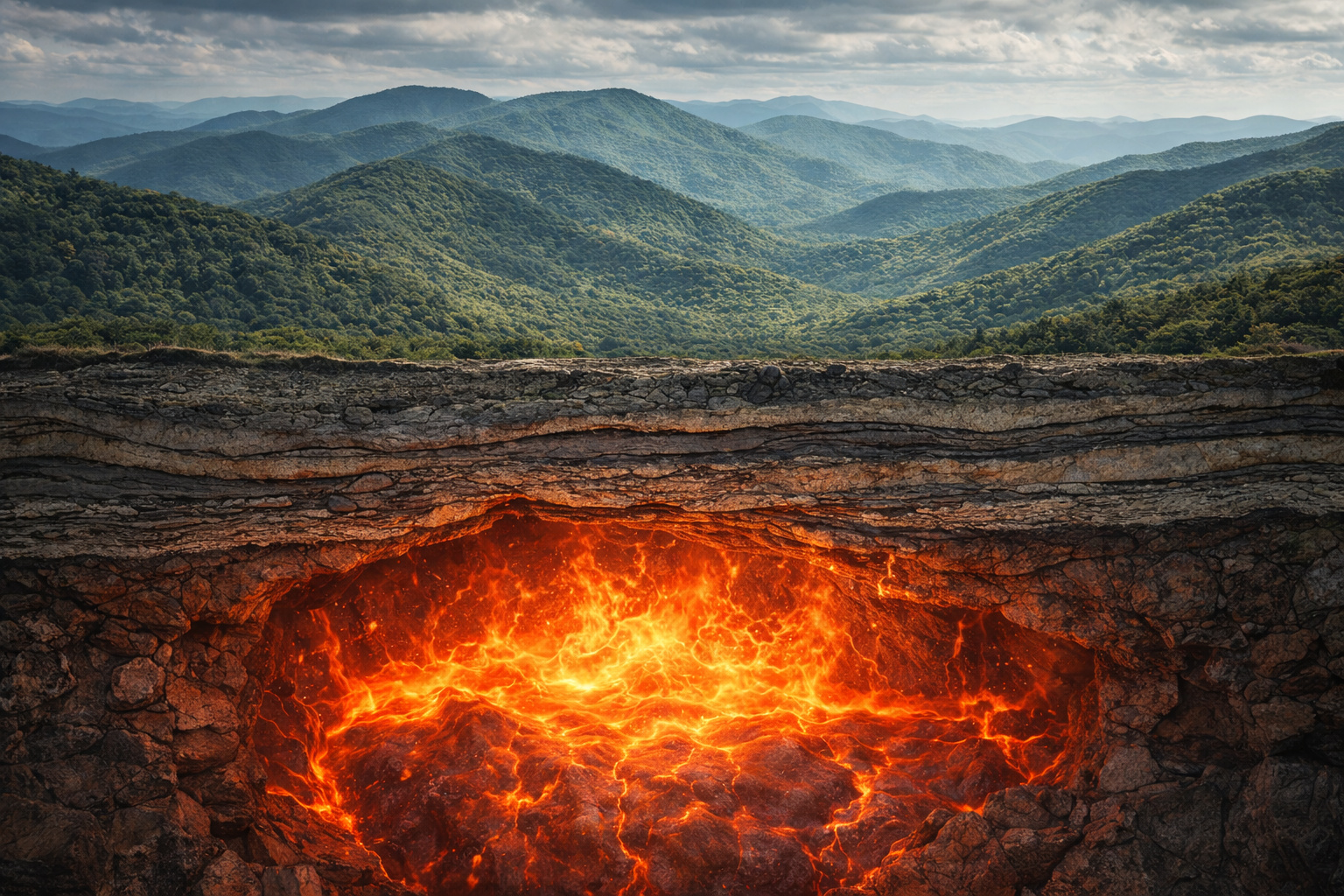


Scientists identify hot rock bubble 200 km below the Appalachians that can support 480 million-year-old mountains against erosion.
The Appalachians are mountains that should not exist. With about 480 million years of formation and over 20 million years of continuous erosion, they should have been reduced to plains long ago, as has happened with similarly aged ranges in other regions of the planet. However, they remain present, with peaks over 2,000 meters, visible from space and extending approximately 2,400 kilometers along the east coast of North America.
According to a study published in the journal Geology in July 2025 by researchers from the University of Southampton, and reported by outlets such as CNN, Live Science, ScienceDaily, and SciTechDaily, the explanation lies about 200 kilometers below the surface: a thermal anomaly formed by a mass of abnormally hot rock approximately 350 kilometers wide, capable of directly influencing the uplift of the mountains.
Why ancient mountains should disappear and why the Appalachians challenge that logic
On a geological scale, mountain ranges are temporary structures. They arise from collisions between tectonic plates and, immediately after their formation, begin to be worn down by erosive processes such as rain, wind, ice, and gravity.
-
Polar Air Mass to Hit Brazil: Temperatures to Plummet in Nine States, Near Freezing in the South with Frost Risk Until Monday

-
Chinese “dark factories” produce electric cars 24/7 with minimal human intervention, as Zeekr assembles 800 units daily, raising concerns in Brazil.

-
Spectacular Green Aurora Seen from Space Illuminates International Space Station, Captivates French Astronaut

-
In Tasmania, a Beach Features a Natural Stone Mosaic Formed by Earth’s Cracks Millions of Years Ago



Younger mountains, like the Himalayas, are still growing due to active tectonic activity. The Appalachians, however, ceased to be driven by this type of force hundreds of millions of years ago.
By traditional geological logic, they should exhibit a smoothed relief. However, they still display elevated and defined structures, indicating the presence of an additional support mechanism.
Thermal anomaly beneath New England detected by seismic tomography
For decades, scientists have identified a region of rock that is hotter than normal beneath the New England region of the United States. This area, known as the North Appalachian Anomaly (NAA), is located in the asthenosphere, about 200 kilometers deep.


The presence of this anomaly is detected through seismic tomography, a technique that analyzes the speed of seismic waves as they pass through different materials. Since hotter rocks reduce the speed of these waves, it is possible to map regions of higher temperature within the Earth.
Separation of Greenland explains origin of thermal anomaly 80 million years ago
The study proposes that the origin of this anomaly is associated with the separation of Greenland from North America, which occurred between 90 and 80 million years ago during the opening of the Labrador Sea.
In this process, the thinning of the crust allowed the ascent of hot material from the mantle. Over time, this material became denser and began to sink again, generating instabilities that propagate laterally beneath the tectonic plate.
These thermal instabilities form structures that can migrate over thousands of kilometers over tens of millions of years.
Mantle wave theory explains displacement of the anomaly over thousands of kilometers
The team utilized the so-called mantle wave theory, which describes how dense fragments from the base of the lithosphere detach and generate convective movements in the mantle.
These structures function as thermal waves that slowly move beneath the continents. In the case of the Appalachians, the anomaly has traveled approximately 1,800 kilometers over about 80 million years.

Despite the extremely slow speed, geological time allows for significant displacements, altering the dynamics of entire regions.
Mass of hot rock functions as invisible support for the mountains
The mechanism that keeps the Appalachians elevated is related to the partial removal of the dense root of the lithosphere.
With the reduction of this heavier mass, the crust becomes lighter and rises, a process similar to the principle of buoyancy. This effect acts as a continuous support system that partially compensates for surface erosion.
While erosion acts on the surface, the thermal anomaly acts at depth, creating a dynamic balance that maintains the structure of the mountains.
Geodynamic models indicate that the anomaly is still moving and is expected to migrate southwest, potentially reaching the New York region in the next 10 to 15 million years. This displacement may cause subtle changes in the elevation of the terrain, noticeable only on geological scales.
Seismic tomography allows mapping deep structures without drilling
The identification of this structure is only possible through indirect methods. The depth of approximately 200 kilometers prevents any type of direct access.
Seismic tomography uses data from earthquakes to construct three-dimensional images of the Earth’s interior, allowing for the identification of variations in temperature and density. This method is essential for studying the internal dynamics of the planet.
Region considered stable reveals invisible geological activity at depth
The discovery highlights an important aspect of modern geology: regions considered stable at the surface may exhibit significant activity at depth.
The New England area has not shown volcanism or significant tectonic activity for millions of years, but it harbors a dynamic structure that continues to influence the relief.
The study also suggests the existence of a similar structure beneath Greenland, formed during the same tectonic event.
This anomaly may contribute to the heat flow at the base of the ice sheet, influencing melting processes through geological mechanisms.
Thermal waves from the mantle may explain other geological phenomena around the world
The researchers indicate that this mechanism may not be exclusive to the Appalachians. Other regions considered stable may be affected by similar processes, including isolated volcanic events and phenomena associated with the formation of deep minerals.
The main implication of the study is the revision of concepts regarding the stability of continental plates. Even after the end of active tectonic events, the effects of these ruptures can persist for tens of millions of years, influencing relief, climate, and the internal dynamics of the Earth.
The presence of a thermal anomaly beneath such an ancient mountain range raises new questions about the geological evolution of the planet.
In your view, could this type of process be occurring in other seemingly stable regions of the world?