Portuguese
  Spanish


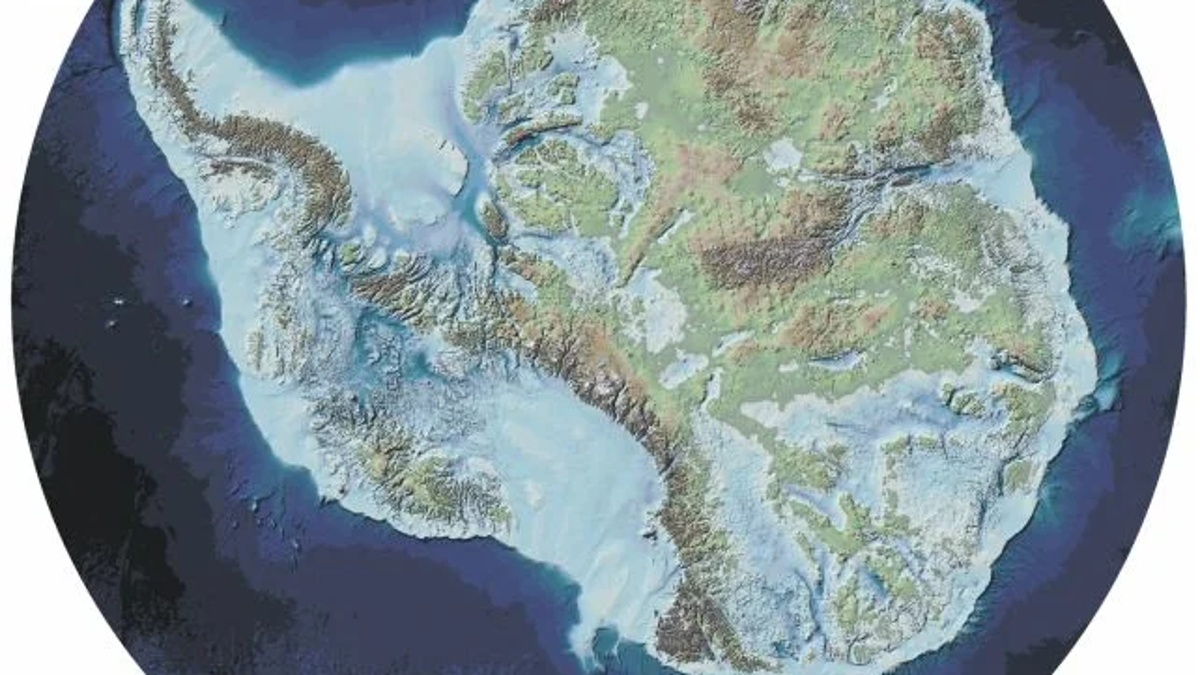
A scientific discovery published in June 2026 is helping researchers better understand the geological history of Antarctica. A study published in the scientific journal Nature Geoscience identified a gigantic fan-shaped structure beneath the ice sheet of East Antarctica.
The research was led by geophysicist Egidio Armadillo from the University of Genoa, Italy, and included the participation of scientists from international institutions, including the University of Durham in the UK and Imperial College London.
The structure was named by researchers as the East Antarctic Fan-Shaped Basin Province. According to the study, the system includes large subglacial basins already known, such as Wilkes, Aurora, and the region where Lake Vostok is located, the largest known subglacial lake on the planet.
What did the scientists find?
The researchers identified a vast network of underground basins located beneath the ice sheet of East Antarctica. Together, these formations create a huge fan-shaped pattern, named the East Antarctic Fan-shaped Basin Province. The structure connects some of the largest known basins in the region, including the Wilkes, Aurora basins, and the area where the famous Lake Vostok is located.
-
Creative Uses for Toilet Paper Rolls That Will Change Your Perspective

-
Crab Trapped in Plastic Bottle for 62 Days Near Okinawa Highlights Little-Known Impact of Marine Pollution on Small Animals
-
Esperanza’s Bamboo Barrier in Oaxaca Redirects River and Reduces Erosion by 85% in Five Years

-
Family Builds Homemade Wind Turbine to Power Off-Grid Home, Video Reaches 555,000 Views on Ngô Thị Huyền’s Channel




According to Egidio Armadillo and the other authors of the article published in Nature Geoscience, this formation may represent one of the largest examples ever identified of rotational extension of the continental crust across the planet.
In simple terms, this means that the Earth’s crust in the region would have stretched and rotated from a central point during tectonic processes that occurred before the separation of the ancient supercontinent Gondwana.
Structure remained hidden for millions of years
The formation remained hidden beneath kilometers of ice and could only be studied using geophysical data and subglacial relief maps.
In the article, the scientists explain that they combined information on the topography beneath the ice with geophysical data to reconstruct the shape of the buried basins. These data showed that the structures, previously analyzed separately, are part of a larger and coherent geological system.
In some regions, the ice layer covering these formations exceeds three kilometers in thickness, which prevents direct observation of the terrain.

Discovery may help understand glacier behavior
Although the discovery has strong geological importance, its implications also help to understand the current behavior of Antarctic ice.
The study published in Nature Geoscience indicates that the underground basins influence the landscape beneath the ice and can affect the flow of glaciers. This occurs because the shape of the terrain hidden under the frozen layer interferes with the direction and speed with which the ice moves.
Understanding these structures can contribute to more accurate models about the evolution of the East Antarctic ice sheet and its possible impact on sea levels.
A continent full of secrets
In recent years, various research has revealed that Antarctica hides impressive landscapes beneath its frozen surface.
Previous studies have already identified underground rivers, hidden lakes, gigantic canyons, and even landscapes preserved for over 30 million years. In some cases, these formations remain practically intact since before the continent was covered by ice.
Furthermore, researchers continue to find new evidence that the region has a much more dynamic geological history than previously believed.
)
Technology allows seeing what is beneath the ice
The exploration of Antarctica has changed radically in recent decades.
Today, scientists use ice-penetrating radars, satellites, gravitational sensors, and seismic techniques capable of revealing details of the terrain hidden beneath the frozen surface. In this way, researchers can create extremely detailed maps of areas that could never be observed directly.
Consequently, new discoveries continue to emerge, expanding knowledge about one of the most mysterious regions on the planet.
What does this discovery mean?
The identification of this enormous underground structure reinforces the idea that Antarctica still holds important information about the Earth’s history.
According to the study led by Egidio Armadillo, the formation may help explain processes related to the breakup of Gondwana, the separation between Antarctica and Australia, and the current configuration of the region’s large subglacial basins.
As new expeditions and technologies advance, the expectation is that other secrets hidden beneath the Antarctic ice will continue to come to light, revealing a world that has remained invisible for millions of years.