






 Portuguese


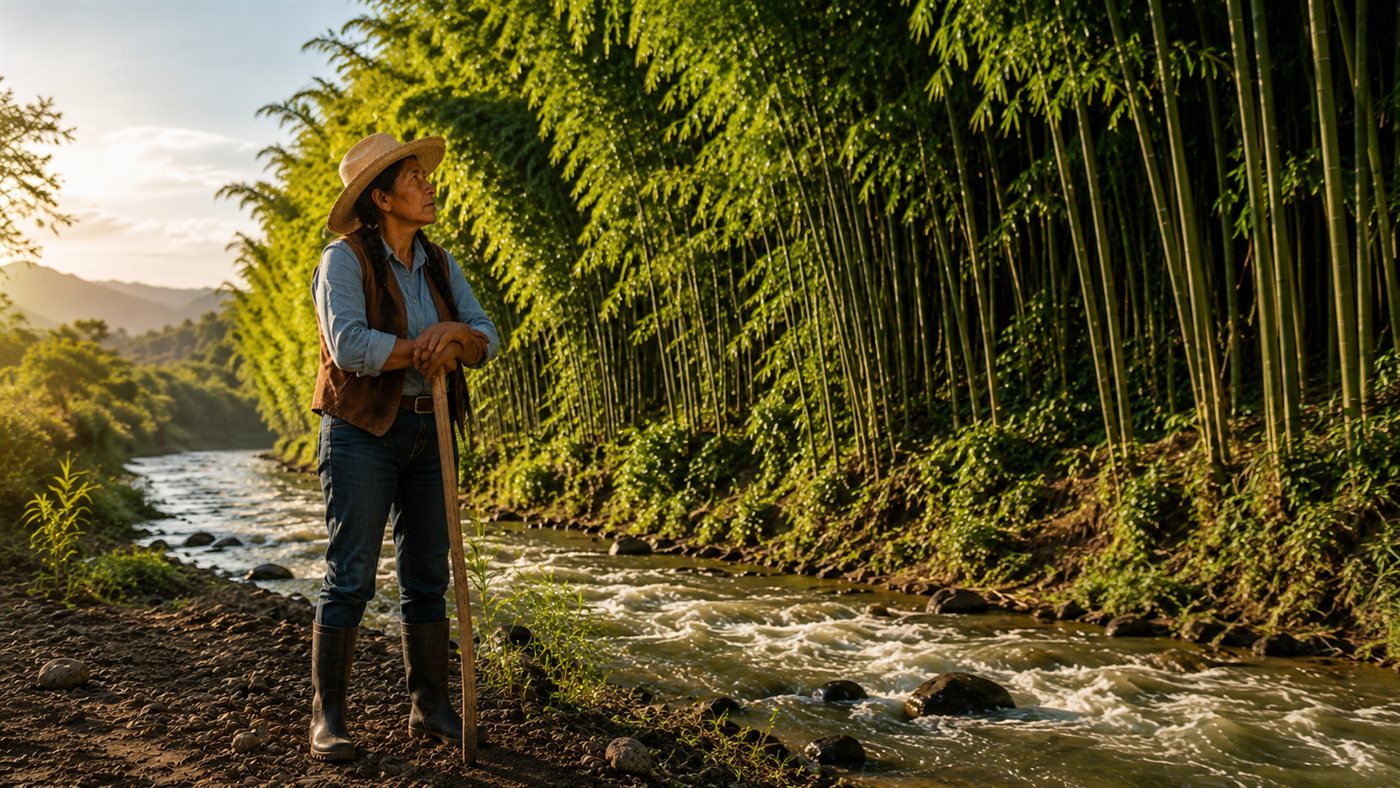

The story told by the La Ranchera channel shows the rural producer who lost land for 12 years, saw expensive techniques fail, and solved the problem with the native species Guadua aculeata and a notebook of notes
A line of bamboo planted on the edge of a stream did what stone, cane, and no technician had managed: it tamed the erosion and forced the watercourse to change its behavior. According to the channel La Ranchera, in a 35-minute video published on June 29, 2026, producer Esperanza Ríos Nolasco marked with stakes, in January 2006, a line of 180 meters on the bank of the El Guayabo stream, 4 km from Huautla de Jiménez, in Oaxaca, Mexico, to plant the barrier that would change the history of that riverside.
At the time, no one bet a peso on the idea. The neighbor responded with a “we’ll see,” the brother doubted, and the municipal technician explained why the bamboo would die in the first flood, as La Ranchera narrates. Five rainy seasons later, the numbers in her notebook silenced the entire region.
12 years watching the stream eat the land
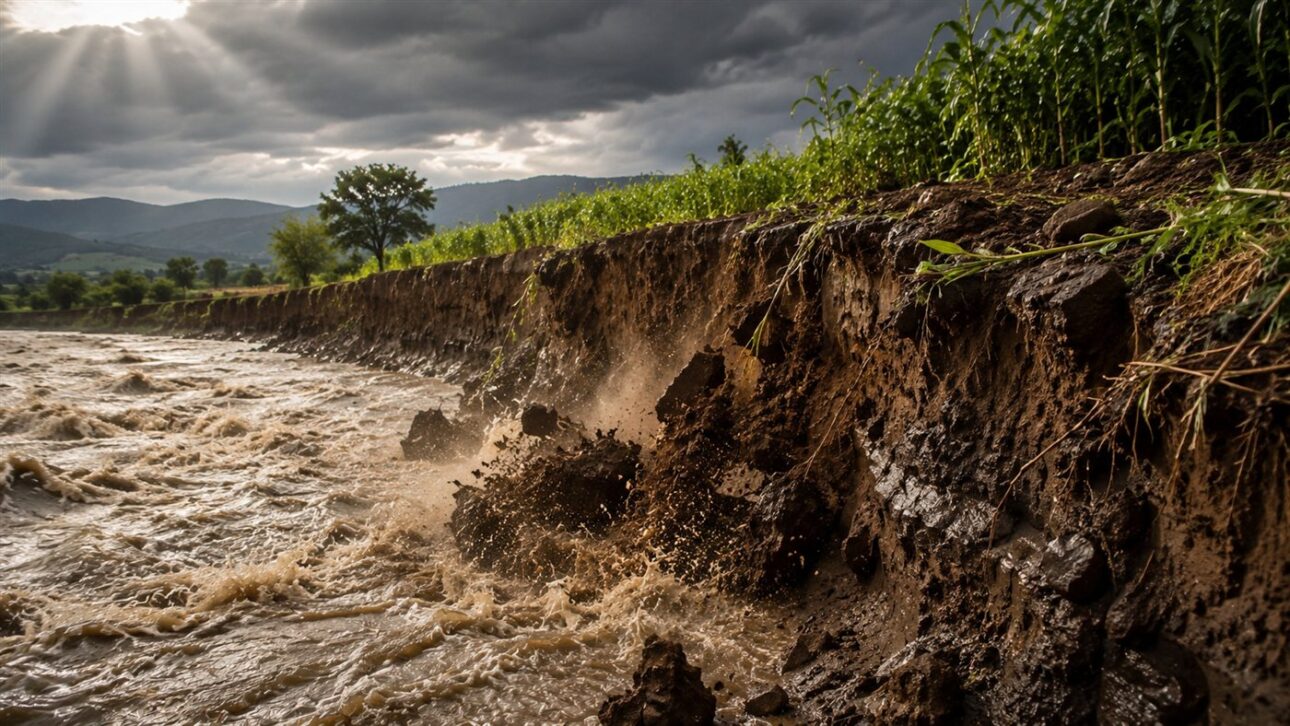
The problem had known size and speed. According to La Ranchera, the El Guayabo stream descended from the mountains with violence during the downpours from June to August and was shifting the bed to the north between 80 centimeters and 1.20 meters per season, eating the productive land of the ranches on the bank.
-
Family Builds Homemade Wind Turbine to Power Off-Grid Home, Video Reaches 555,000 Views on Ngô Thị Huyền’s Channel

-
Indian Brand Creates Sneakers from Recycled PET Bottles and Discarded Tires, Repurposing Over 1 Million Bottles and Raising $4 Million for Expansion

-
Brazilian Innovator Uses 3D-Printed Device to Cool Two Rooms with One Air Conditioner

-
Brazilian Designer Turns Broken Umbrella Nylon into Jackets, Employs 101 Seamstresses to Create 19,500 Pieces and Earn R$ 240,000


The producer’s calculation was concrete. In 12 years, about 380 square meters of her 4 hectares of corn and bean crops had disappeared into the stream, as the La Ranchera channel on YouTube documents, and the flood of 1994 alone took 92 square meters in a single night. It was that year she noted in her notebook the observation that would guide everything: water does not take the land where there are deep roots.
The attempts that failed before the bamboo
Bamboo was not the first idea, it was the last one left. According to La Ranchera, in 1997 she and the neighbors piled up 600 river stones on a 20-meter wall: the 1998 season took half, the 1999 season took the rest. In 2001, she planted 90 seedlings of castilla cane, and the 2002 flood uprooted everything except 16 plants because the roots were shallow.
Not even the official recommendation escaped. In 2003, the vetiver suggested by a technician as a cheap solution lost 70% of the plants in the first season, according to La Ranchera, because the water speed on the outer curve exceeded what the young seedlings could withstand. Each failure refined the diagnosis: it wasn’t enough to plant anything on the bank, it needed to be the right plant, with the right root, at the right density, and protected in the first years.
The 3-day trip that changed the project
The answer came from observation and the road. According to La Ranchera, Esperanza noticed for years that the stream never caused damage in sections where native bamboo was established, and she went after the explanation: she took a technical course in Tuxtepec and traveled 3 days by bus, alone, to Coapilla, in Chiapas, where a similar system had been holding the banks of the Magdalena River for 8 years.
There she was not a tourist, she was a flip-flop researcher. She measured the plants with her own tape measure, filled her notebook with data, and spent 5 hours discussing the system with the local technician, as reported by the La Ranchera channel on YouTube. The chosen species was Guadua aculeata, a native bamboo from the Oaxaca mountains, with a rhizome that spreads up to 4 meters horizontally and forms an underground network practically impossible to uproot.
142 rhizomes, 9 days of mud, and 4,360 pesos
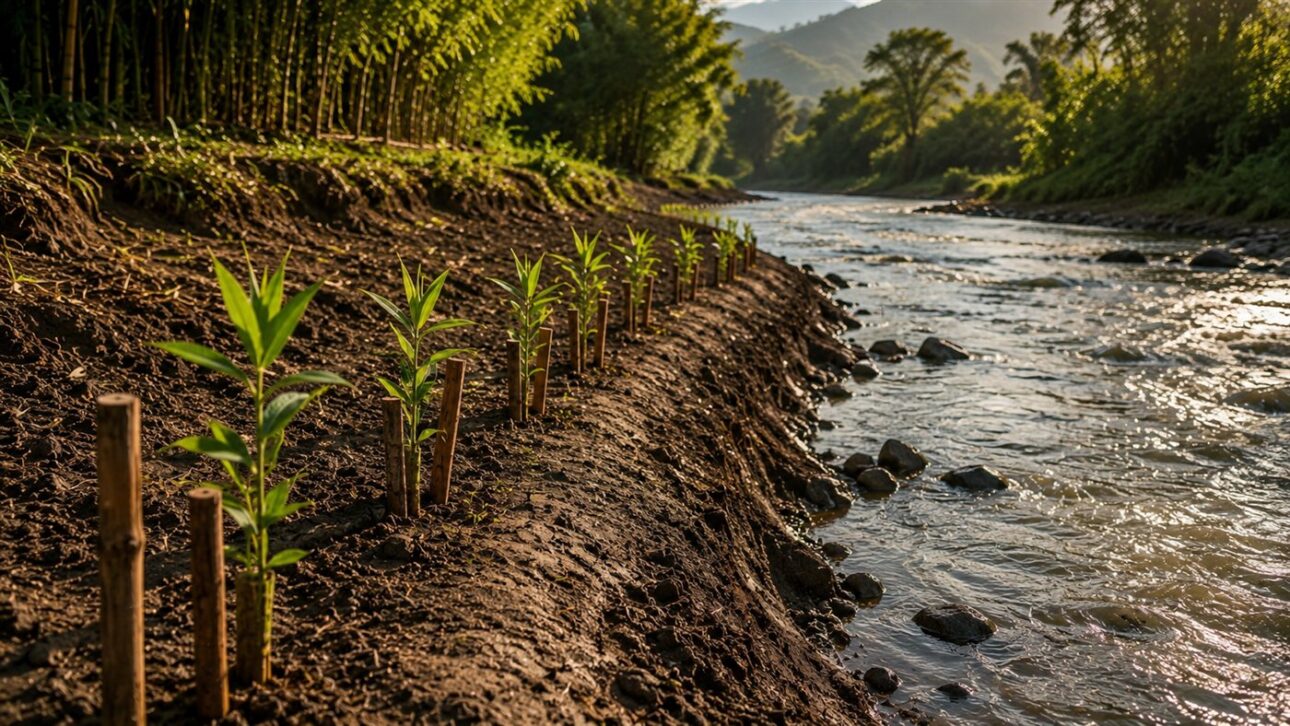
The planting began on February 14, 2006, and it was hard work. According to La Ranchera, Esperanza and her son Eliodoro, then 19 years old, took 9 days to bury 142 rhizomes weighing 4 to 7 kilos each, in holes at least 40 centimeters deep, along the 180 meters of the line.
The design had built-in engineering. The spacing was 1.20 meters on the curves, where the water hits harder, and 1.5 meters on the straight sections, with each seedling protected by two stakes of mature bamboo driven into the mud, as detailed by La Ranchera. The total cost was 4,360 pesos including daily wages, stakes, and transportation, less than the stone wall that the first season had destroyed, and a fraction of the more than 18,000 pesos the neighbor calculated he had spent on solutions that lasted at most three seasons.
The first flood: 4 plants lost and an adjustment
The real test came on June 23, 2006, with seedlings just 4 months old. According to La Ranchera, the 48-millimeter flood in 4 hours partially submerged the plants, and the producer went to the bank to observe their behavior during the current: the young culms bent with the flow instead of resisting rigidly, dissipating the energy of the water.
The outcome turned into a lesson the same day. Four plants were uprooted on the outer curve, and the note in the notebook already had the correction: reduce the curve spacing from 1.20 meters to 90 centimeters, as recorded by the La Ranchera channel on YouTube. In the second flood of the year, stronger than the first, the bamboo barrier did not lose a single seedling.
12 centimeters against 84: the number that silenced the skeptics


At the end of the first season, the notebook delivered the verdict. According to La Ranchera, the section with 6-month-old bamboo suffered lateral erosion of 12 centimeters, while the neighboring section without bamboo lost 84 centimeters: an 85% reduction in the erosion rate in the first year alone.
The following years increased the advantage. In the great flood of August 2007, with the stream at 92% of the maximum historical flow, the protected bank receded 6 centimeters against 104 centimeters of the bare section, according to La Ranchera, and in 2008 came the surprise: the soil behind the bamboo barrier had risen 11 centimeters, because the line of culms filtered the water and captured the sediment that used to wash away downstream. The bank not only stopped shrinking, it started growing, adding 22 centimeters in height and up to 60 in width in five years.
The river changed course and neighbors rushed to plant
The final effect no one had clearly predicted. According to La Ranchera, from 2010 the axis of the stream began to migrate south, at an average of 4 centimeters per month, seeking the path of least resistance, and erosion appeared for the first time on the neighbors’ bank on the other side.
That’s how the skeptics became students. Fortino Mendoza, the neighbor of “we’ll see,” had already planted his own line in 2009, and the owners of the southern bank planted in 2011, with the design, spacing, and protection stakes that Esperanza taught, according to the La Ranchera channel on YouTube. The technician who predicted failure returned with a form from the national water commission to register the case as a study of bank restoration with native vegetation, and the producer signed with one condition: that the document stated that the solution was found by seeing with their own eyes, not in a laboratory.
Watch the complete story of the bamboo barrier
The video reconstructs the five years of measurements, floods, and adjustments that transformed a line of stakes in the mud into a case study of bank bioengineering, with Esperanza’s notebook as the guiding thread.
The lesson from the El Guayabo stream applies to any watershed in the world, including Brazilian ones that lose soil every rainy season: deep roots hold the bank, sediment turns into new land, and the cheapest solution is sometimes the one that grows on its own in the nearby mountains. Tell us in the comments: do you know any river or stream that needed a bamboo barrier like this?


