Portuguese
  Spanish


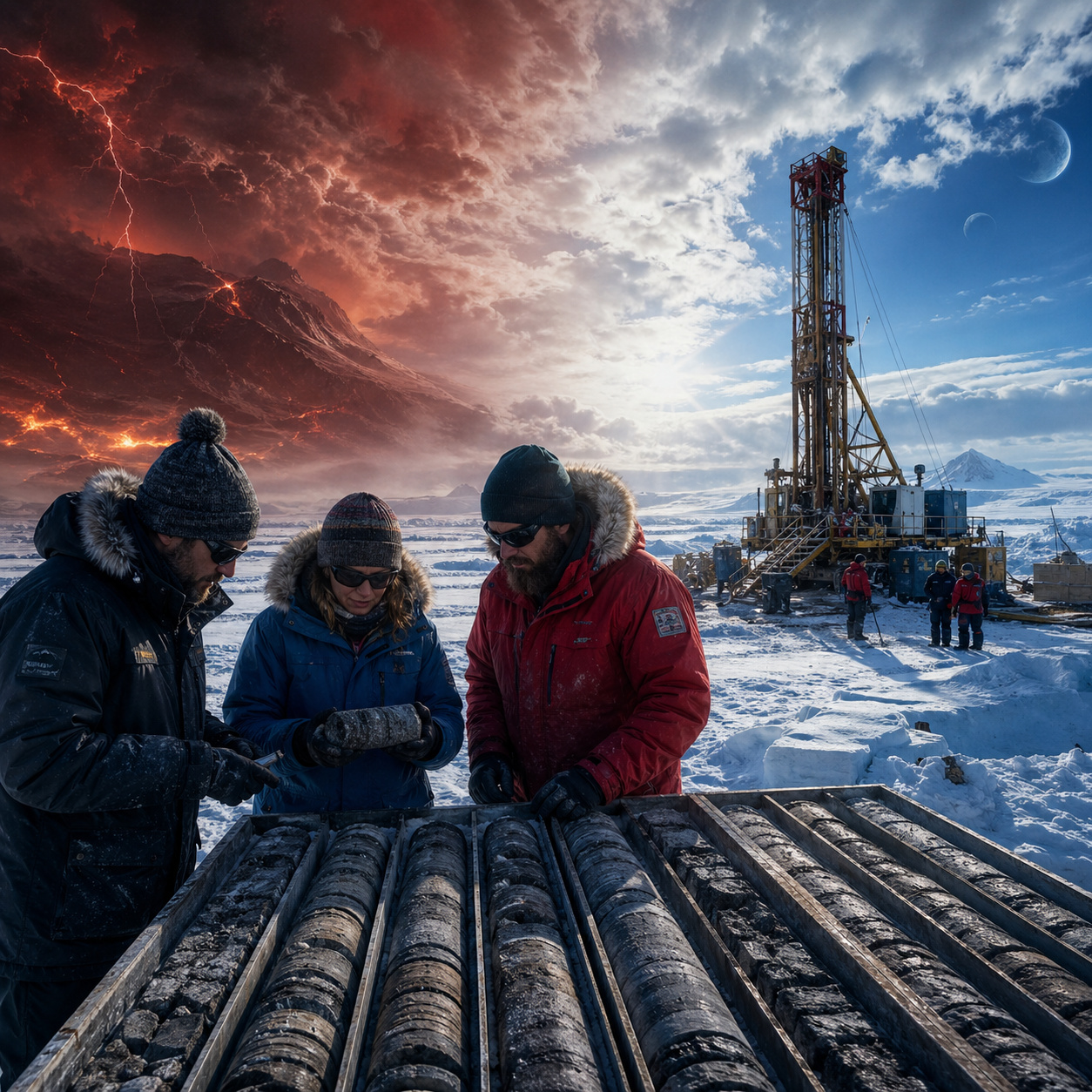

FAR-DEEP Project drills 3,650 meters of rocks in Arctic Russia to understand how oxygen transformed Earth billions of years ago.
In one of the most ambitious geological investigations ever carried out in Russian Fennoscandia, scientists from the Fennoscandia Arctic Russia Drilling Early Earth Project, FAR-DEEP, concluded in 2007 a campaign that drilled 15 wells and recovered approximately 3,650 meters of rock cores formed between 2.5 billion and 2 billion years ago, according to a report published in April 2010 in the scientific journal Scientific Drilling. The objective was to reconstruct one of the deepest turning points in Earth’s history: the transition that led to the increase of oxygen in the atmosphere and the emergence of a progressively more aerobic planet.
The FAR-DEEP project, linked to the International Continental Scientific Drilling Program, focused on Paleoproterozoic volcano-sedimentary successions preserved in the Fennoscandian Shield, a region chosen for preserving records of major global environmental changes associated with the so-called Great Oxidation Event. According to the official ICDP page, the scientific goal was to assemble a consistent model to explain the origin and timing of when the modern Earth system began to establish itself during the early Paleoproterozoic.
The mission sought to directly access ancient crustal layers to document changes in the biosphere, geosphere, and chemical cycles that accompanied the rise of atmospheric oxygen. According to the expedition report, the recovered cores record global environmental events that occurred between 2,500 Ma and 2,000 Ma, including changes related to carbon, sulfur, ancient glaciations, and the progression of oxidizing conditions that helped transform early Earth.
-
Scientists Confirm “Greening” of Antarctica: Ice on the World’s Coldest Continent Turns Green as Mosses Multiply Over Tenfold in Four Decades

-
2,000-Year-Old Gold Rings Found with Human Bones in Thailand Reveal Rare Burial and Feature Ancient Indian Inscription

-
Lenovo Unveils Legion Y700 Tablet with RGB Backlighting, 5G, and SIM Card Support

-
World’s First Nuclear Hydrogen Unit Begins Operation: Copper-Chlorine Technology with Initial Capacity of 150 Liters per Hour, Aiming for 3,000 Liters per Hour



Rocks up to 2.5 billion years old reveal a radically different planet
The samples recovered by the project belong to extremely ancient volcano-sedimentary formations, deposited during a period when Earth was a much more hostile environment.
At that time:
- The atmosphere contained very little oxygen
- Oceans were rich in dissolved iron
- Life existed only in simple microbial forms
These rocks serve as a direct record of these primitive conditions. Each drilled layer holds chemical and mineral information that allows us to reconstruct what Earth’s environment was like before the significant presence of oxygen.
Great Oxidation transformed the atmosphere and changed the course of life on the planet
The main focus of the project is the so-called Great Oxidation Event, which occurred between approximately 2.4 billion and 2 billion years ago.
This event marked the transition from an atmosphere practically devoid of oxygen to an environment where the gas began to accumulate significantly.


The origin of this change is linked to the activity of photosynthetic microorganisms, which began to release oxygen as a byproduct.
This transformation profoundly altered the chemistry of the atmosphere, oceans, and Earth’s surface, paving the way for more complex life forms.
Drilling allowed access to chemical transitions recorded in rocks
FAR-DEEP’s differential lies in its ability to access continuous rock layers that span different phases of this process.
The collected cores show:
- Changes in mineral composition
- Variations in the presence of oxidized iron
- Evidence of chemical alteration in the oceans
These data allow identifying when and how oxygen began to influence the Earth system. The drilling acts as a “vertical timeline,” where each meter represents thousands or millions of years of the planet’s history.
Banded iron formation reveals direct impact of oxygen on ancient oceans
One of the most important signs found in rocks is the presence of banded iron formations, structures typical of the Great Oxidation Event period.

These formations emerged when oxygen began to react with dissolved iron in the oceans, forming solid deposits that accumulated on the seabed. This process is direct evidence that oxygen began to alter the planet’s global chemistry.
Project connects geology, chemistry, and evolution of life in a single record
FAR-DEEP is not just a geology project. It connects different scientific areas:
- Deep geology
- Atmospheric chemistry
- Biological evolution
- History of the oceans
By analyzing these rocks, scientists can understand not only the physical environment but also the conditions that allowed for the emergence of more complex life. The drilling transforms ancient rocks into an integrated archive of Earth’s evolution.
Arctic regions preserve rare and little-altered geological records
The choice of the Russian Arctic region was not by chance. These areas preserve ancient geological formations that have undergone fewer alterations over time, retaining original characteristics.

This allows scientists to access more “pure” records of the past. Locations like this function as geological time capsules, where ancient processes remain preserved.
Data helps understand how Earth became habitable
The project’s importance goes beyond scientific curiosity. Understanding how oxygen emerged and accumulated in the atmosphere is fundamental to explaining why Earth became habitable.
This process influenced:
- Cellular respiration
- The formation of the ozone layer
- Protection against solar radiation
- The diversification of life
Without the increase in oxygen, complex life as we know it today probably would not exist.
Results also aid in the search for life on other planets
The data obtained by FAR-DEEP has implications for astrobiology. By understanding how Earth evolved from a hostile planet to a habitable environment, scientists can apply this knowledge in the search for life on other worlds.
This includes identifying oxygen-rich atmospheres, analyzing chemical signals on exoplanets, and studying extreme environments. Earth’s past becomes a reference for interpreting other planets.
Deep drilling reveals the limits of science in exploring Earth’s past
Despite the advances, the project also highlights challenges. Deep drilling in remote environments requires:
- Advanced technology
- Complex logistics
- High operational cost
Furthermore, interpreting such ancient geological records involves uncertainties and multiple hypotheses. Even with direct data, reconstructing billions of years of history is still a complex scientific challenge.
Given these discoveries, what else does the Earth’s crust still hide about the origin of life?
The FAR-DEEP project shows that the planet’s subsurface still holds fundamental answers about Earth’s history.
With thousands of meters of rock revealing processes that shaped the atmosphere and life, scientific drilling continues to be one of the most powerful tools for investigating the past.
The question that remains is direct: how many other decisive events in the planet’s history are still recorded in the depths of the crust, waiting to be discovered?