






 Portuguese
  Spanish


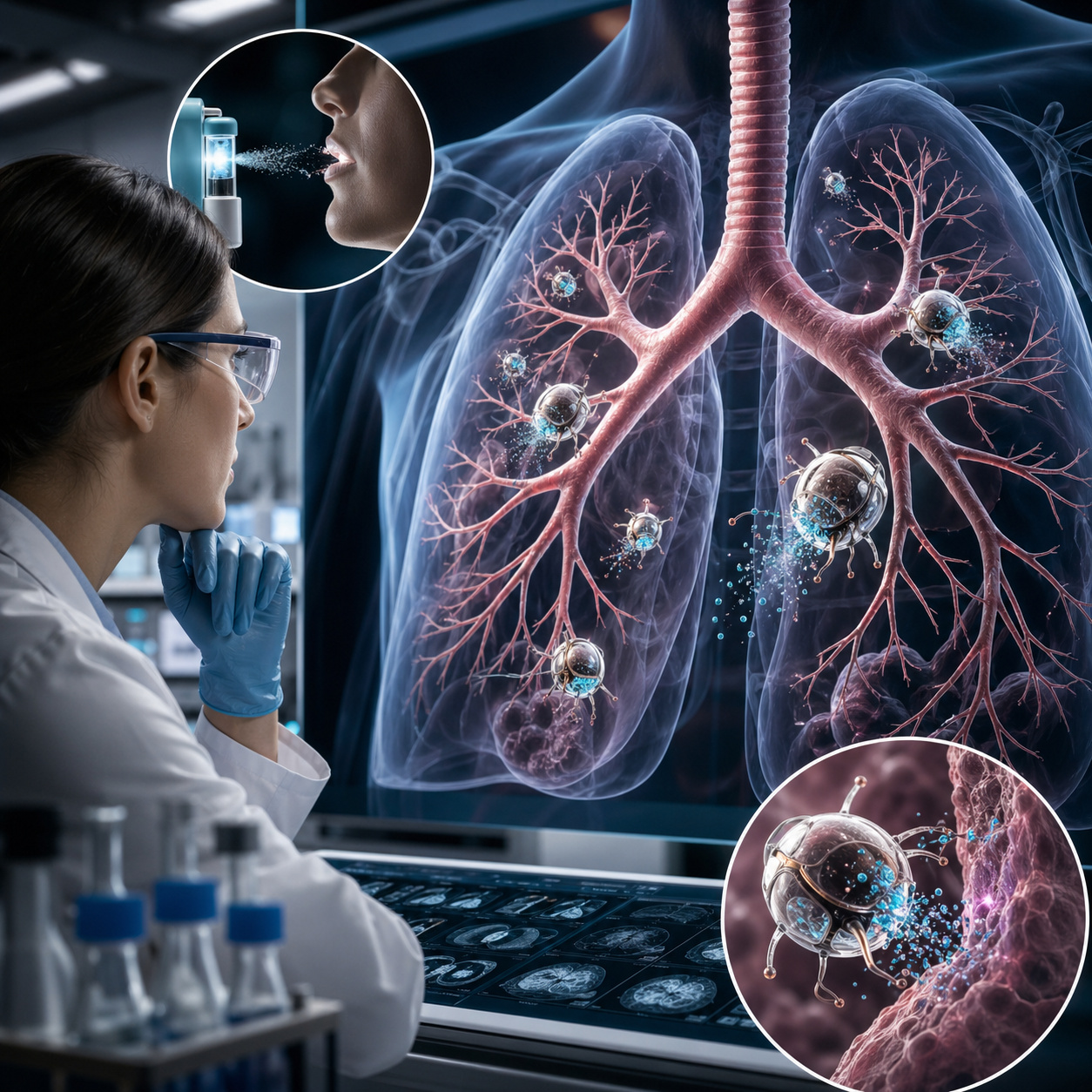


Inhalable microrobots with living cells can deliver drugs directly to the lungs, paving the way for more precise treatments for respiratory diseases.
On January 14, 2025, a study published in Nature Communications presented a new approach to lung treatment: inhalable bio-hybrid microrobots capable of delivering drugs directly to the respiratory system via nebulization. The work did not generically address “respiratory diseases” in humans, but demonstrated the technology in mice with acute MRSA bacterial pneumonia, an important adjustment for factual accuracy.
The research was conducted by a team from the University of California San Diego, with participation from areas such as chemical and nanoengineering, materials science, oceanography, and pediatrics, who developed microscopic microrobots based on the microalga Micromonas pusilla. The platform’s distinguishing feature is precisely its bio-hybrid nature: it combines synthetic components with living biological elements, allowing these structures to maintain mobility after inhalation and distribute more homogeneously in the lungs.
The central objective of the technology is to create a drug delivery system that not only transports the medication to the lung, but also interacts more efficiently with the pulmonary environment. According to the study, these microrobots maintained motility of about 55 micrometers per second after nebulization and remained in the lungs for more than five days, which helped to increase treatment retention and improve therapeutic efficacy in the analyzed animal model.
-
AI Data Centers Now Feature Built-In Nuclear Power Plants and Have Ordered Non-Existent Reactors

-
In India, thousands earn about $2.50 an hour cooking and cleaning with a phone strapped to their heads, as every move is recorded to train humanoid robots for jobs they might one day replace.

-
Nuclear Fusion Study Proposes Transforming Mercury into Gold Using Tokamak Neutrons, but Real-World Application Remains Uncertain
-
Brazilian Researchers Develop Floor Tiles That Convert Student Footsteps into Electricity to Reduce University Energy Costs





Technology uses microscopic particles capable of being inhaled as an aerosol
The microrobots were designed to be administered via inhalation, similar to aerosols used in conventional treatments, such as asthma inhalers.
This means that the patient could receive treatment by breathing in particles carrying the microrobots, which would then deposit in the lungs.
Once inside the respiratory system, these structures can move, interact with tissues, and release drugs in a controlled manner.
The main advantage of this method is the ability to directly target the disease site, reducing the need for high systemic doses.
Living cells enable movement and interaction with the pulmonary environment
The use of living cells is one of the most innovative elements of the technology. These cells function as active components of the microrobots, allowing them to respond to the surrounding environment and, in some cases, aid in movement within pulmonary fluids.

This bio-hybrid approach seeks to leverage natural cell characteristics, such as mobility and tissue interaction capability, to improve device performance.
The integration of biology and engineering creates systems that can better adapt to the body’s internal environment.
Respiratory system presents unique challenges for microscopic navigation, and the arrival of inhalable microrobots could change everything
Despite the potential, operating within the lungs involves significant challenges. The respiratory system has a complex structure, with progressively smaller branches, as well as natural defense mechanisms such as mucus and cells that remove foreign particles.
Microrobots need to be able to:
- Penetrate deep into the airways
- Resist elimination by the immune system
- Maintain stability in humid environments
- Release drugs at the correct point
These challenges make the development of this technology particularly complex.
Applications include treating lung diseases with greater precision
Researchers highlight several potential applications for inhalable microrobots. These include the treatment of diseases such as:
- Asthma
- Chronic obstructive pulmonary disease (COPD)
- Respiratory infections
- Pulmonary fibrosis
In all these cases, localized drug delivery can increase treatment effectiveness and reduce side effects. The ability to act directly in the lungs can represent a significant advance over current therapies.
Localized delivery of inhalable microrobots reduces the need for high doses and minimizes adverse effects
One of the main problems with conventional treatments is the need for high doses to ensure the drug reaches the desired location.


This increases the risk of side effects, as the drug circulates throughout the body. With inhalable microrobots, the idea is that the drug is released only where necessary.
This model can reduce the total amount of medication used and minimize impacts on other organs.
Studies indicate the possibility of controlled response and gradual drug release
Another relevant aspect is the control of drug release. Microrobots can be designed to release the drug gradually or in response to specific environmental stimuli, such as changes in pH or temperature.
This allows for more precise administration tailored to treatment needs. Controlled release can increase therapeutic efficiency and improve clinical outcomes.
Despite advances, inhalable microrobots are still in the research stage. Studies conducted so far involve laboratory tests and, in some cases, animal models. Application in humans requires additional validation, including safety, efficacy tests, and regulatory approval.
Furthermore, issues such as biocompatibility, elimination of microrobots, and possible immunological reactions still need to be fully understood.
This indicates that the technology is not yet ready for widespread clinical use but represents a promising direction for the future of medicine.
Integration between engineering, biology, and medicine drives innovation in the field
The development of inhalable microrobots depends on collaboration between different areas of knowledge.
- Materials engineering is responsible for the structure of the devices
- Biology contributes with the use of living cells
- Medicine guides clinical applications
This integration allows for the creation of solutions that combine technical precision with biological compatibility. The convergence of these areas is one of the factors driving the advancement of technology.
Advance points to a new generation of less invasive therapies
The possibility of treating diseases through inhalable particles represents a less invasive alternative compared to traditional methods.
Instead of surgeries or intravenous administration, treatment could be performed simply, by inhalation.
This can reduce risks, facilitate access, and improve patient adherence to treatment. The less invasive approach is one of the main attractions of this technology.
Given this advance, to what extent can microscopic robots transform the treatment of respiratory diseases?
Inhalable microrobots represent a new frontier in medicine, combining advanced engineering with biology to create systems capable of operating within the human body.
With the potential to increase the precision of treatments and reduce side effects, this technology points to a future where therapies will be increasingly targeted. The question that arises is direct: if it is already possible to take microscopic machines to


