Portuguese
  Spanish


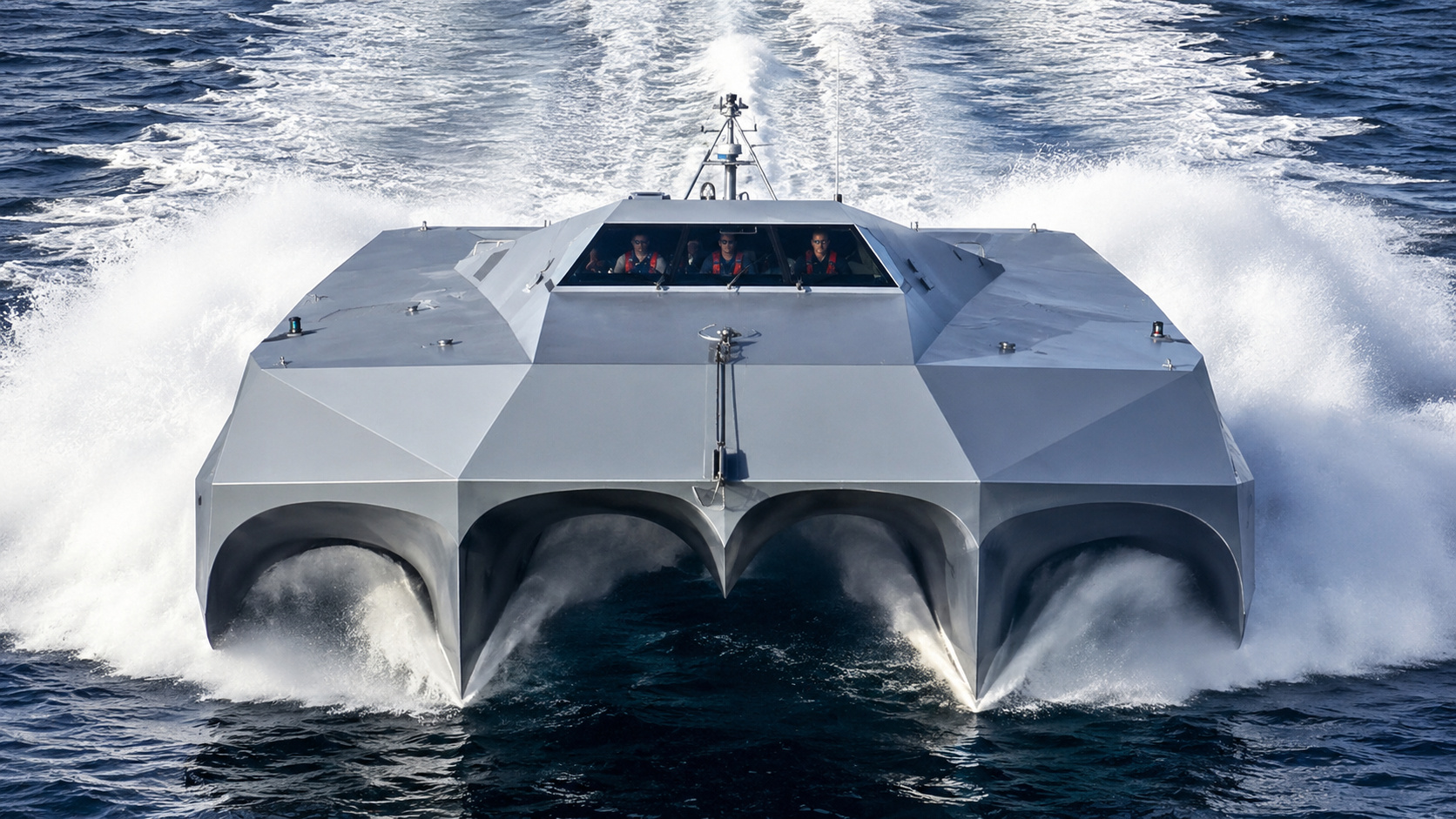

M80 Stiletto was a carbon fiber naval prototype with five hulls, speed over 50 knots, and stealth design developed in the USA.
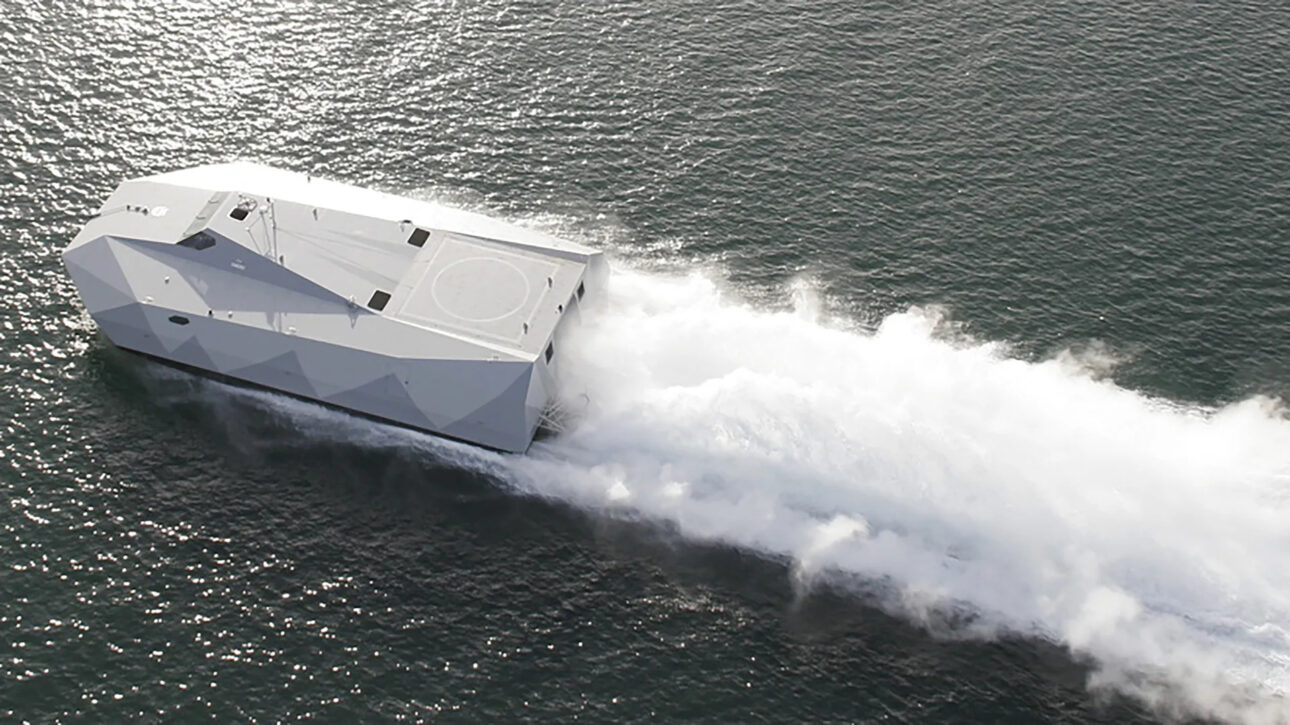
Few experimental military vessels ever built look as strange as the M80 Stiletto. With a shape that resembles a mix of futuristic ship, catamaran, and stealth aircraft, the project drew attention for trying to solve a problem that has challenged naval engineers for decades: how to create an extremely fast vessel, stable in rough seas, difficult to detect, and capable of operating in shallow waters. The result was one of the most unusual prototypes in modern naval history. Built for the former Office of Force Transformation of the Pentagon, the M80 Stiletto used a configuration of five hulls, known as pentamaran, along with a structure made almost entirely of carbon fiber.
With only 2.5 feet of draft, speed over 50 knots, and a design that looked like it came out of a science fiction movie, the vessel became one of the boldest maritime experiments ever put in the water.
The secret of the M80 Stiletto was in a hull with five floating structures working together
The most striking feature of the vessel was its hull. While most ships use a single hull and some catamarans use two, the M80 Stiletto was developed with a concept called pentamaran, composed of five narrow structures distributed under the main platform. This arrangement was part of the so-called M-Hull technology, patented by the M Ship Company.
-
China Unveils Laser Weapon Capable of Instantly Neutralizing Military Drones, Marking a Significant Advancement in Air Defense Technology

-
U.S. Navy’s Ticonderoga-class Cruiser Becomes a 9,800-Ton Missile Fortress with Advanced Aegis System Capable of Tracking Hundreds of Targets

-
France’s Charles de Gaulle: The Sole Nuclear-Powered Aircraft Carrier Outside the US, Weighing 42,500 Tons and Equipped with Two Atomic Reactors

-
The military spaceplane that almost took the Cold War into orbit: Boeing X-20 Dyna-Soar was designed to re-enter above Mach 20, fly for up to 40 hours, land like a plane, and transform Titan rockets into a gateway to a new era of orbital warfare.




According to the project documentation, the five hulls allowed the vessel to use its large width to increase stability without sacrificing speed.
The shape also helped reduce wave formation at the bow and diminished some of the effects normally associated with fast vessels in rough seas.
The visual result was so unusual that many observers compared the Stiletto to a spaceship landed on the water.
Carbon fiber transformed the prototype into one of the largest vessels made of this material ever built in the United States
Another revolutionary aspect of the project was the choice of materials. The M80 Stiletto was constructed using extensive carbon fiber and epoxy resin, becoming one of the largest American military vessels produced with this type of structure.
The use of the material allowed for a drastic reduction in weight without compromising structural strength.
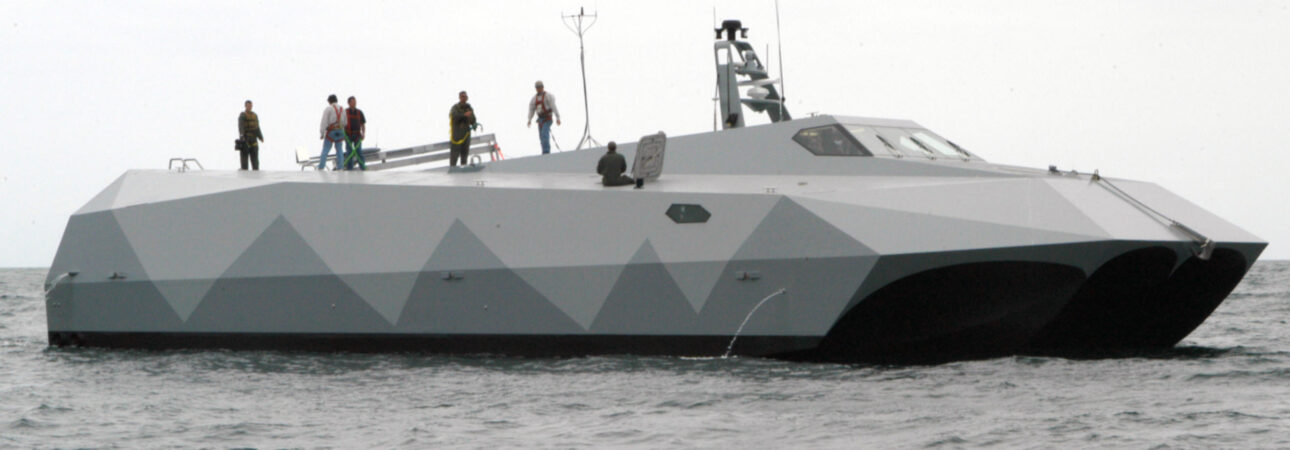
The ship was approximately 88.6 feet long (27 meters), 40 feet wide (12 meters), and displaced about 60 tons when fully loaded. Despite these dimensions, the relatively low weight contributed to its high speed and ability to operate in areas where conventional vessels would struggle.
The composite construction also helped reduce detectable signatures, something important for a project that aimed to explore naval stealth concepts.
Speed above 50 knots placed the prototype among the fastest vessels in its category
If the appearance caught attention, the performance was equally impressive. The M80 Stiletto used four Caterpillar engines of approximately 1,650 horsepower each, producing more than 6,600 hp combined.
This configuration allowed it to reach speeds over 50 knots, with some sources indicating peaks close to 60 knots, equivalent to more than 110 km/h on the water. For a vessel nearly 27 meters long, these numbers were impressive.
Besides the maximum speed, the project also aimed to improve crew comfort during fast movements in rough seas. One of the developers’ arguments was that the M-shaped hull helped to soften impacts caused by waves, reducing physical strain on the occupants.
Draft of only 2.5 feet allowed navigation where many ships cannot reach
Perhaps the most surprising feature of the Stiletto was its ability to operate in extremely shallow waters.
The prototype had a draft of only 2.5 feet, approximately 76 centimeters. This allowed it to navigate in coastal areas, estuaries, river regions, and zones close to the beach where larger vessels would face limitations.
This concept was part of the vision to create a highly flexible platform for coastal environments, a region considered one of the most complex for naval operations due to the combination of shallow waters, heavy traffic, and natural obstacles.

The shallow depth required to operate was one of the main differentiators compared to conventional ships of similar size.
The stealth design made the vessel look like a maritime version of the F-117
The angular design of the Stiletto was not just an aesthetic choice. The bow and external surfaces featured faceted shapes similar to those used in low-observability aircraft. The goal was to reduce radar reflections and test stealth concepts applied to the maritime environment.
This appearance eventually led to the informal nickname “Naval Batmobile”, as the vessel looked more like a futuristic vehicle than a traditional ship.
The combination of aggressive lines, low profile, wide beam, and pentamaran hull made the Stiletto one of the most visually striking experimental vessels ever built.
The project was used as a laboratory for advanced technologies
The M80 Stiletto was never intended to become a large class of mass-produced ships. Its main function was to serve as an experimental platform to test new ideas related to naval architecture, onboard systems, and technological integration.
The vessel participated in the Trident Warrior exercises and other evaluations conducted by the United States Navy. It was also used in tests involving sensors, surveillance systems, auxiliary vessels, and unmanned vehicles.
According to operational records, the Stiletto also participated in maritime monitoring missions and operations linked to American government agencies during the 2000s.
The Time magazine placed the project among the best inventions of the year
The technological impact of the Stiletto caught attention beyond the naval sector. The magazine Time included the vessel among the best inventions of 2006 in the category related to the armed forces. The recognition occurred precisely because the project presented unconventional solutions to old problems in naval engineering.
Although it never evolved into an operational fleet, several ideas tested during the program helped broaden the debate on speed, stability, composite materials, and operations in shallow waters.
In many aspects, the M80 functioned as a floating laboratory for concepts that would continue to be studied in the following years.
The prototype remains one of the strangest vessels ever placed at sea
Naval history is full of bold projects, but few managed to gather so many unusual characteristics in a single platform.
Five hulls working together, carbon fiber structure, speed over 50 knots, draft of only 2.5 feet, and a design reminiscent of a stealth aircraft transformed the M80 Stiletto into something very different from traditional ships.
Even without becoming an operational class, the project continues to be remembered as one of the most radical experiences in modern naval engineering.
And decades after its launch, it is still difficult to look at the Stiletto without thinking that it looks less like a ship and more like a futuristic craft that decided to sail over the ocean.