





 Portuguese
  English
  Spanish
  4 min of reading
  0 comments


Experiments conducted in Spain and Japan indicated that human walking may carry a subtle, yet measurable, tendency to turn counterclockwise, observed in groups, teenagers, small children, and also in people walking alone, with no definitive explanation so far.
Human walking may have a hidden bias: in experiments in Spain and Japan, groups and individuals tended to turn counterclockwise, even when factors such as culture, laterality, gender, and vision were tested.
Experiments revealed an unexpected pattern in walking
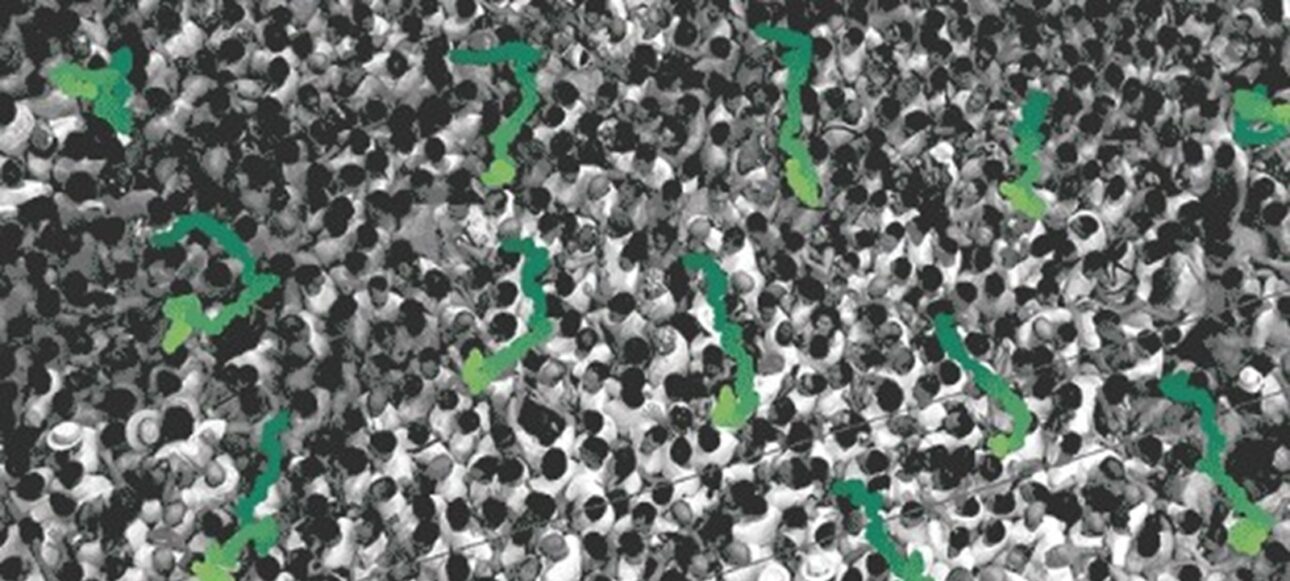
The behavior appeared consistently in controlled environments. In one of the first sets of tests, 32 of the 33 groups observed showed a counterclockwise shift while walking and turning through space.
The finding surprised researchers because, in seemingly free walking, the expectation was that people would change direction as needed. Still, the pattern appeared as a defined and measurable tendency.
-
Samsung inaugurates a new era of refrigerators with a 664-liter model, just 0.4 cm spacing, and AI that promises to reduce energy consumption while automatically producing two types of ice.

-
China has an ambitious plan to invest $295 billion in artificial intelligence, but one detail of the strategy to dominate the sector could change the balance of the global technological race.
-
End of truck drivers: self-driving truck transports 700,000 tons, completes over 11,000 trips, and covers 56,000 km to build a dam in Sweden without human intervention
-
Not even Generation Z is putting up with itself: a 23-year-old recruiter exposes a job interview that went viral with over 300,000 likes after a candidate joined via cell phone, treated the conversation as “not so serious,” and assumed immediate hiring.




Claudio Feliciani, associate professor of the project at the University of Tokyo, reported that the preference was noticed during the analysis of the experiments. The team then began to investigate whether any known variable explained the phenomenon.
Culture, laterality, and walls did not explain the effect
The tests began in a circular arena in Spain, with groups formed by people with different characteristics. Some participants had shown a preference for turning right when encountering a wall, while others were left-handed.
If laterality or individual turning preference determined the collective outcome, the expected direction should change. This did not happen. The counterclockwise tendency remained in the groups evaluated.
The team also removed walls from the equation. In a schoolyard measuring 50 by 60 meters in Spain, more than 100 teenagers walked in an almost unrestricted space, and the bias continued to appear.
In Japan, the result was also repeated. The comparison was important because circulation habits can vary between countries, including how pedestrians cross or organize walking lanes.
Children showed an even stronger tendency
Researchers observed children in a Japanese daycare during a free running activity. The counterclockwise movement appeared even more pronounced, with groups forming a stable pattern similar to a vortex.
This data weakened the hypothesis that the behavior was merely a result of adult social conventions. Children around 5 years old had less time to absorb rules of circulation, sports, or etiquette in public spaces.
Feliciani stated that, among the factors evaluated, age stood out as a possible element related to the intensity of the effect. The children’s preference seemed stronger than that observed in adults.
The team also interviewed 168 people in Spain in search of an unwritten social rule. The responses did not indicate a clear pro-counterclockwise norm; many people, in fact, expected clockwise movement.
Tendency also appeared in individuals alone
A subsequent test evaluated over 200 people walking alone, one at a time, inside an enclosed space. Even without a crowd, the paths still showed a tendency towards the counterclockwise direction.
This result suggested that the origin of the phenomenon might lie in individual movement. The crowd makes the pattern more visible, but does not seem necessary for the preferential direction to appear.
The researchers also evaluated common bodily asymmetries. No significant differences were observed between right-handed and left-handed individuals, different ocular dominance, men and women, or participants walking with one eye covered.
The cause remains unknown. Feliciani stated that vision likely does not explain the deviation, as the effect persisted when participants’ left or right eye was covered.
Discovery may help in the design of public spaces
The authors consider it unlikely that large-scale phenomena, such as the Coriolis force or Earth’s magnetic field, explain the pattern. The open hypothesis involves subtle biomechanical or neurological asymmetries.
The discovery may have future applications in the planning of museums, airports, stations, shopping centers, outdoor stadium areas, and other spaces with high pedestrian traffic.
If human walking favors certain circulation patterns, designers can use this knowledge to reduce friction and improve comfort. For now, the team plans new experiments with individuals.
The results were published in the journal Nature Communications. The next step will be to seek the origin of the asymmetry in balance, gait, attention, and body mechanisms related to movement.
Does the discovery change the way you view walking in crowds, corridors, and public spaces? Share your opinion, tell us if you have noticed this type of movement in crowded places, and say if you believe this pattern should influence urban projects.
Study published by the journal nature


Be the first to react!