Portuguese
  Spanish


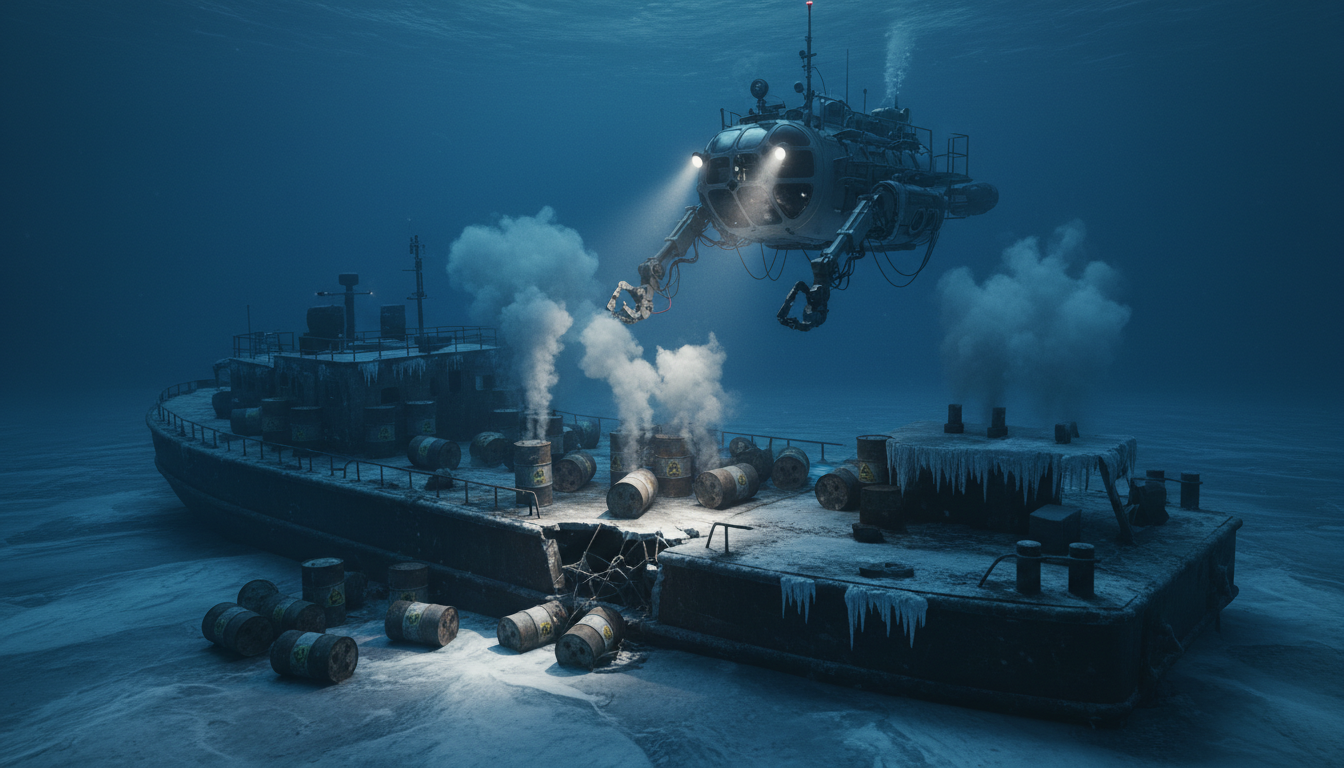

While the West debates how to track radioactive reserves, a Russian expedition has identified a Soviet nuclear barge hidden for 38 years at the bottom of the Kara Sea.
The discovery of Likhter-4 was not in any public record of either Rosatom or the modern Russian Navy.
As reported by Indian Defence Review, the feat was achieved during the 70th voyage of the research vessel Akademik Ioffe.
-
The Arctic is no longer just a frozen region and is becoming a new military board with the opening of maritime routes, expansion of bases, nuclear icebreakers, and competition among Russia, NATO, the United States, and China.

-
U.S. Dismisses Brazilian Foreign Ministry’s Military Risk Warning as “Absurd,” Cites Brazilian Criminal Gangs Operating in the U.S. Since May 2026
-
Ukraine War Impacts Brazilian Fuel Supply: Russian Diesel Imports Drop 65% in June, Brazil Turns to US and India Amid Market Concerns

-
Chinese Nuclear Submarine Launches Simulated Warhead Missile in Pacific, Heightening Regional Tensions Amid Naval Drills with Russia Near Qingdao; New Zealand and Papua New Guinea Warn of Persistent Chinese Military Presence



In fact, the mission was a joint operation between the Kurchatov Institute and the Shirshov Institute of Oceanography. The Russians sought to confirm the declared disposal coordinates in Soviet-era archives.

The site is located in the so-called Bay of Currents, on the east coast of Novaya Zemlya. The Russians did not find the object where the archives indicated — bathymetry showed a local depression more than 100 meters deep.
Likewise, the Daily Galaxy reported that the barge carries 146 containers of Soviet-era solid radioactive waste.
According to expedition data, it also carries two reactor vessels from the K-22 nuclear submarine. The fuel had been removed before disposal, which reduces the immediate risk.
What makes the Likhter-4 in the Kara Sea an unprecedented graveyard
The site is unique because it combines three factors: it was hidden for decades, carries a significant volume of radioactive material, and is located in deep Arctic waters where recovery is technically complex.
According to the Polar Journal, measurements with an REM-4-50 spectrometer confirmed that the lead shielding of the reactor vessels remains intact.
Therefore, there are no signs of active leakage from the barge. Radiation readings on the hull are within background levels comparable to the open Arctic.
- 146 containers of radioactive waste — solids disposed of in 1988
- 2 reactor vessels from the K-22 submarine — fuel previously removed
- Depth of more than 100 meters — local depression in the Bay of Currents
- Site hidden for 38 years — never appeared in public record
- Shielding intact according to REM-4-50 — no sign of active leakage
According to the Indian Defence Review, this was the first time the exact location of the Likhter was confirmed by modern instrumentation.
The K-27 submarine: Likhter’s most dangerous neighbor
The same expedition also examined the Soviet K-27 submarine, sunk in 1981 in Stepovoy Bay. Unlike the Likhter, it still contains nuclear fuel.

In fact, the K-27 was towed to be scuttled after 13 years in reserve. The Soviet fleet lacked the technical capacity to decommission nuclear reactors at the time.
As a result, it remains there with intact fuel. For the international nuclear safety community, this is the item of greatest concern in the Russian Arctic.
According to the CPG’s archive of Soviet submarines, the removal of the K-27 remains stalled due to budgetary and technical issues.
Likewise, the coverage on the Komsomolets shows that this pattern is not isolated.
The Nikel barge and other sites of the Russian expedition
In addition to the Likhter and K-27, the expedition located the Nikel barge with about 580 tons of radioactive waste. The case adds to the list of poorly documented disposals.
According to Pravda, the Nikel was sunk in another region of the Bay of Currents. Researchers are now compiling an updated map of Soviet nuclear disposals.
On the other hand, the work of the Akademik Ioffe is considered pioneering because it combines archival data with field surveying. Most previous missions relied only on declared coordinates.
As a result, the international community gains for the first time a verifiable inventory of Russian nuclear sites in the Arctic.
The Soviet context of nuclear disposal in the Russian Kara Sea
During the Cold War, the Soviet Union disposed of hundreds of radioactive objects in Arctic waters and Novaya Zemlya. The Soviet nuclear fleet grew faster than the decommissioning infrastructure.

According to an analysis by Bellona, today there are more than 17,000 radioactive objects in the Arctic.
On the other hand, new studies by Bellona suggest slow flows of radionuclides coming from sealed fissures. Continuous monitoring is still the only tool available.
In fact, Bellona — a Norwegian nuclear environmental foundation — maintains the most complete record on the subject. Its estimates serve as a reference for European authorities.
Likewise, the problem directly affects Norway, Finland, and Sweden. Each of these countries operates fishing fleets in waters near the zone.
Geopolitical and environmental implications for the Arctic
The discovery of the Likhter barge reopens the debate about who pays for the cleanup of the Soviet nuclear legacy. Russia traditionally has been reluctant to collaborate with international inspection.
On the other hand, the International Atomic Energy Agency (IAEA) has had joint programs with Moscow since the 1990s. The scope is limited to some more critical sites.
As a result, the Likhter becomes a test for a possible deepening of this cooperation. Without international funds, the removal of any item would remain unfeasible.
Despite this, the melting of the Russian Arctic facilitates future logistics. The safe operational window in the region has already extended from 3 to 5 months per year.
Caveats and what has not yet been disclosed
However, Rosatom has not yet released complete data on the contents of the Likhter containers. REM-4-50 measurements indicate intact shielding, but do not quantify total activity.
Despite this, independent experts warn that external measurements do not replace internal inspection. The cost of removal would be prohibitive without international cooperation.
According to Bellona data, more than 17,000 radioactive objects remain in Russian Arctic waters. Without a public inventory, the issue remains opaque to foreign partners.
On the other hand, the 2024 expedition marked a new model. Other Russian agencies may use the bathymetric mapping method to revisit old disposals.
In fact, several Norwegian scientific bases offer cooperation in the region. The initiative only encounters diplomatic access issues.
However, Rosatom announced that it will include the 146 containers in the official list for continuous monitoring. It is the first time this site has moved from archival limbo to public record.