






 Portuguese
  Spanish


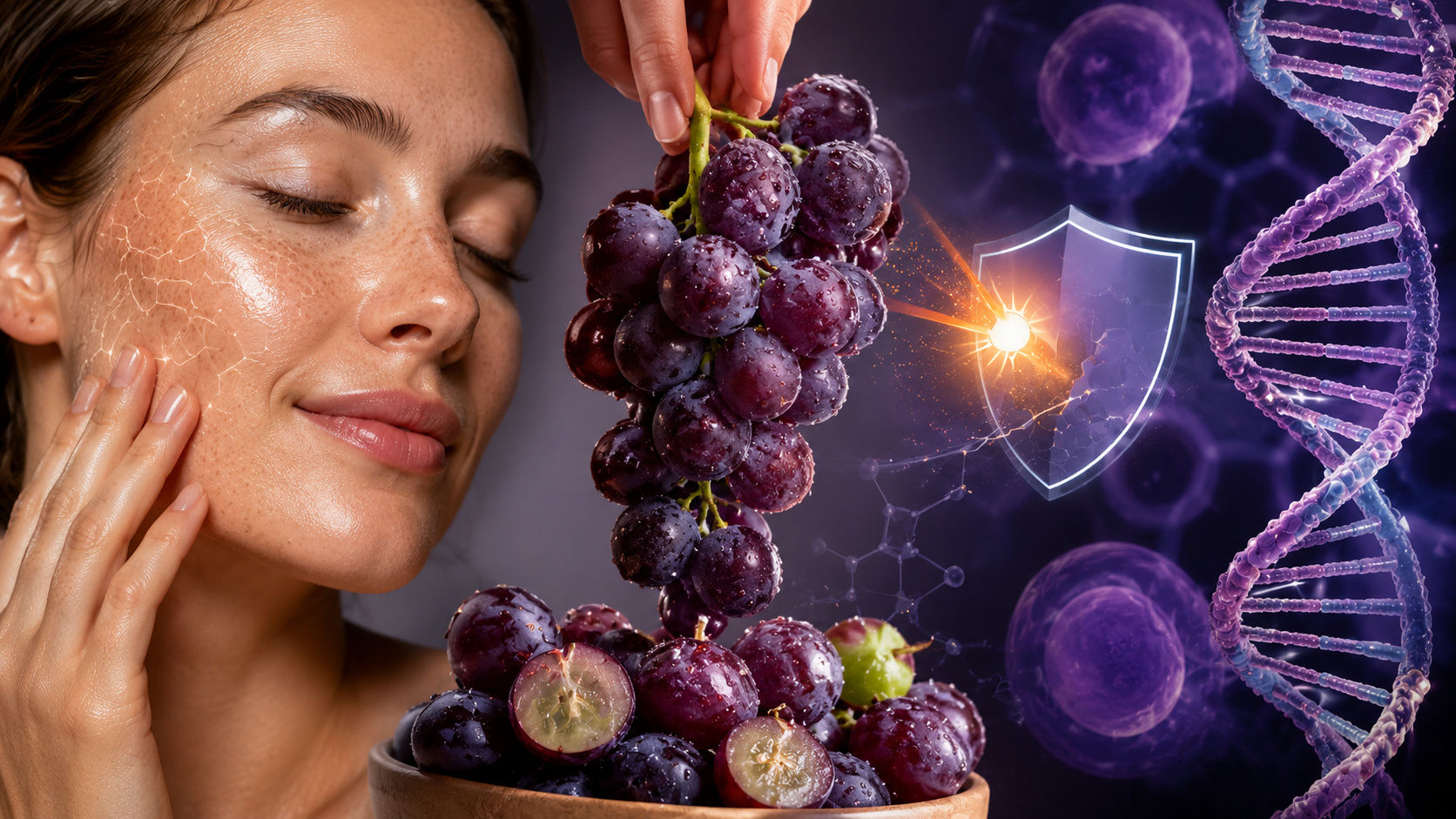

Study shows that consuming grapes for two weeks alters skin genes, strengthens the protective barrier, and reduces oxidative stress marker caused by UV radiation.
According to ScienceDaily, researchers from Western New England University in Springfield, Massachusetts, in collaboration with Oregon State University, published on May 13, 2026, in the journal ACS Nutrition Science, a study showing that grape consumption measurably alters gene expression in human skin. The research was conducted with volunteers who consumed the equivalent of three servings of whole grapes per day for two weeks.
Before and after the consumption period, scientists collected skin samples and analyzed which genes were active or inactive. They also exposed the participants’ skin to low doses of ultraviolet radiation to assess whether grapes changed the skin’s response to sunlight.
The results indicated changes in processes related to keratinization and cornification, essential mechanisms for strengthening the skin’s protective barrier. The study also observed a reduction in malondialdehyde, a marker associated with oxidative stress caused by UV exposure.
-
Qatar Commissions World’s Largest Gas Ship, a 344-Meter Giant Now Under Construction

-
Expert Challenges Alarmism Over El Niño in Brazil: Atmosphere Yet to Respond to Warm Pacific, Advises Farmers Against Selling Cattle or Delaying Planting Before September
-
In a Degraded Atlantic Forest Area, a São Gonçalo Resident Transforms Land into a Living Eco-Museum, Now a Model for Environmental Education

-
World’s First Lithium-Sulfur Battery Factory Launches, Promising to Double Range Without Relying on China


Grapes alter human skin gene expression, scientific study shows
The most relevant point of the research was not just detecting a biological change after grape consumption. The most unexpected finding was that genetic alterations appeared in all study participants.
Previous clinical trials had already indicated that grapes could increase UV resistance in 30% to 50% of people. Now, the analysis showed that the genetic response occurred in everyone, although each organism reacted differently.


This suggests that the compounds present in grapes act on real biological pathways of the skin. The grape did not change the volunteers’ DNA, but influenced which genes were more or less active after consumption.
Gene expression explains how foods can influence the skin
Gene expression is the process by which the body turns genes on or off in response to the environment. The DNA remains the same, but the way cells use these instructions changes according to age, sun exposure, inflammation, sleep, stress, and diet.
A skin cell does not use the same genes as a liver cell, even though it carries the same DNA. Similarly, a cell exposed to the sun activates different mechanisms from a cell protected from radiation.
The field that studies how foods interfere in this process is called nutrigenomics. The study with grapes falls precisely into this area by measuring, in real samples of human skin, changes in genetic activity after the ingestion of the fruit.
Keratinization and cornification reinforce the skin’s protective barrier
The two processes most affected by grape consumption were keratinization and cornification. They are fundamental for the formation of the outer layer of the skin, responsible for protecting the body against UV radiation, pollution, microorganisms, chemicals, and water loss.
Keratinization is the process by which skin cells produce keratin, a structural protein that gives resistance to the outermost layer. Cornification occurs when these cells complete their cycle and become rigid structures, rich in keratin, functioning as a physical barrier.
When these processes are activated adequately, the skin tends to be better prepared to face environmental aggressions. Therefore, the study associates grape consumption with molecular signals of strengthening the skin barrier.
Grapes reduced oxidative stress marker after UV exposure
In addition to genetic changes, researchers observed a reduction in levels of malondialdehyde, a marker of oxidative damage. This compound appears when ultraviolet radiation causes stress in cells and affects lipids present in cell membranes.
The drop in this marker indicates that the skin suffered less oxidative damage after controlled UV exposure. This result is important because it shows a functional response, not just an isolated molecular change.

Even so, the data needs to be interpreted with caution. The study does not claim that grapes replace sunscreen, nor that they sufficiently protect the skin against burns, premature aging, or skin cancer.
Grape polyphenols may act in cellular protection against ultraviolet radiation
The researchers point to polyphenols as likely compounds behind the observed effects. Grapes contain substances such as resveratrol, quercetin, anthocyanins, and ellagic acid, associated with antioxidant and plant defense mechanisms.
These compounds are produced by plants for protection against UV radiation, fungi, and insects. When consumed, they can be absorbed by the intestine, enter the bloodstream, and reach tissues such as the skin.
The hypothesis is that these polyphenols influence transcription factors, proteins that regulate which genes will be activated or silenced. This is how a fruit can interfere with processes related to cellular defense and the response to oxidative stress.
Each participant responded differently to grape consumption
The study also showed that the response was not identical among the volunteers. The most altered genes in one person were not necessarily the same as those observed in another.
This variation was expected because nutritional responses depend on individual genetics, gut microbiota, age, metabolism, habitual diet, and other biological factors. Even so, the researchers found convergence in similar final processes.
In simple terms, different organisms reached similar routes through different paths. Grapes activated responses related to skin protection in all participants, but each person exhibited their own genetic pattern.
Nutrigenomics shows that foods can have different effects on each organism
Nutrigenomics helps explain why the same diet can generate different effects in different people. Two individuals can consume the same amount of grapes but metabolize their compounds in different ways.

The gut microbiota can transform polyphenols into different metabolites, increasing or reducing their availability in the body. Individual genes also influence how each cell responds to these compounds.
This is one of the most promising points in the field. In the future, nutritional recommendations may consider not only calories, vitamins, and fibers but also how certain foods influence genetic expression in each person.
Study was funded by the California Table Grape Commission
An important fact for critical reading is that the study was funded by the California Table Grape Commission, an organization representing grape producers in California. This does not automatically invalidate the results, but it needs to be informed to the reader.
Industry-funded research is common in the field of nutrition and food. They can undergo peer review and be published in legitimate scientific journals, as occurred with the study in ACS Nutrition Science.
Caution is in the interpretation. The measured data indicate real changes in gene expression, but it is still necessary to confirm the clinical magnitude of these effects in larger, independent, and long-term studies.
Grapes do not replace sunscreen or dermatological treatment
The practical conclusion needs to be clear: eating grapes does not replace sunscreen, protective clothing, dermatological follow-up, or traditional measures for preventing sun damage.
The study shows that consuming the fruit can influence genes related to the skin barrier and reduce a marker of oxidative stress under experimental conditions. This is relevant, but it still does not allow us to say that grapes protect against skin cancer or sunburns.
The field of nutrigenomics itself is still being consolidated. The research indicates a promising path, but it does not authorize turning grapes into a “natural sunscreen” or medical treatment.


