






 Portuguese
  Spanish


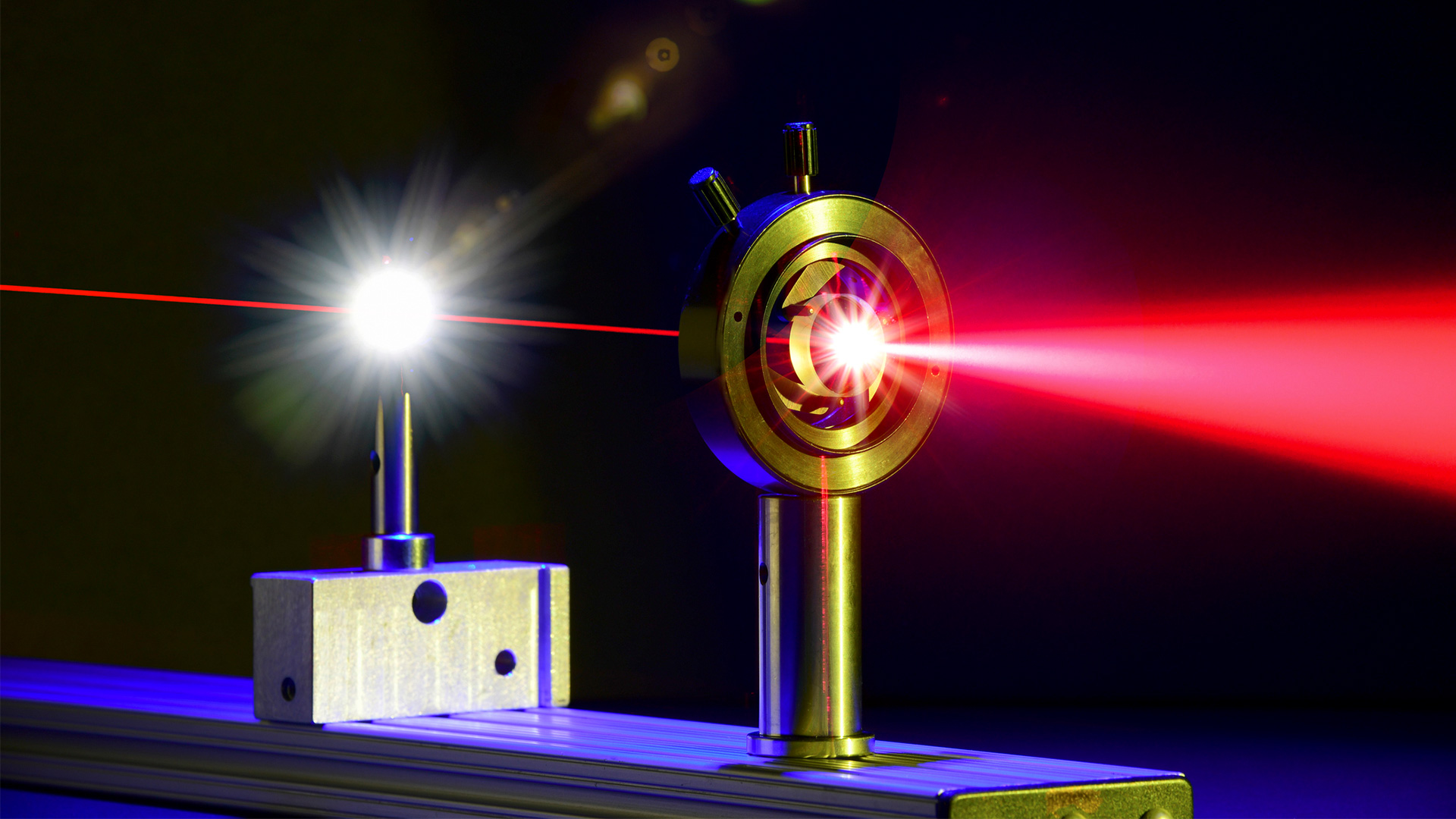

The application of advanced optical technologies allowed physicists to identify that the structure of the most massive elements is not spherical, presenting an oval geometry that redefines the understanding of the stability of matter in the Universe.
An innovative study conducted by international researchers revealed that the nuclei of the heaviest atoms in the Universe have a peculiar shape of rugby ball.
Through the use of high-precision laser pulses, the team was able to observe structural deformations in elements that challenge traditional spherical representations in nuclear physics. This discovery offers a new perspective on how matter organizes under extreme conditions of mass and density.
The laser pulse technology in nuclear observation
The applied technique uses pulses of laser to probe the internal structure of heavy isotopes with unprecedented resolution in current science. By firing these beams of light at the atoms, scientists can measure the energy transitions that indicate the distribution of protons and neutrons in the nucleus.
-
China Develops Custom 140-Ton Electric Mining Truck with 770 kWh Swappable Battery, Deploys 290 Units in Xinjiang’s Largest Zinc Mine

-
Meta to Launch Arena, a New Prediction App Targeting 3.56 Billion Users, Competing with Polymarket and Kalshi

-
Scientist Challenges Famous Human Evolution Theory, Argues Homo Sapiens Evolved Gradually Over Thousands of Years
-
15-Year-Old American Builds Ocean Generator with PVC Pipe and 3D-Printed Propeller for $12, Wins National Prize, Presents at White House, and Makes Forbes 30 Under 30 List




This method allowed the identification that, instead of perfect circles, the internal architecture of these elements presents a characteristic longitudinal elongation.
The collected data indicates that the repulsive force between positively charged particles plays a crucial role in this geometric distortion. The balance between the strong nuclear force and electromagnetic repulsion results in this elongated shape, which visually resembles a rugby ball.
Such a configuration is more stable for nuclei that contain a large number of nucleons concentrated in a reduced space.
Implications for the understanding of heavy elements
The mapping conducted with laser pulses focuses especially on elements situated at the edge of the periodic table, where nuclear stability is volatile.
The researchers noted that the rugby ball-shaped deformation is not an anomaly, but a fundamental property of atoms with high atomic mass. This characteristic directly influences how these elements interact with other particles and how they undergo radioactive decay processes.
The precision of laser pulses has also allowed for the differentiation of subtle variations between isotopes of the same chemical element. Although they share the same number of protons, the addition of neutrons significantly alters the degree of elongation of the atomic nucleus observed.
These measurements are essential to validate theoretical models that attempt to predict the existence of new superheavy elements in the so-called “island of stability”.
Technical challenges and the future of nuclear physics
The use of laser pulses to investigate the rugby ball shape of nuclei requires laboratory facilities of extremely high complexity and absolute vacuum. Each experiment requires perfect synchronization between the firing of the laser and the trajectory of the heavy ions accelerated in the laboratory. The success of this approach demonstrates that laser spectroscopy is one of the most powerful tools to unravel the secrets of subatomic matter.
With the consolidation of this data, the scientific community hopes to refine calculations about the synthesis of elements inside stars and in violent cosmic events.
The rugby ball shape identified via laser pulses serves as a fundamental marker to understand the chemical evolution of the cosmos. The next steps of the research aim to expand this analysis to even more ephemeral and massive elements.
Click here to access the study.






