Portuguese
  Spanish


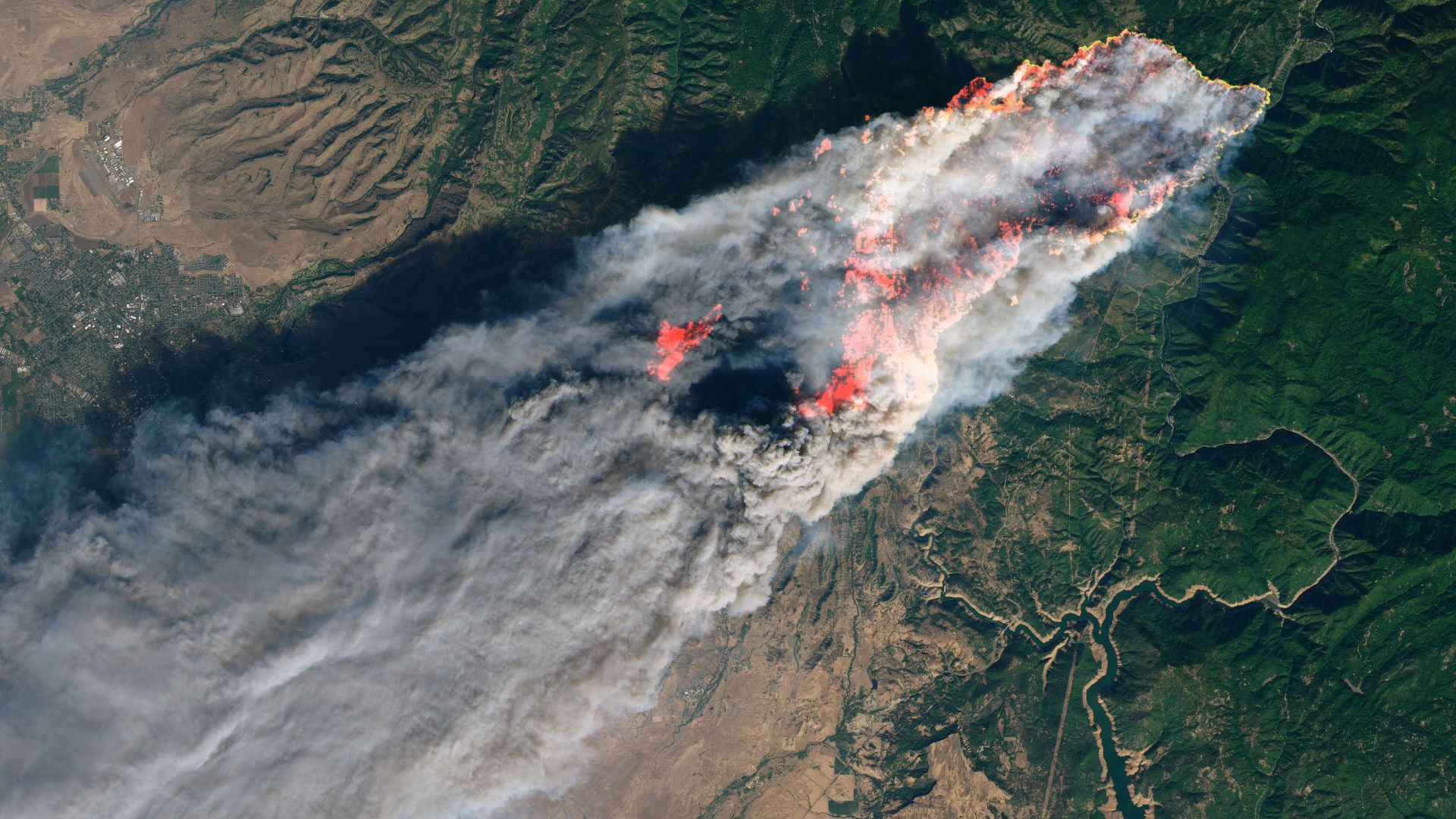

Silent advance of fire during the night alters historical patterns, increases risk in forests, and pressures cities in vegetation areas, with a consistent increase in favorable burning hours in recent decades.
The early morning has long served as a partial truce in the advance of large wildfires in parts of North America. However, this pattern has weakened.
A study published in the journal Science Advances indicates that favorable weather conditions for fire have consistently extended over the past few decades, allowing flames to advance for longer during the night and regain intensity early in the morning.
Expansion of fire risk hours
The work points out that the annual total of hours with weather conducive to burning has increased by 36% compared to the mid-1970s.
-
Engineers Develop Fridge-Sized Machine to Produce 95-Octane Synthetic Fuel from Air and Water, Aiming to Sustain Combustion Engines Without Oil

-
Two-Armed Robot Uses AI to Reassemble Destroyed Pompeii Frescoes, Solving an “Impossible” Puzzle
-
New Law in Brazil Requires Breaks for Type 1 Diabetes Management at Work, School, and Public Exams

-
Scientists Confirm “Greening” of Antarctica: Ice on the World’s Coldest Continent Turns Green as Mosses Multiply Over Tenfold in Four Decades


Additionally, the days with favorable weather for fire have increased by 44%, equivalent to 26 extra days per year compared to the pattern observed about fifty years earlier.
In practice, the risk window has ceased to concentrate only on the hottest periods of the afternoon and has begun to invade nighttime and morning hours that previously helped to curb the spread.
Warmer and drier nights favor fire

This change alters one of the most important mechanisms of fire behavior.
In traditional scenarios, the drop in temperature and the recovery of relative humidity during the early morning reduced the intensity of the flames and provided more favorable conditions for firefighting.
Now, according to researchers, warmer and drier nights weaken this relief period and keep vegetation in a more susceptible state to combustion.
Analysis of thousands of fires and historical data
The result is not based on isolated episodes.
To reach this conclusion, the team analyzed hourly satellite data regarding nearly 9,000 large wildfires recorded between 2017 and 2023 in different areas of North America.
Based on this information, the authors trained a model to relate fire activity to variables such as temperature, wind, rain, air humidity, and fuel moisture, and then applied this system to historical climate series since the 1970s.
Faster and more intense fires
The most recent data helps to quantify the speed at which these events have become more dangerous.
Among the analyzed fires, 60% reached peak intensity in less than 24 hours.
Another number reinforces the change in pattern: 14% reached this peak precisely at night, contrary to the historical expectation that the early morning would tend to weaken the flames and allow for more effective containment operations.
Impacts on combat and predictability
Instead of serving as a predictable pause, the night has, in many cases, provided continuity to the advance of the fire.
This has a direct impact on response planning because it reduces the operational margin that firefighters and emergency teams used to have between one critical period and another.
When the fire remains active for longer without nighttime slowdown, containment work becomes more complex, and the chances of rapid expansion increase.
Regions most affected by the advance of fire

The distribution of this worsening is not homogeneous.
In parts of California, the study indicates about 550 additional hours per year with favorable fire weather compared to the reference period of the 1970s.
In sectors of the southwest New Mexico and central Arizona, the increase reaches up to 2,000 annual hours, placing these areas among the most pressured by the expansion of fire-prone weather.
In western Canada, the trend also appears consistently.
Regions of Alberta and British Columbia recorded, according to the study, something between 200 and 250 extra hours of weather conditions favorable to fires in the current seasons.
Change in daily fire rhythm
This advancement does not represent just more time available for the fire to burn.
What changes is the daily rhythm of the emergency.
When humidity stops recovering as before and nighttime temperatures remain high, the fire encounters fewer meteorological barriers to stay active in areas of dense vegetation, slope corridors, highway margins, and transition zones between forest and human occupation.
The predictability of the behavior of the flames, in turn, decreases.
More risk throughout the year, not just in summer
Although the study does not treat each additional hour as an automatic synonym for an ongoing fire, it shows that the atmospheric background has become more permissive for the persistence and intensification of fire.
It is not only summer that concentrates this aggravation.
Although the season continues to gather the greatest absolute gain of hours favorable to fire, researchers indicate that the deterioration has also spread to other parts of the calendar.
As a result, the issue is no longer just the severity of a classic fire season but involves the expansion of the period of the year in which aggressive episodes can occur more easily and last longer.
Recent examples reinforce the scientific alert

Recent cases help to give practical dimension to this scenario.
The study mentions fires such as the one in Lahaina, Hawaii, in 2023, the one in Jasper, Alberta, in 2024, and the large fires in Los Angeles in 2025, as examples of events where nighttime advancement gained relevance.
These episodes do not appear as isolated proof but as signs of a broader pattern in which fire activity during the night has ceased to be an exception in different climatic contexts.
Increasing pressure on forests and cities
The explanation presented by the authors is linked to the weakening of the daily contrast between day and night conditions.
When this contrast decreases, especially due to drier nights that are less capable of recovering humidity, vegetation remains vulnerable for longer.
The fire then finds continuity where there was once a kind of natural brake, albeit temporary, important for containing speed, intensity, and affected area.
Experts in management and disaster response monitor this process with concern because the change pressures ecosystems already exposed to prolonged heat and dryness.
It also amplifies the threat to communities located at the so-called interface between vegetated areas and urban occupation, precisely where the expansion of fire can reach homes, infrastructure, energy networks, roads, and essential services in an increasingly shorter interval.
Change in fire behavior concerns experts
The relevance of the study lies, also, in the hourly scale of the analysis.
A large part of the public debate about fires tends to focus on the size of the burned area or the total duration of the season.
By measuring the risk within each day, researchers show that the crisis is not only in the length of the calendar but in the loss of a meteorological pause that historically helped reduce damage and guide firefighting efforts.
Without this breather, more persistent fires tend to require a quicker response, continuous monitoring, and adaptation of protocols in forests and cities exposed at the edge of vegetation.
The scientists’ warning is that fire no longer depends solely on the afternoon heat to gain strength, and the erosion of this old nighttime interval transforms the early morning into yet another period of elevated risk, with direct effects on safety, urban planning, and environmental protection.