Portuguese
  Spanish


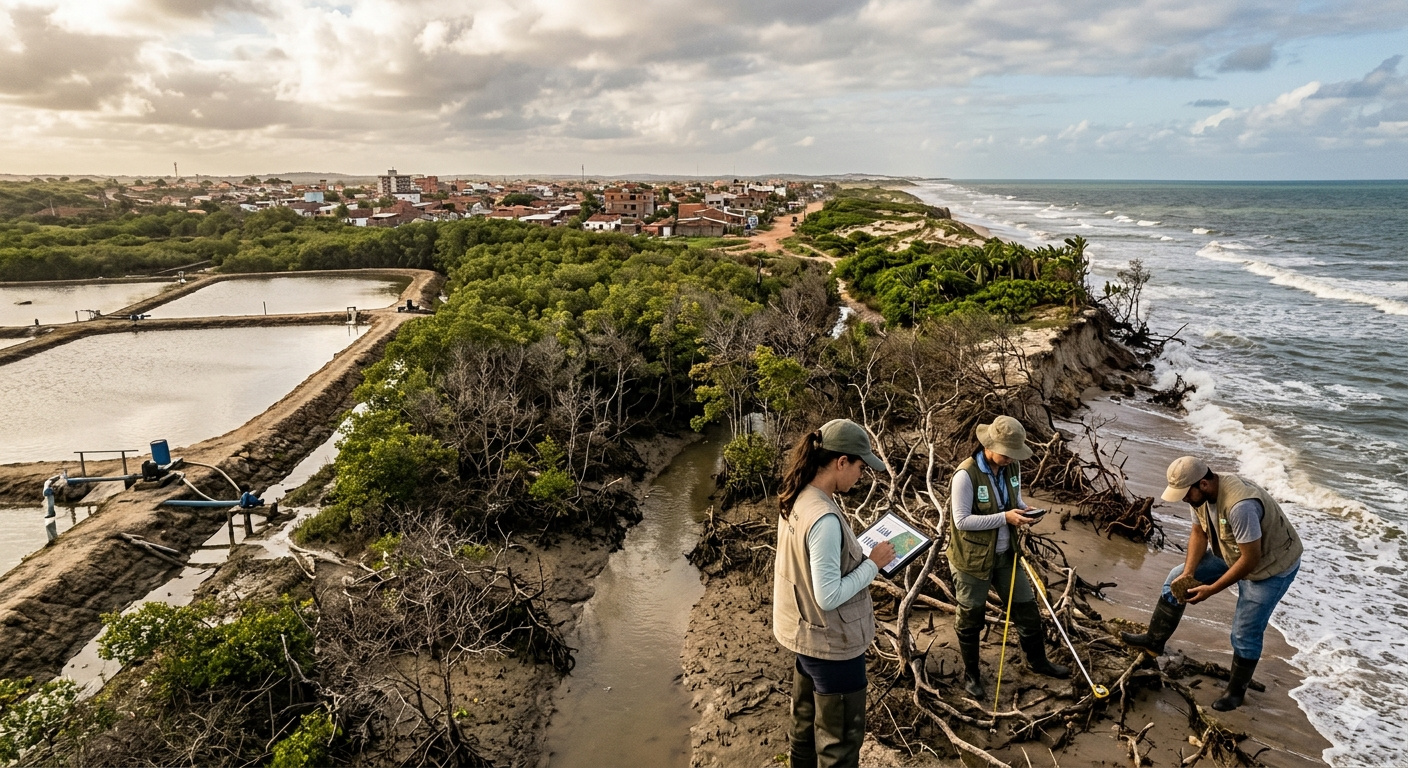

Study reveals functional loss in restingas and mangroves of the Northeastern coast, where urbanization, shrimp farming, and invasive species reduce coastal protection, increasing erosion, storm surges, and risks to vulnerable communities in the region.
According to the Brazilian Journal of Biological Sciences, studies published in 2025 by researchers from Brazilian and European universities document that the mangroves of the Northeastern coast are among the most productive and most threatened coastal ecosystems on the planet simultaneously — and that the loss of their functional biodiversity is not just an ecological problem, but a progressive removal of the natural infrastructure that protects communities, estuaries, and fishing economies along a coastline stretching over 3,300 kilometers.
ICMBIO estimates that 25% of Brazilian mangroves have already been lost, with shrimp farming being the main cause in the Northeast. In Pernambuco, surveys documented that shrimp farming was responsible for the loss of 9.6% of mangroves in the state’s northern coast alone by 2005 — two years before much of the current environmental legislation had even been approved.
What the monitoring of coastal plots over recent years shows is that the loss has not stopped. It has become more complex: it now combines the direct expansion of shrimp farming with coastal urbanization, effluent pollution, solid waste disposal, and the introduction of exotic species that compete with native mangrove species. And every hectare of mangrove lost is a hectare of coastal protection that no longer exists.
-
El Niño Intensifies: Over 90% Chance of Persisting Until 2027, Raising Ocean Temperatures and Increasing Severe Weather Risks in Southern Brazil, Warns Federal Report

-
NASA Prepares Trio of Small Satellites to Track Tropical Storms and Capture Rapid Rainfall Development from Above the Clouds

-
$7,999 Isaac 1 Robot Aims to Tackle Household Chaos: Folds Clothes, Makes Beds, and Organizes, but Raises Privacy and Cost Concerns with Camera Reliance and Remote Human Assistance
-
Mobile Electron Accelerator Units Enable Safe Testing of Water, Materials, and Industrial Waste Treatment in Countries Without Permanent Labs




What mangroves and restingas do that no engineering work can replicate
To understand what is being destroyed on the Northeastern coast, it is necessary to understand what mangroves and restingas do — not ecologically in abstract, but physically, in terms of concrete services that sustain human lives. Mangroves are transitional coastal ecosystems between terrestrial and marine environments, characterized by vegetation with aerial roots adapted to brackish and periodically flooded soils.

In the Brazilian Northeast, the dominant species — Rhizophora mangle, Avicennia germinans, Avicennia schaueriana, and Laguncularia racemosa — form dense forests on the margins of estuaries, at river mouths, and along tidal channels. Their aerial roots create a labyrinth of structures that reduce current velocity, deposit suspended sediments, and progressively build the substrate in which they grow.
Substrate construction and stabilization
This function of substrate construction and stabilization is what makes mangroves irreplaceable as coastal protection. When waves and storm surges reach a coast with an intact mangrove, they lose energy as they pass through the root forest before reaching dry land. Coastal protection studies document that mangroves reduce wave height by 50 to 70% over distances of 500 meters of vegetation. During extreme events such as storm surges and storm tides, this dampening can be the difference between a fishing community that survives the event and one that loses homes, boats, and infrastructure.
Restingas are the plant formations that grow on coastal sands — the dune ridges and sandy plains between the sea and the terrestrial vegetation. Their primary function is to stabilize the dunes that protect the coast from wind erosion and marine intrusion. Restingas vegetation anchors the sand with roots, reduces wind speed on the sandy surface, and forms a biological barrier that, when removed by urbanization, leaves the sand loose to be carried into estuaries and out to sea.


In areas where mangroves and restingas have been removed — for the construction of shrimp farms, condominiums, or coastal roads — coastal erosion advances at a satellite-documented speed. What took millennia to build can be destroyed in a single storm surge season.
Shrimp farming that entered through the mangrove
Shrimp farming — the cultivation of shrimp in ponds — arrived forcefully on the Northeastern coast starting in the 1980s, taking advantage of the climatic differential and access to estuaries that the Northeast offers compared to any other Brazilian coastline. The business model was simple: convert mangroves and apicuns — the hypersaline plains adjacent to the mangrove — into rectangular ponds where shrimp would be cultivated with feed and water quality control.
The impact has been documented from the beginning. The suppression of mangrove vegetation for the implementation of nurseries causes a direct loss of biodiversity. The discharge of effluents rich in organic matter directly into estuaries promotes eutrophication — the excessive enrichment of nutrients that generates algal blooms, reduces dissolved oxygen, and kills aquatic fauna. The use of sodium metabisulfite in harvesting contaminates watercourses.
The escape of exotic shrimp species into estuaries competes with native species. And the destruction of the mangrove removes the source of particulate organic matter that is the base of the trophic chain in estuaries — the fishing productivity that traditional communities directly depend on.
Consequences of the suppression of mangrove forests
One of the direct consequences of the suppression of mangrove forests is soil erosion, which in turn is related to the silting of rivers and tidal channels. When mangrove roots are not present to retain sediments, the tides progressively remove them. Channels that once allowed fishing boats to navigate become shallow.
Estuaries that were once breeding grounds for fish and crustaceans lose the substrate that made them productive. Shrimp farming, which promised an economic alternative to fishing communities, has in many cases destroyed the productive base that those communities had depended on for generations.

Who loses when the mangrove disappears
The injustice of the degradation of northeastern mangroves has a precise social dimension that 2025 studies clearly document: those who lose are traditional fishing communities, those who gain are shrimp farm owners — and the two groups rarely overlap.
The inefficiency of environmental legislation for conflict management, the lack of fair and participatory environmental management, and the lack of representation of traditional communities in solving these problems have allowed the generated environmental impacts to be socially aggravated. The degradation of mangroves through vegetation suppression and the discharge of polluting effluents into estuaries have been highlighted as the main threats to the activities of traditional communities.
Shellfish gatherers, artisanal fishermen, and other residents of coastal communities are being affected by degradation
Shellfish gatherers who collected mollusks and crustaceans in the mangroves for decades find estuaries degraded by the eutrophication from shrimp farming effluents. Artisanal fishermen who depended on the productivity of estuaries as natural breeding grounds find reduced fish stocks. Residents of coastal communities who lived protected by the mangrove barrier against storm surges find their homes increasingly vulnerable to erosion and coastal flooding.
The paradox is documented in multiple studies: shrimp farming was implemented in much of the Northeast as an economic alternative for vulnerable coastal communities. In many cases, it destroyed the ecological conditions that made these communities viable — artisanal fishing, shellfish extraction, protection against extreme events — without creating equivalent jobs in volume or stability. The shrimp was exported. The destruction remained.
What coastal monitoring reveals in satellite images
Brazil has one of the most extensive and most satellite-monitored tropical coastlines in the world — a consequence of the economic importance of the coastal zone and the research programs of INPE and northeastern federal universities. What long-term monitoring documents for the mangroves of the Northeast is a pattern of loss that combines abrupt events with gradual erosion.
Abrupt events include the opening of new shrimp farms, the construction of roads and coastal condominiums, and deforestation associated with the urban growth of tourist cities like Fortaleza, Natal, João Pessoa, Maceió, and Aracaju. Each of these events removes mangrove or restinga in a measurable way in Landsat and Sentinel multitemporal images.

Gradual erosion is less visible by satellite but more insidious: the degradation of water quality by effluents that progressively weakens mangrove vegetation without physically removing the trees; the silting of tidal channels that reduces the periodic flooding necessary for mangrove physiology; the compaction of soil by solid waste disposal that alters root aeration. The forest appears present in satellite images but is losing its ecological function — a process analogous to what occurs in the Amazon under thermal and water stress.
The conversion of apicuns and mangroves for shrimp farming, when carried out without adequate planning, has shown potential to cause significant environmental degradation, affecting biodiversity and ecosystem services. These ecosystems perform essential functions, such as carbon sequestration, protection against coastal erosion, and support for artisanal fishing.
The carbon that mangroves store and that no one accounts for
In addition to coastal protection and support for fishing, mangroves have a third function that has gained increasing relevance in climate debates: they are among the ecosystems with the highest density of carbon stock on the planet. Blue carbon — carbon stored in coastal ecosystems such as mangroves, salt marshes, and seagrass meadows — accumulates both in living biomass and, mainly, in anoxic soil sediments, where decomposition is extremely slow and carbon can remain for centuries.
Global studies estimate that mangroves store between 1,000 and 2,000 tons of carbon per hectare in sediments — values much higher than those of terrestrial tropical forests, which accumulate carbon mainly in biomass and surface soil.

When a mangrove is destroyed to make way for a shrimp farm, the carbon stored in the sediments begins to oxidize and be released into the atmosphere over years. A shrimp farm built on a mangrove not only removes the ecosystem that sequestered carbon — it converts a stock accumulated over centuries into emissions.
The economic value of this carbon is not accounted for in the licensing of shrimp farms. It does not enter into the production cost of exported shrimp. It does not appear in the Northeastern trade balance. It is an externality that society pays distributed over time while shrimp profits are privatized in fast motion.
The coastline that can still be recovered
The good news — and it exists — is that mangroves have a natural regeneration capacity when pressures are removed and the substrate is preserved. Studies on the recovery of Brazilian mangroves document natural recolonization in abandoned pond areas when estuarine hydrology is restored. Vegetation grows, roots return to retain sediments, and fauna progressively returns.
The problem is what the scientometric study published in 2025 in the Brazilian Journal of Biological Sciences identified as the dominant pattern in the literature: the degradation of Northeastern mangroves is widely documented, but research on recovery is minority, and effective restoration programs are rare, underfunded, and disconnected from the traditional communities that depend on these ecosystems.
The partial observation of restinga and caatinga vegetation recovering in some areas of the Northeastern coastal zone — documented in Ceará surveys — shows that recovery is possible when pressures recede. But it does not recede on its own while shrimp farming remains economically viable without paying for the environmental cost it generates, while coastal urbanization advances without environmental compensation requirements, and while traditional communities who have lost their livelihood in degraded mangroves have no voice in the planning of the coastal zone they have inhabited for generations. The natural barrier that has protected this coastline for millennia does not require sophisticated engineering to function. It requires that it continues to exist.