Portuguese
  Spanish


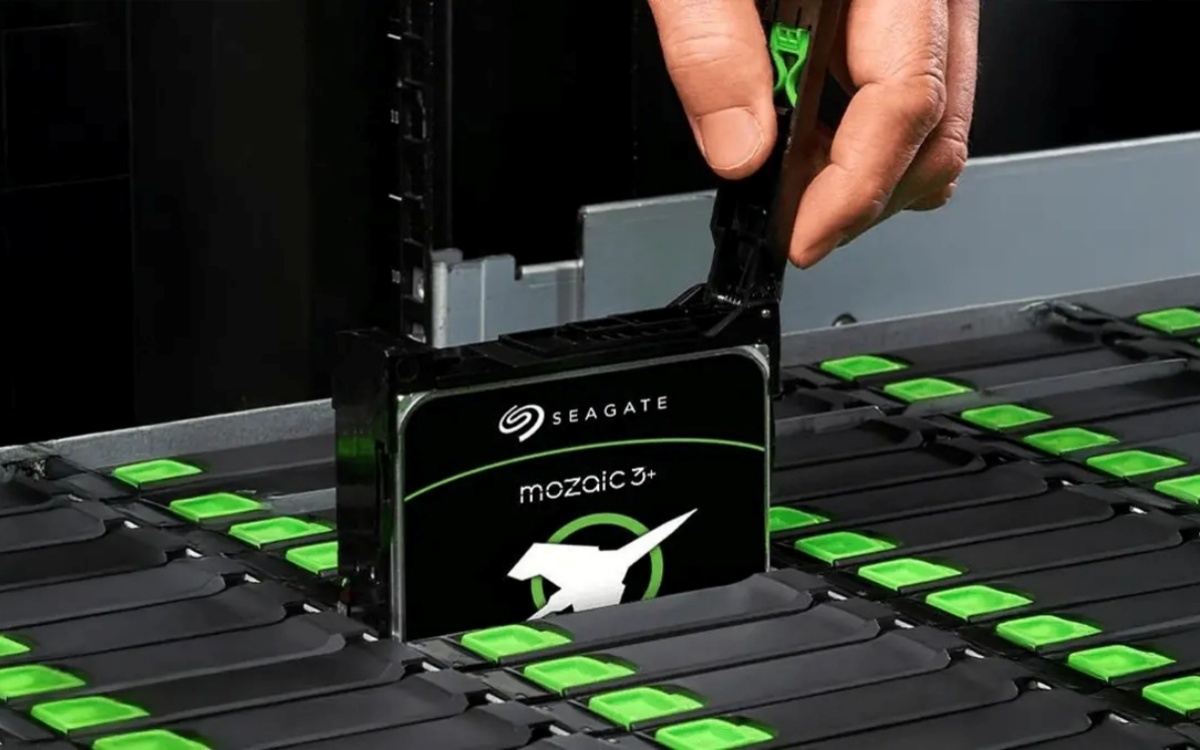

Seagate Goes Beyond And Plans A Bold Proposal: 100 TB Hard Drive May Hit The Market In 2030 To Meet The High Demands In The AI And Data Centers Sector.
The storage market continues to expand and now Seagate, known for its HDDs and SSDs, has announced something that goes well beyond bold plans. According to information from BS Teh, the company’s commercial director, Seagate plans to launch its first 100 TB hard drive by the beginning of the next decade. Today we will explore everything known about Seagate’s 100 TB hard drive.
Understand Seagate’s Intentions Behind The Launch Of The New 100 TB Hard Drive
The executive explained in his interview on CNBC the company’s plan to launch something so demanding that it would have about three times the capacity of the company’s main storage models. It is important to mention that the largest hard drive ever produced by the brand is the EXOS M, which delivers a storage space of 36 TB. This hard drive was initially launched in January of this year.
Teh mentioned the possible 100 TB hard drive from Seagate when asked about the real demand for a drive of this size. In explaining, the executive mentioned that hardware of this level would be a key enabler for the industry to deliver the storage capacity that the market needs.
-
The Trap of Modern Technology: How Screen Overload and Digital Connections Can Impact Your Mental Health and Well-being

-
Wyoming Couple Grows Tropical Fruits Year-Round in -40°C Using Geothermal Greenhouse, Demonstrating Earth’s Heat Can Produce Oranges and Lemons in Snow Without Traditional Heating

-
Ship Returns from Brazilian Coast with Thirty Newly Discovered Life Forms
-
Nigerian Professor Invents Electricity-Free Refrigerator Using Clay Pots and Wet Sand, Extending Shelf Life of Vegetables to 27 Days; 7,000 Units Distributed in Energy-Deprived Villages



Moreover, it was also said that a product like this could contribute to the energy demands of Artificial Intelligence technologies. This could be one way to address the increasing energy needs of AIs as they evolve.
According to the executive, with this product, the company will create a hard drive that uses less energy per terabyte and has more density in the device, so that when the consumer integrates the product into their data center, less space, less energy, and other benefits are needed, considering they will be using fewer drives to reach capacity.
Learn What The Official Company Roadmap Says
Despite the executive’s excitement in promoting his company during the interview, we still do not have confirmation of Seagate’s 100 TB hard drive in the official company roadmap. And it doesn’t stop there, the brand has previously failed to deliver on promises of increased capacity.
It is worth recalling that in its 2017 roadmap, the company spoke of offering 50 TB storage by 2026 in the form of the Exos Mosaic 5+. However, this forecast was adjusted to 2028, with the following year being reserved for the Exos Mosaic +4, which delivers 40 TB.
The entire line uses HAMR technology to achieve these large capacity numbers. If Seagate maintains the same solution, it is a bit difficult to envision such a bold leap in storage between the 2028 forecast and 2030. It is possible that the brand’s executive is overly optimistic or already knows of some new generation of technology that has not yet been disclosed by the company.
Discover The Most Powerful Hard Drive From Seagate
While Seagate’s 100 TB hard drive does not hit the market, let’s explore the company’s latest launch. In January of this year, the company raised the storage industry standard with the launch of the Exos M, a hard drive with an impressive capacity of 36 TB. To give you an idea, this equipment can hold up to 900 movies in 4K resolution.
Using Heat Assisted Magnetic Recording (HAMR) technology, the company managed to surpass the old 32 TB offered by previous models. However, as not everything is perfect, this unit will not be available for regular consumers, as it was specifically developed for data centers and cloud services.
The secret to this product lies in HAMR technology, which uses a small laser to heat the disk’s magnetic surface exactly where the data will be recorded. This allows for a higher recording density. Currently, the company is the only manufacturer capable of producing disks with a requirement of 3.6 TB per internal disk, and the new model features 10 of these platters.
Among the first customers to use this new technology is Dell Technologies, which aims to integrate the disk into its data center solutions. Dell’s vice president, Travis Vigil, explained that customers who develop AI factories need storage that is economical, flexible, and scalable, designed to handle the most demanding workloads.