Portuguese
  Spanish


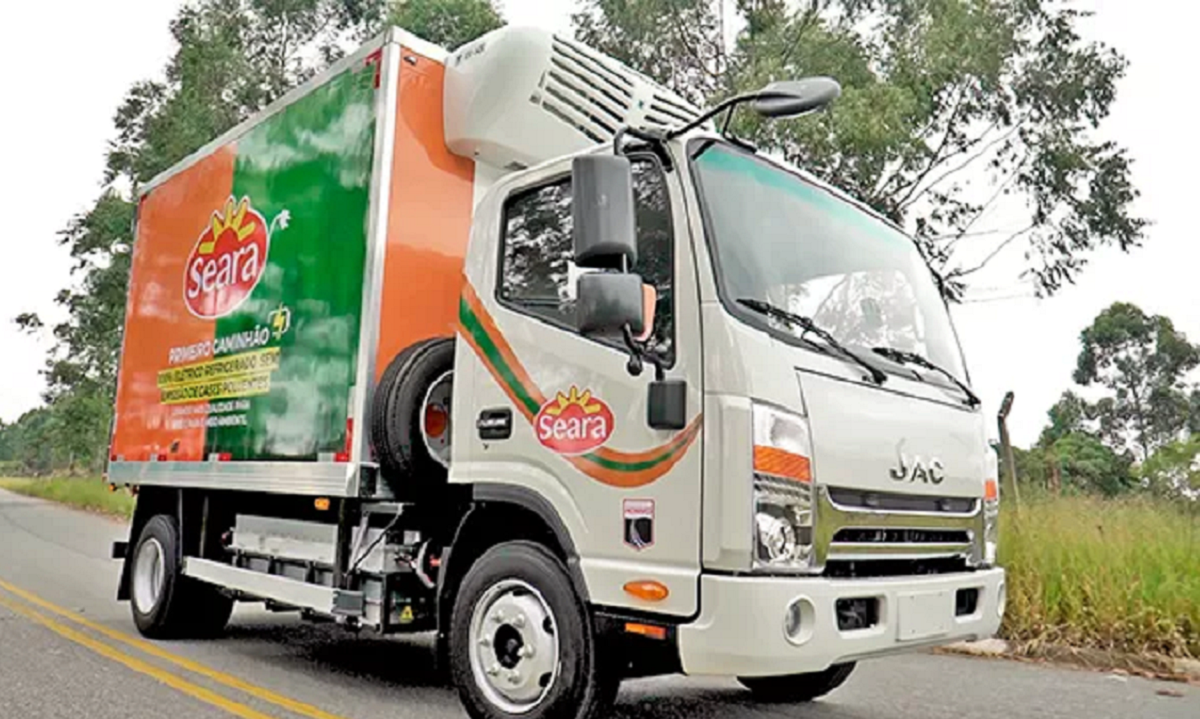

The Adoption of More Electric Trucks Is Associated With Reducing Pollutant Gas Emissions by the Seara Brand, Along With the Low Cost of These Vehicles
The Seara aims, by January 2023, to increase the number of 100% electric refrigerated vehicles used for distributing its products nationwide from 19 to 200. The expectation is that the new electric trucks in circulation will help reduce scope 3 greenhouse gas emissions, which aligns with JBS Group’s efforts to become Net Zero by 2040.
The group, which includes the Seara brand, expects to zero out the balance of its scope 1 emissions, related to direct operations, scope 2 emissions, linked to energy, and scope 3 emissions, related to suppliers and the post-industrial chain, by that year.
Seara Will Use Electric Trucks Provided by No Carbon, Which Will Reduce Annual CO2 Equivalent Emissions by Approximately 6,000 Tons
No Carbon, a new JBS New Ventures company focused on leasing electric trucks, will be responsible for supplying the vehicles to Seara. The company’s trucks have a range of 170 kilometers and can carry up to 4 tons of cargo. They are also equipped with refrigerated boxes, storing both chilled and frozen products simultaneously.
-
1983 Chevrolet Runs Over 100,000 km Without Gasoline, Powered by Wood Chips, Reaches 125 km/h in Airport Test

-
Workshop Converts Giant Tractor Tire Tricycle into a Three-Wheel Drive Hybrid with 36,000-Watt Electric Motor Capable of Climbing Hills

-
Chery Offers Lifetime Battery Warranty and Car Replacement for Major Failures Under New Chinese Regulations
-
Sales of Brazil’s Cheapest Electric Car Halted Before First Deliveries: E-Motors Suspends Emova Easy Due to Import Tax Increase and Rising Freight Costs



Each truck prevents approximately 30 tons of carbon dioxide (CO2) equivalent from being released into the atmosphere. Thus, the introduction of 200 new vehicles into Seara’s transport fleet will enable a reduction of about 6,000 annual tons of emissions, which is equivalent to planting 45,000 trees. This can be explained by the fact that the electric trucks will replace diesel-powered vehicles, which are much more polluting.
Seara’s Logistics Director Highlights the Motivations Behind the Increased Adoption of Electric Vehicles by the Brand
Seara’s Logistics Director, Fabio Artifon, states that the brand’s goal is to increasingly expand the reach of sustainable and low-carbon logistics solutions. According to him, their goal is to have electric vehicles in all metropolitan areas with the company’s Distribution Center. Seara is a pioneer in the adoption of refrigerated electric trucks, with the vehicles already distributing products in the states of Santa Catarina, Paraná, São Paulo, and the Federal District.
Artifon also states that with the entry of new electric trucks, the brand facilitates fleet renewal and supports its partner transporter without requiring them to make the investment to transition to a low-carbon fleet.
About Electric Vehicles
Electric vehicles have a number of advantages, such as reduced environmental impacts and low operating and maintenance costs. Consequently, there is a growing trend toward the adoption of electric trucks in the fleets of various companies.
This type of vehicle does not have, for example, oil filters; air filters; fuel filters; belts; injection pumps; exhaust systems; fuel injectors; among other items that make the maintenance of a conventional automobile up to six times more expensive than that of an electric model.
In light of this, Seara has sought to diversify and expand the use of renewable energy sources for its operations. From this perspective, variations in diesel prices, which is also more polluting, may further contribute to the use of electric vehicles, as well as other alternative fuel sources, such as biodiesel and biogas.