






 Portuguese
  Spanish


An Unprecedented Intervention That Transformed Engineering And Environmental Conservation
In June 1969, engineers from the United States, after years of technical discussions, made a historic decision. They completely blocked the flow of the Niagara Falls. After all, this feat forever marked international hydraulic engineering while involving the U.S. Army Corps of Engineers at every stage.
In this context, the teams sought to analyze the stability of the rocks, as they needed to avoid the risk of collapse, since alerts about erosion had emerged since the early 1960s.
Thus, by stopping the waters, the engineers carefully inspected the dry riverbed of the falls. In doing so, they discovered elements that, surprisingly, shocked scientists and authorities from both countries.
Unprecedented Intervention Aimed to Preserve a Natural Heritage
As a result of careful analyses, technical and environmental reports motivated the decision to halt the flow of the falls. According to the U.S. Army Corps of Engineers, the falls were under constant threat of accidents, mainly due to accelerated erosion.
Over the years, geology experts, environmental agencies, and authorities from Canada and the United States debated containment strategies. Furthermore, since 1965, the project gathered efforts to ensure safe outcomes.
- First, teams conducted environmental studies and technical simulations.
- As a consequence, the project ensured the safety of visitors and protected the tourist site.
- At every stage, researchers monitored the environmental impact of the work, ensuring transparency.
How Engineers Halted the Falls
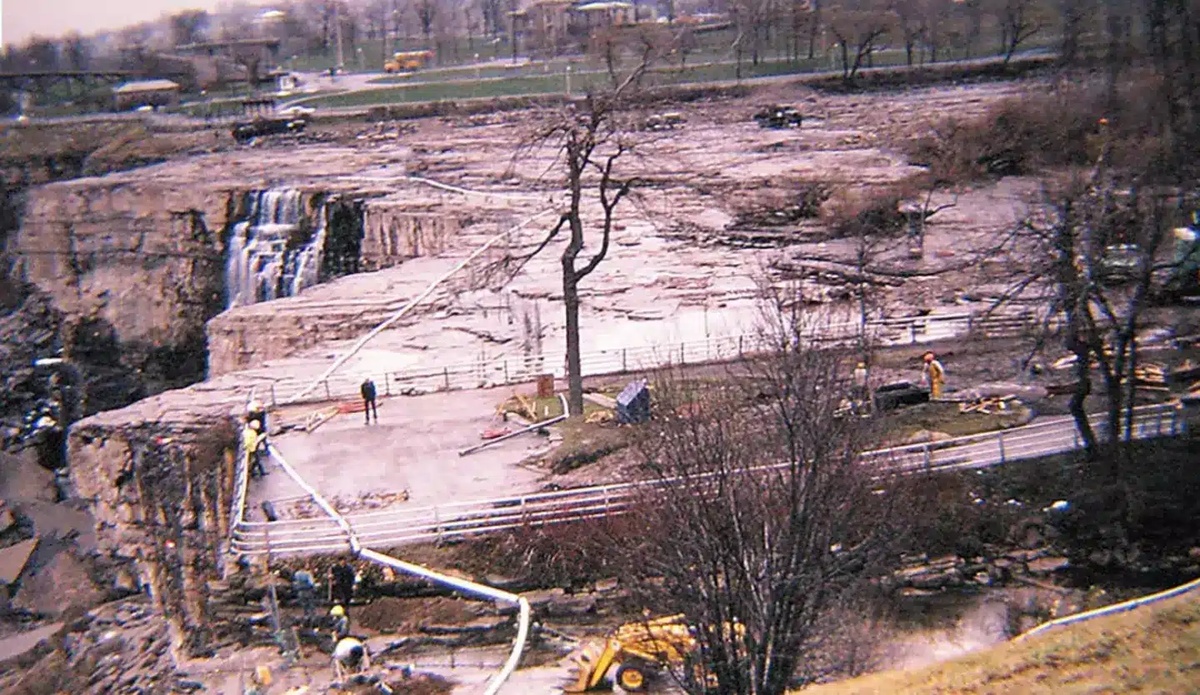
Right at the beginning of spring 1969, the team began the operation with meticulous planning. To divert the course of the Niagara River, engineers used about 27,000 tons of stone. Therefore, they built a temporary dam, directing all the flow to the Canadian side of the falls.
In this way, heavy machinery and dozens of workers raised the barrier in just three days. Thus, engineers completed the blockage on June 12, 1969, the moment when the water ceased to flow over the American Falls.
On the other hand, authorities and international press followed the entire process and ensured transparency at every stage.
-
Man Who Lost Vision Due to Lack of Roads Invests Fortune in Building 59 km Route, Ending 1,300 Years of Isolation in Brazilian Village and Boosting Tourism and Jobs

-
São Paulo Invests Millions in Massive Reservoirs to End Decades of Water Shortages, Providing Relief to Residents

-
Luxury Mansion in Rio with Views of Christ the Redeemer Listed for $25 Million
-
How Underwater Bridge Foundations Support Thousands of Tons Without Sinking: The Engineering Techniques Behind River and Sea Constructions



Discoveries Surprised During the Inspection
With the riverbed dry, researchers began to study the rock structure up close. During the inspection, the teams found coins, ancient artifacts, and remains of people who had disappeared in past accidents.
Authorities quickly identified many of these findings as belonging to victims of tragedies that occurred before the 1960s, according to records from the Niagara Gazette and the official report from the U.S. Army Corps of Engineers in 1969.
Additionally, regional museums received historical objects for detailed analysis.
- Throughout the work, the discoveries sparked debates about safety and preservation of the site.
- Meanwhile, archaeologists, historians, and environmentalists documented all the details in technical reports.
Environmental Monitoring and Restoration of Water Flow
Although the temporary blockage lasted about five months, technicians rigorously monitored the environmental impacts from start to finish. By November 1969, the teams restored the flow of water, always following the recommendations of the environmental agencies of the U.S. and Canada.
Consequently, the reports ensured that local flora and fauna continued to be preserved.
Moreover, the technicians developed protocols for future interventions in natural areas.
Over time, governments and institutions collaborated, creating a reference for new operations worldwide.
Global Repercussions and Lessons for Modern Engineering
Shortly after the blockage, the news of the halt at Niagara spread across the world. As expected, the Associated Press and Engineering News-Record highlighted the environmental care and technical precision of the project.
For this reason, several academic studies cited the case as an example for works in tourist and protected areas.
International experts praised the transparent process and the commitment to the environment.
Additionally, engineers from other countries were inspired by the episode and adopted similar methods.
Even today, the 1969 project inspires significant engineering interventions.
The Future of Preserving the Falls
The experience of 1969 continues to influence current decisions, as governments, universities, and environmental entities constantly monitor the falls.
As a result, they apply lessons learned to protect the natural heritage, without compromising the safety of tourists.
Still, the challenge requires balancing intense visitation and periodic maintenance.
In this way, specialists are seeking innovative technologies and increasingly efficient preservation methods.
Do you believe that large natural monuments should undergo technical interventions for conservation, even if it means temporarily suspending their beauty?


-

-

2 people reacted to this.