Portuguese
  Spanish




Know Bir Tawil, The Curious Unclaimed Region Between Egypt And Sudan. Get To Know The Ownerless Territory That Neither Country Wants To Control And Understand Why This ‘No Man’s Land’ Challenges Boundaries And Traditional Laws
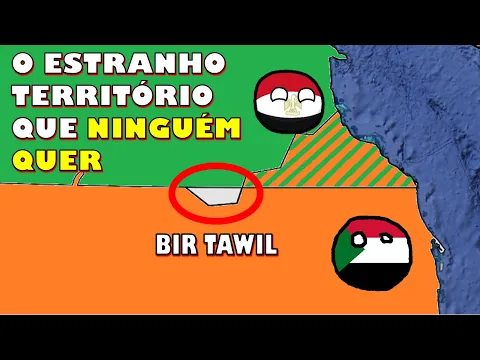
In the middle of the desert between Egypt and Sudan lies a unique region that defies the traditional rules of modern geopolitics. Bir Tawil is a “no man’s land,” a piece of soil measuring approximately 2,060 km² that is not claimed by either country. While other regions of the world are fiercely contested, Bir Tawil remains an exception: an area where no government wants to plant its flag.
The origin of this unusual enclave dates back to a border dispute between Egypt and Sudan during the British colonial period. In 1899, the British defined the border between the two countries along the 22nd parallel.
However, in 1902, a subsequent British administration drew a new line that took into account tribal and ethnic criteria. As a result, the Hala’ib region to the north was administered by Sudan, while Bir Tawil to the south remained under Egyptian responsibility.
-
A Brazilian street cleaner built a machine to recycle PET bottles in the hinterlands of Paraíba, transforming the trash he swept from the streets into threads, brooms, and equipment sold even outside Brazil, and began earning about R$ 7,500 per month with his own invention.

-
In a city where every piece of land is worth gold, he began buying plots in the 1960s and built a real estate empire with over a thousand properties.

-
An artist sank over 500 life-sized human statues at the bottom of the Caribbean Sea, and what seemed like macabre art turned into a living reef covered with corals that attracts divers from all over the world.

-
A fossil kept for years in a small museum in Montreal concealed 450-million-year-old soft tissue, a discovery that has only happened once before in history.


The problem is that Hala’ib is a valuable coastal region, strategically located on the Red Sea. Both countries claim it as their own.
To maintain territorial consistency, whoever claims Hala’ib cannot at the same time desire Bir Tawil, as accepting this territory would imply recognizing the 1902 border line. Thus, both Egypt and Sudan prefer to keep Bir Tawil as an unclaimed region.

A Region Without Sovereignty: What Exists In Bir Tawil?
Bir Tawil is an inhospitable place, characterized by extreme temperatures, arid soil, and a total absence of infrastructure. There are no cities, roads, or even permanent villages. The site is rarely visited, except by adventurers, explorers, and occasionally Bedouins crossing the desert.
According to Google Earth and satellite images, the landscape is dominated by sand and rock formations. Bir Tawil measures about 79 km long by 26 km wide. Due to the adverse conditions and lack of natural resources, the region has never drawn commercial or strategic interest. This helps explain why it continues to be a “no man’s territory.”
The average temperature in summer can exceed 45 °C during the day, with drastic drops at night. The local ecosystem, although sparse, comprises a few species of insects and small reptiles adapted to the scarcity of water.
Attempts To Occupy: From Micronations To Personal Claims
Although no state officially recognizes Bir Tawil as its own, various individuals over the years have attempted to symbolically occupy the region. One of the best-known cases is that of American Jeremiah Heaton, who traveled there in 2014 to establish the “Kingdom of Northern Sudan.”
His goal was to fulfill his daughter’s wish to be a princess. He planted a flag made by the child, posted photos on social media, and even requested recognition from the UN, without success.
Other similar initiatives have emerged, such as the project “The Grand Duchy of Westarctica,” which, although initially focused on Antarctica, also mentioned Bir Tawil as a neutral territory. There are also cases of influencers and YouTubers who claimed to establish fictional countries in the region to produce viral content.
However, none of these claims hold legal value or international recognition. The principle of uti possidetis juris, which regulates borders inherited from colonization, prevents unclaimed territories from being unilaterally annexed. Furthermore, any attempt at physical occupation faces significant logistical and climatic barriers.
Legal And Geopolitical Imbrications: What Bir Tawil Represents?
Bir Tawil is a rare example of how borders are not just lines on a map, but also political, historical, and cultural constructions. The border between Egypt and Sudan is not contested in the conventional sense, but rejected by both, for broader strategic issues linked to sovereignty over Hala’ib.
This raises interesting questions about international law, the validity of colonial borders, and the limits of the concept of state sovereignty. The fact that a piece of land is left “ownerless” shows how politics can override geography. It also reveals how the concept of nation can be flexible and, at times, paradoxical.
The existence of a region like Bir Tawil stimulates reflections on territories that exist outside conventional political order. In a world where almost every piece of land falls under the jurisdiction of some country, a “legal vacuum” like this is a subject of debates among jurists, historians, and scholars of modern geopolitics.
Bir Tawil And The Contemporary Fascination With The “No Man’s Land”
With the growing curiosity about unusual territories and the emergence of online communities focused on alternative geopolitics, Bir Tawil has gained attention in news articles, social media, and documentaries. It symbolizes, for many, the last frontier of a post-nationalist era, where the existence of a place without law, without a flag, and without a government evokes both fear and fascination.
Bir Tawil is also a theoretical experimentation ground for idealists questioning the current models of nation-state. Some scholars view the region as a “blank space” to test concepts such as voluntary sovereignty, stateless society, or collective ownership. Although these ideas have no practical application in the area, they reflect the growing interest in alternatives to the traditional international system.
However, it is important to remember that Bir Tawil is not a land of opportunity. There are no significant mineral resources, nor drinkable water or possibility for cultivation. Instead, it represents an anomaly of the international system, a cartographic error with profound implications. The romance of the “ownerless land” dissipates in the face of harsh environmental reality and the impracticality of any sustainable occupation.
The Symbolic Importance Of A Forgotten Place
Bir Tawil, this mysterious piece of desert between Egypt and Sudan, remains a unique example of how politics and history shape the modern world. Its existence as an unclaimed region is a reminder that not every piece of land needs to be under a flag or have a government.
Although Bir Tawil does not offer wealth or strategic advantages, its value lies in the discussion it provokes: about sovereignty, national identities, and the complex legacies of colonialism. A true “no man’s land,” which more than a physical location, is a mirror of the contradictions of the world order.
The case of Bir Tawil compels us to reflect on the future of borders, states, and international coexistence in times of globalization and environmental crisis.