





 Portuguese
  English
  Spanish
  5 min of reading
  0 comments


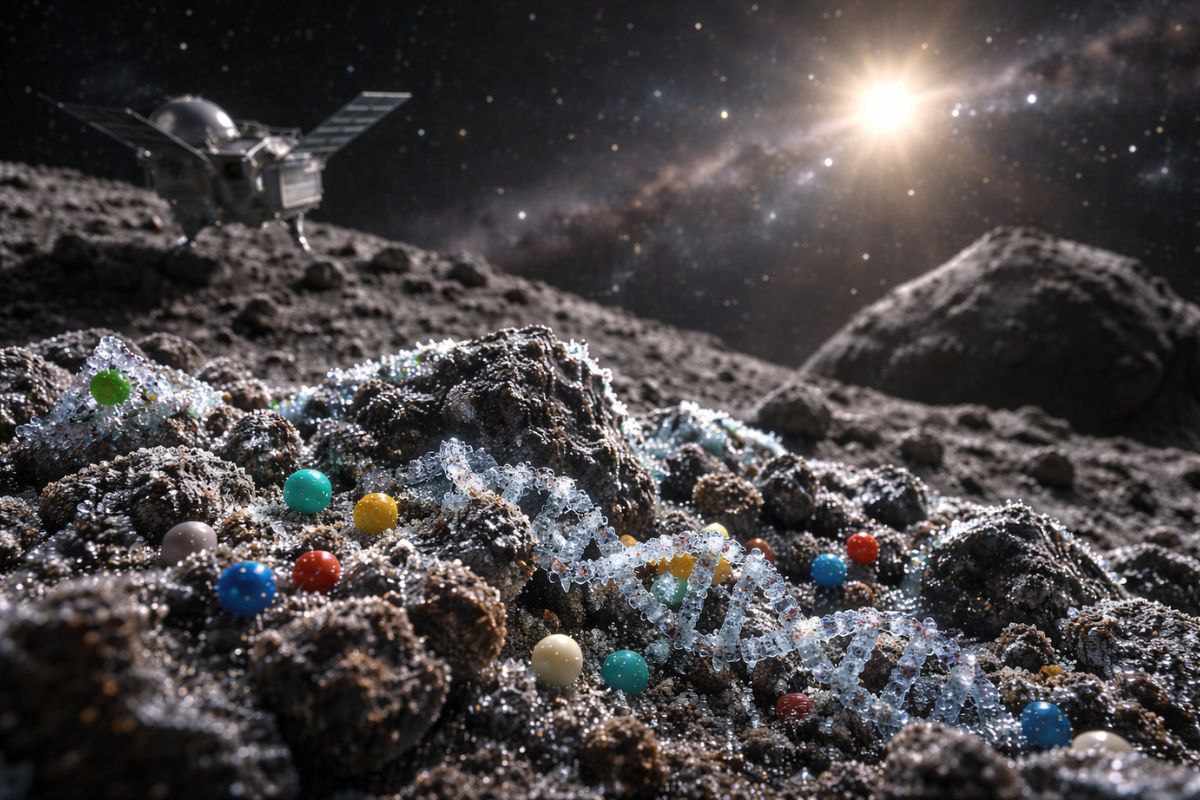
OSIRIS-REx Mission Analyses Indicate That The Origin Of Life Does Not Rely Solely On Warm Puddles On Earth, But Also On Ice Irradiated In Deep Space.
When the OSIRIS-REx mission capsule landed in the Utah desert in September 2023, bringing back a handful of dark dust collected from the asteroid Bennu, scientists knew they were not just dealing with any material. This dust has the potential to rewrite our understanding of the origin of life, shifting the focus from a young Earth to frozen and irradiated regions of space.
For decades, the classic scenario envisioned the origin of life in warm pools of water, where heat and liquid would form a “chemical soup” full of amino acids and complex molecules. However, new analyses of Bennu show that the fundamental building blocks of biology can emerge in icy environments, from irradiated ice, even before stable oceans or seas exist on planets like Earth.
The Capsule That Brought Clues About The Origin Of Life
The OSIRIS-REx was sent specifically to collect samples from Bennu and bring them back to Earth intact. Inside the capsule, there was black dust formed billions of years ago, long before any form of life we know.
-
Pope Leo 14 shakes up the artificial intelligence board by advocating for public governance, independent auditing, protected data, and human responsibility in machine decisions.

-
New technology may retire the common bathroom fixture: smart shower turns on by voice, heats up before the shower, adjusts temperature via mobile phone, and transforms the shower stall into a digital system inspired by a connected home.

-
Workers were digging to build a railway in northern Mexico and found beneath their feet a 1,200-year-old village with underground houses, ancient burials, and rock engravings.

-
The scientists did not expect it, but they found fossils of mysterious species in a cave among volcanic ashes over 1 million years old, revealing an ancient history.



This dust is a kind of physical archive of the early moments of the solar system, carrying chemical clues about the origin of life and how biological ingredients were distributed throughout space.
By analyzing this dust in the laboratory, scientists could identify not only the presence of carbon, nitrogen, water, and organic compounds, as had already been suspected, but also much deeper details about how these molecules emerge.
What Science Believed Until Now About The Origin Of Life
Until recently, the prevailing theory stated that the origin of life depended on heat and liquid water. The classic image was that of the “primordial soup”: warm puddles or lakes where simple molecules, energized by the environment, began to combine into increasingly complex structures, like amino acids and, later, DNA and RNA bases.

This model is not exactly wrong, but Bennu showed that it is incomplete. The new evidence indicates that the building blocks of life do not necessarily need to arise in warm environments, but can form in ice, under extremely cold conditions, under gamma radiation.
This radically expands the possible scenarios for the origin of life, both on Earth and on other worlds.
Bennu, A Fossil Of The Solar System And A Natural Laboratory
Bennu is an asteroid about 500 meters in diameter, considered a fossil of the primitive solar system. It is approximately 4.6 billion years old, the same age as Earth, but its surface has not been melted or reshaped by volcanism, tectonic plates, or intense erosion, as has happened here.
This means that Bennu preserves a much more faithful record of the chemical conditions that existed when the solar system was forming and the origin of life was still a distant possibility.
Even before recent detailed analyses, preliminary studies had already pointed to an unusual abundance of carbon, nitrogen, water, and organic compounds in its samples. The next step was to look more closely at the isotopic signature of the amino acids.
Amino Acids In Ice: When The Origin Of Life Begins Frozen
When studying amino acids present in Bennu, especially glycine, researchers noticed something that did not fit with the traditional explanation based on warm water.
The isotopic composition of these molecules did not match the expected pattern of water-altering processes, in which ice melts, becomes liquid water, and reacts with rock.
Instead, the evidence points to another path. The data suggest that amino acids can form directly in ice, without depending on liquid water, in frozen environments permeated by gamma radiation.
In this scenario, grains of ice mixed with simple molecules would be bombarded by energy from radioactive elements present in the early solar system, generating, step by step, increasingly complex organic structures.
Gamma Radiation As The Chemical Engine Of The Origin Of Life
The “fuel” for this process would be the gamma radiation emitted by abundant radioactive elements in the early phases of the solar system. The energy would not come from the heat of a young planet, but from the radioactivity present in the materials that were coalescing to form asteroids.
Since this process occurs in cold environments, long before the asteroid heats up enough to maintain liquid water, the origin of life gains a new pathway: first the irradiated ice produces amino acids, then these materials can be transported to forming planets, where they will encounter oceans, seas, and other favorable environments to advance in complexity.
This explains why we find amino acids both in asteroids that have undergone intense heating and in celestial bodies that remained relatively cold.
Tryptophan And DNA Building Blocks: A Surprising Chemical Menu
The samples from Bennu did not bring back only simple molecules. The analyses identified a variety of more complex compounds, among them tryptophan, an essential and structurally more sophisticated amino acid, fundamental for terrestrial life.
Additionally, components of DNA and RNA, as well as ammonia and amines, were detected, indicating a much richer set of chemical ingredients than what is observed in classic meteorites like Murchison.
In other words, Bennu carries a chemical menu capable of feeding multiple hypotheses about the origin of life, showing that organic chemistry in space is more diverse and robust than previously thought.
Reinforced Panspermia: Earth Seeded From Space
If amino acids and DNA and RNA building blocks can form relatively easily in irradiated ice grains in the solar nebula, that means these basic ingredients for the origin of life were scattered throughout the solar system even before the planets finished forming.
Bennu, a carbonaceous type B asteroid, full of these compounds, suggests that Earth did not need to “invent” all the building blocks of life on its own.
During the period of intense late bombardment, a rain of asteroids and meteorites may have delivered to the Earth’s surface a true biological kit ready-made, a stock of organic molecules prefabricated in deep space.
What Bennu Tells Us About Ourselves
When we look at a grain of dust from Bennu, we are not just studying a distant piece of space rock.
We are looking at possible chemical ancestors that helped build the origin of life on Earth, in a process that began long before the first ocean formed and the first cell existed.
This type of discovery also changes how we think about life elsewhere. If essential blocks arise so easily in frozen environments under radiation, then entire planetary systems may have been seeded with biological raw material very early on.
And you, after learning that the origin of life may have begun in grains of ice in space, do you think it’s more likely that we will find signs of life in other corners of the Universe?








-

1 person reacted to this.