Portuguese
  Spanish


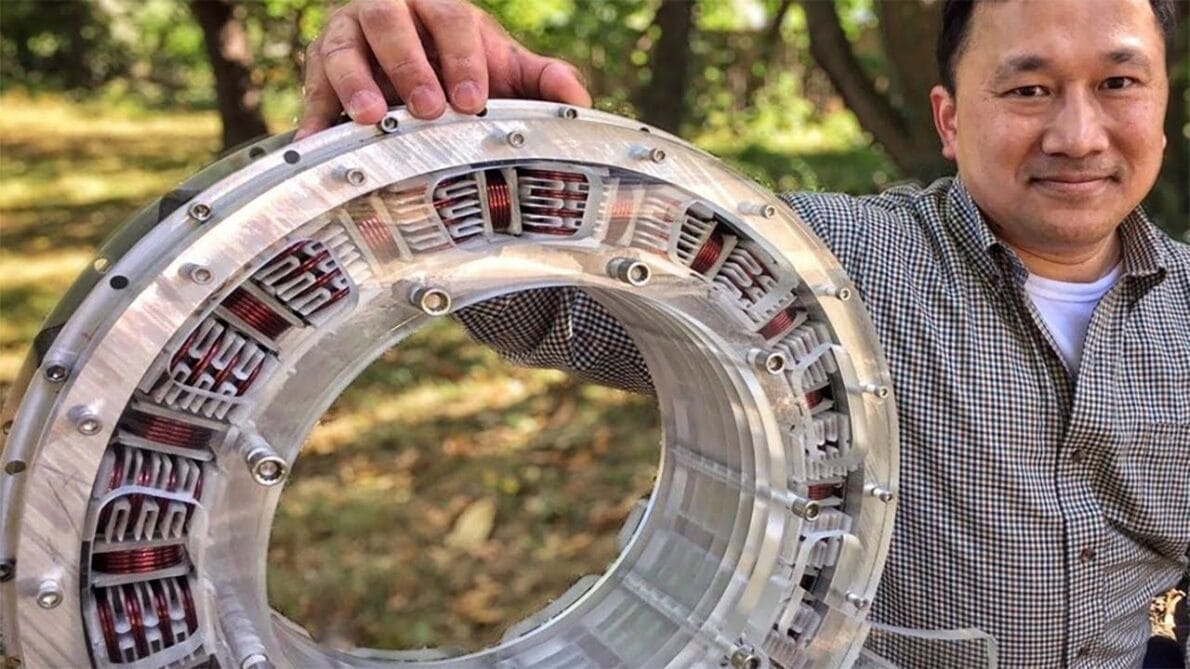

New Motor Without Magnets Promises to Revolutionize Electric Motors
Focused Energy is promising a revolution in the world of electric motors with its new project: the spiral Halbach array motor. This technology could result in one of the lightest and most powerful electric motors ever seen. But the big question is: can we really build a motor without magnets?
Focused Energy presented a bold concept that promises to be more efficient than any existing motor. The technology is based on the Halbach array, an arrangement of magnets that focuses energy directly into the stator, minimizing losses. Invented in 1987 by Klaus Halbach, this configuration allows for a stronger magnetic field on one side, without losses on the other.
How The Spiral Halbach Array Motor Works

The Halbach array can be linear, circular, or volumetric, and has evolved into permanent magnet synchronous motors that use Halbach stators. The great insight is that a perfect motor with a Halbach array does not require laminations or back iron, reducing hysteresis losses and the total weight of the motor, while achieving high revolutions per minute (RPM).
-
Hatch with sedan space and 1.0 car consumption: equipped with a 1.5 engine with 126 hp, CVT transmission with seven simulated gears, and consumption of up to 17.4 km/l, this used Honda delivers technology, comfort, and reliability; meet the 2022 Honda City Hatch Touring.

-
End of an era in Brazil: beloved sedan by Brazilians is discontinued despite having a 2.0 engine with 151 hp, CVT transmission, 466-liter trunk, and up to 650 km of range.

-
New Law Proposal in Brazil Could Heavily Penalize Drivers: Dangerous Overtaking May Become a Serious Offense with Fines Increased Tenfold and a 12-Month License Suspension; Update on 2026 Progress

-
Electric Revolution: Watts W125 Motorcycle Offers 160 km Range, 90 km/h Speed, and Affordable Price Starting at $3,000


Focused Energy’s Motor
Focused Energy’s motor is similar to Halbach array designs but replaces permanent magnets with electromagnetic coils. The coils are arranged to create a controlled magnetic field, offering a lighter, smaller, and potentially more powerful motor. However, the company claims that its motor is twice as efficient as any other electric motor on the market. Is this really true?
Claim That The New Motor Is Twice As Efficient As Any Other Electric Motor Sounds Exaggerated
Let’s be honest, the claim that the new motor is twice as efficient as any other electric motor sounds exaggerated. A permanent magnet synchronous motor (PMSM), for example, can have efficiencies over 90%. Perhaps Focused Energy is comparing its motor to brushed motors, which have significantly lower efficiency.
Mechanical Power Generated and Electric Power Consumed
The efficiency of a motor is determined by the relationship between the mechanical power generated and the electrical power consumed. All electric motors lose energy in the form of heat due to mechanical friction, electrical resistance, and losses from parasitic currents and hysteresis. The most efficient synchronous motors can achieve 99% efficiency, but this requires large coils to keep electrical resistance low.
The Promise of Superconducting Motors
Superconducting motors, which replace copper coils with HTS wires (high-temperature superconductors), have incredible potential, achieving power-to-weight ratios of 20 kW per kg and over 99% efficiency. However, they still require cryogenic cooling, which limits their practicality until we have superconductors that work at room temperature.
Motor Without Magnets Is Gaining Momentum
Even though we are far from a perfect conventional electric motor, Focused Energy’s innovation with its spiral Halbach array motor is promising. The use of coils instead of permanent magnets offers greater control over the magnetic field and may result in lighter and more powerful motors. There is still much skepticism about the efficiency claims, but the idea of a motor without magnets is gaining traction.
Other Promising Initiatives
In addition to Focused Energy, other companies are exploring motors without magnets. ZF, for example, is developing induction synchronous motors, which also do not use magnets and promise torques comparable to PMSM, with a smaller and more efficient design.
We are at an exciting moment for electric motor technology. Focused Energy and other companies are challenging the status quo with innovations that could transform the sector. If these promises of lighter, more powerful, and efficient motors come to fruition, we may be on the brink of a revolution in electric transportation and many other industrial applications. We can only wait and see if the motor without magnets will truly be the motor of the future.