Portuguese
  Spanish


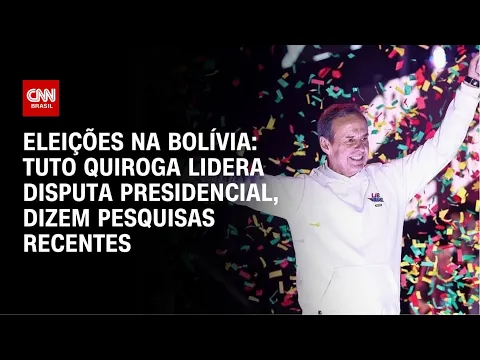
Tuto Quiroga, Leader in Bolivia’s Elections, Criticizes Mercosur and Brics and Promises Free Trade and a New Foreign Policy If Elected.
The former president Jorge “Tuto” Quiroga, favorite for the second round of the elections in Bolivia taking place this Sunday (10/19/2025), has stood out for his critical stance on Mercosur and Brics.
Leading in the polls, the candidate from the Freedom and Democracy Alliance (Libre) claims that the current format of the regional blocs is detrimental to the Bolivian economy and promises to adopt a free trade policy if he wins the election.
His statements have sparked debates about the future of the country’s foreign policy and Bolivia’s role in international agreements.
-
Ukraine War Impacts Brazilian Fuel Supply: Russian Diesel Imports Drop 65% in June, Brazil Turns to US and India Amid Market Concerns

-
Chinese Nuclear Submarine Launches Simulated Warhead Missile in Pacific, Heightening Regional Tensions Amid Naval Drills with Russia Near Qingdao; New Zealand and Papua New Guinea Warn of Persistent Chinese Military Presence
-
Ayatollah Ali Khamenei’s Funeral Draws 15 to 20 Million in Tehran, Calls for Revenge Against Trump After Joint Israel-U.S. Attack

-
U.S. Establishes Permanent Embassy in Jerusalem, Reigniting International Debate Over Israel’s Capital



Criticism of Mercosur and Promise of New Trade Policy
During an interview given in August to CNN, Quiroga described Mercosur as a “trade prison” and said that the bloc is “very protectionist.”
According to the former president, the regional integration model imposes tariff barriers that hinder Bolivia’s competitiveness in the global market.
“From a commercial standpoint, I am not interested in participating, because it is entering a trade prison where you need to increase external tariffs. It is very protectionist. I want to reduce tariffs, make free trade agreements with Europe, with Asia, like Chile and Peru have done,” he stated.
Bolivia officially joined the bloc last year, but has not yet completed its full membership nor complied with customs union regulations.
Nonetheless, Mercosur requires the application of a Common External Tariff (TEC) and restricts the signing of bilateral agreements outside the bloc—points that raise concerns among Bolivian economists and businesspeople.
Free Trade as an Economic Flag
Quiroga’s government program reinforces the intention to reduce import tariffs and seek free trade treaties with various countries.
The candidate believes that Bolivia, by negotiating individually, would have more competitive advantages than depending on regional consensus.
“It is better to approach foreign trade individually as a country to gain advantages,” Quiroga advocates in his economic plan.
This view directly contrasts with that of Rodrigo Paz, a senator and political opponent, who sees Mercosur as a strategic opportunity.
“In our case, everything related to a logic of borders in Bolivia is a fundamental issue,” said Paz, advocating for regional integration.
Skepticism Towards Brics
Quiroga’s critical stance also extends to the Brics, a group that includes Brazil, Russia, India, China, South Africa, and other emerging countries, of which Bolivia is an Associated State.
In an interview with Folha de S. Paulo, the former president stated he has no interest in participating “in a summit whose idea is to criticize the United States.”
He also claimed that he would never align himself with countries like Azerbaijan and Qatar, emphasizing his distance from alliances he considers “ideological.”
On the other hand, Rodrigo Paz sees the bloc as a “positive platform” that can open doors for investments and new markets.
Analysis: Ideology and Strategy in Foreign Policy
According to political sociologist Franco Gamboa, a professor in La Paz, Quiroga’s position reflects ideological skepticism regarding the direction of international integration led by current president Luis Arce.
“Jorge Quiroga believes that all of Luis Arce’s international insertion efforts are futile. Rejecting Bolivia’s continued membership in Mercosur also means rejecting Arce’s foreign policy,” the analyst explained to CNN.
Gamboa assesses that Bolivia’s entry into Mercosur occurred without a deep analysis of the real benefits the country could obtain.
As for Brics, he notes that Quiroga’s criticism follows the same logic: a rejection of rapprochement with regimes aligned with the so-called 21st Century Socialism, such as Nicaragua and Venezuela.
Elections and the Future of Bolivia in the Global Scenario
The elections in Bolivia this Sunday promise to define not only the internal political future but also the country’s international positioning.
If elected, Quiroga intends to adopt a diplomacy centered on free trade and bilateral agreements, distancing himself from blocs like Mercosur and Brics, which he sees as obstacles to economic modernization.
His victory, if confirmed, could represent a change in the course of Bolivian foreign policy and influence the geopolitical balance in Latin America.