






 Portuguese
  Spanish


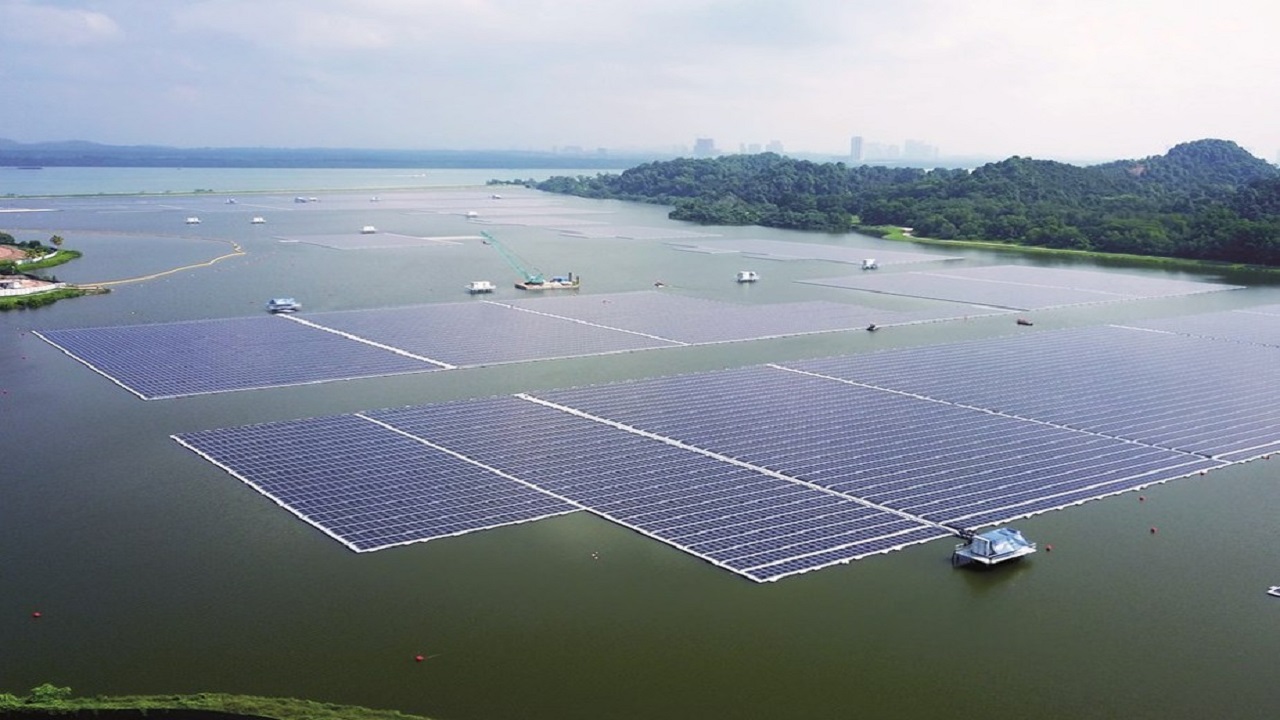

Due To Lack Of Land Space, Singapore Presented One Of The Largest Offshore Solar Power Plants In The World With More Than 120,000 Solar Panels Capable Of Generating 60 MW Of Energy
This Wednesday (14), Singapore presented one of the largest offshore solar power plants in the world, with a size equivalent to almost 45 football fields. A total of 122,000 solar panels were installed at the Tengeh reservoir. The panels will allow the production of enough electricity to supply five water treatment stations in Singapore.
Read Other Related News
An Offshore Solar Power Plant Capable Of Generating 60 MW
The available land area poses a significant challenge for the development of sustainable energy projects, such as solar energy. For this reason, the idea of installing plants offshore or in reservoirs arises.
This plant features more than 120,000 solar panels, can generate up to 60 megawatts of electricity, and will reduce CO2 emissions equivalent to 7,000 combustion vehicles on the streets, according to the Singapore Water Management Agency and Sembcorp Industries, partners in the project.
-
Giant Batteries Take Center Stage in Chile Auction as Company Offers 960 GWh of Solar Energy for Nighttime Use, Aiming to Stabilize Solar Power Supply

-
After a Year of Success in Switzerland, Solar Railway Attracts Italy’s Interest for Clean Energy Transformation
-
Robots Clean Solar Panels in Desert Power Plants Without Water, Preventing Energy Losses
-
Brazil’s Offshore Wind Energy Potential Worth $1 Trillion Stalled by Long-Delayed Agreement




Solar Panels Can Save Climate Change


Singapore has also installed solar power plants in the Johor Strait, which separates it from the Malaysian peninsula, and other onshore facilities. The city-state, which is threatened by rising water levels caused by climate change, is aware of the high need to reduce CO2 emissions, but expert observers consider the country’s efforts somewhat more restrained so far.
The Singapore government announced in February this year a “Green Plan,” which includes tree planting, increasing the number of charging stations for electric cars, and reducing the volume of waste sent to landfills.
Another government strategy is to quadruple solar energy production to achieve, by 2025, 2% of consumption, and by 2030, 3%, equivalent to the needs of 350,000 households per year.
Other Offshore Solar Power Plants
In April, Thailand inaugurated a new photovoltaic plant that has the capacity to generate enough energy to power a small city. The plant was inaugurated in June of this year and received initial investments of $27 million.
With the installation, Thailand increased its share in the renewable sector by 37%. It is estimated that by 2036, the country will increase its market share by an additional 37%. Each segment of the solar panels is about 130 meters long and 30 meters wide.







