Portuguese
  Spanish



Swiss startup Sun-Ways considers expansion to South Korea, Netherlands, China, India, and Singapore after positive results of solar panels installed between the tracks of an active railway
A railway line in the interior of Switzerland has completed a year operating as a small solar power plant, and the results have excited both the Swiss and neighboring Europeans. According to a report published by Euronews on July 5, 2026, the Swiss startup Sun-Ways has already signed a collaboration contract with an Italian business partner in direct contact with Rete Ferroviaria Italiana (RFI), the administrator of Italy’s national railway infrastructure. A pilot project in the country is expected to be announced in the coming months.
How the Swiss solar railway was born
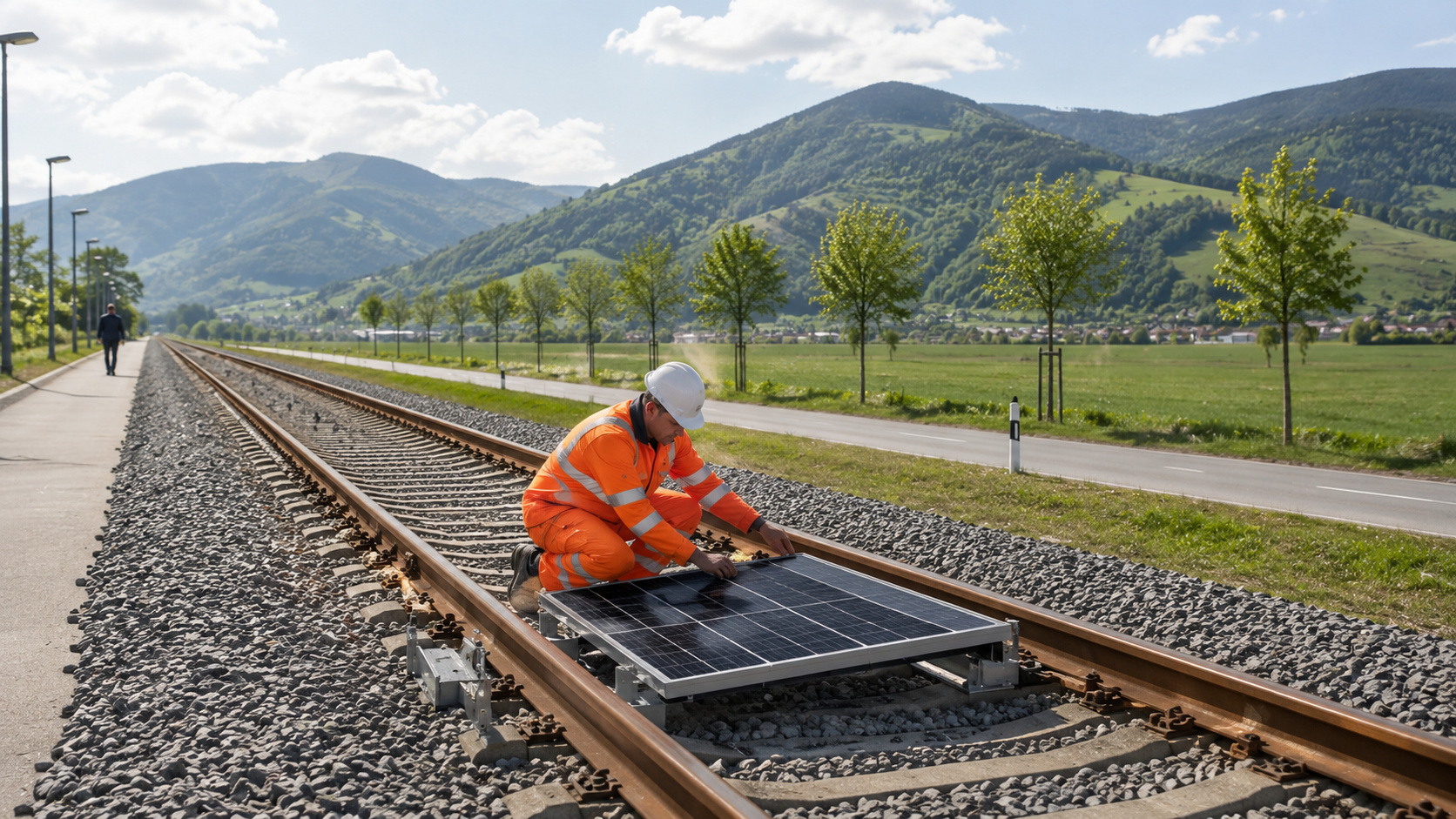
The story began in Buttes, a small village in the Val-de-Travers district, in the canton of Neuchâtel. On April 24, 2025, Sun-Ways inaugurated what it describes as the world’s first solar railway: 100 meters of photovoltaic panels installed between the tracks, on the sleepers, in a section where trains continue to run normally. In total, 48 specially designed panels add up to a combined power of 18 kWp. The project began as a three-year test authorized by the Swiss Federal Office of Transport, but the numbers from the first year have changed the plans.
Since May 20, 2025, the installation has already produced more than 16,000 kilowatt-hours of electricity, equivalent to the average annual consumption of three to four households, even facing about a month of downtime due to snow and integration works of a technical component. Given this performance, Sun-Ways and Swiss authorities are now considering advancing the final approval and making the system permanent even before the original three-year deadline.
-
Robots Clean Solar Panels in Desert Power Plants Without Water, Preventing Energy Losses

-
Brazil’s Offshore Wind Energy Potential Worth $1 Trillion Stalled by Long-Delayed Agreement

-
World’s Largest Engie Solar Plant in Brazil Highlights Billion-Dollar Energy Waste Issue: Company Considers Batteries and Bitcoin Mining to Avoid Wasting Production

-
Air Products Cancels $2.9 Billion Clean Hydrogen Megaproject in Louisiana, Shuts Down Arizona Unit, Highlighting High Costs of U.S. Energy Transition


Technical concerns and engineering solutions
Transforming tracks into sources of clean energy is no simple task. Before installation, the International Union of Railways had raised relevant concerns: the panels could suffer microcracks under the weight and vibration of trains, increase the risk of fires, or even distract drivers due to sun reflections. To overcome these risks, Sun-Ways developed panels more resistant than those used on residential roofs, equipped with an anti-reflective filter. Additionally, trains passing through the section are equipped with cylindrical brushes attached to the rear, responsible for removing dirt from the surface of the modules and maintaining energy generation efficiency.
So far, no incident related to blinding train drivers has been recorded, which reinforces the technical feasibility of the project. Meanwhile, the operation continues to be closely monitored by engineers and the Swiss innovation agency, Innosuisse, which financially supported the pilot alongside twelve other partner companies.
Italy, France, South Korea, and other countries eyeing the technology
International interest is growing at the same pace as the good results. According to Euronews, Sun-Ways has already received approval from South Korean authorities to install a similar system there, while negotiations are advancing with companies in the Netherlands, China, India, and Singapore. In Europe, the French railway company SNCF signed a cooperation agreement with the Swiss startup in February of this year, a move seen as strategic given the operator’s plan to cover 20% of its energy consumption with photovoltaic sources by 2030.
In the Italian case, the proximity to RFI is seen as favorable because the state company already plans to build solar plants near the tracks to power the country’s railway traction network. Thus, the arrival of Swiss technology could complement this strategy, combining transport infrastructure and distributed clean energy generation in a single corridor.
In terms of potential, the numbers are impressive. If applied to the entire Swiss railway network, of 5,317 kilometers, the technology could cover an area equivalent to 760 football fields, more than 50,000 times the size of the pilot section in Buttes. In this scenario, Sun-Ways estimates a generation of approximately 1 terawatt-hour (TWh) of electricity per year, equivalent to about 2% of the country’s total energy consumption. Even so, experts point out that the installation angle matters: in regions like Spain, for example, the ideal inclination to maximize panel efficiency is between 30° and 35°, according to a 2022 study published in the scientific database Science Direct, which indicated annual production losses of less than 1% with a 34° inclination on the Iberian Peninsula.
For now, the next chapter of this story is expected to be written on Italian soil, where negotiations between Sun-Ways and RFI are already at an advanced stage. If confirmed, the Italian pilot could become another step towards the consolidation of solar railways as part of the European energy infrastructure — uniting two sectors that, until recently, seemed to operate on completely separate tracks.
Original source: Euronews, “Italy could be the next country to build a solar railway after Switzerland’s successful trial”, published on July 5, 2026.