Portuguese
  Spanish


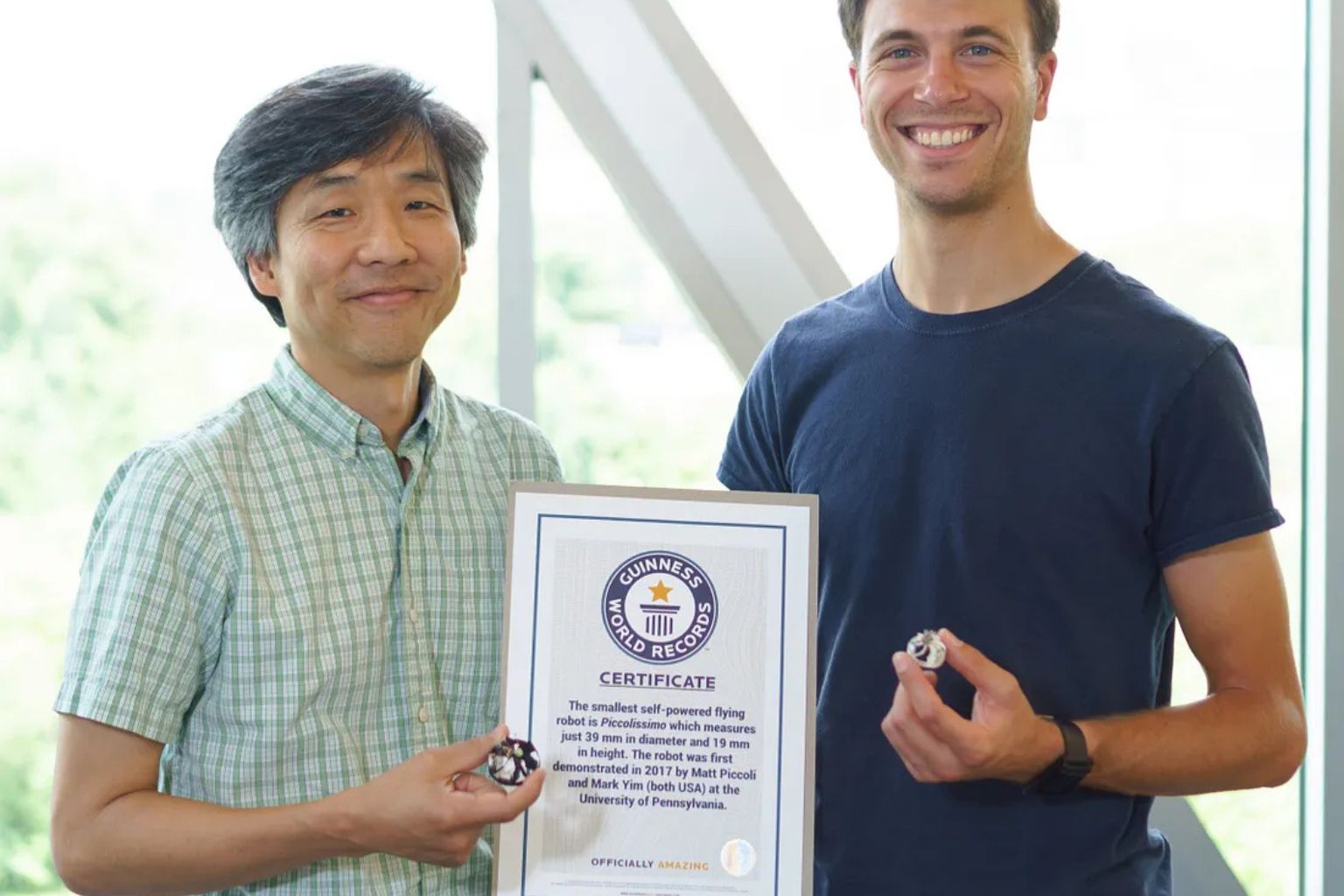


2.48 g flying robot enters the Guinness by using its own body to fly, redefining the limits of aerial robotics on a microscopic scale.
In 2016, researchers from the University of Pennsylvania, in the United States, presented the Piccolissimo, a flying microrobot created by Matt Piccoli, in Professor Mark Yim‘s ModLab, and announced by Penn Today on October 25 as the “smallest controllable and self-propelled flying vehicle in the world”. The project gained international attention for reducing flight architecture to an extreme scale: according to the Guinness World Records, the maneuverable model of the Piccolissimo was recorded on May 29, 2017 as the smallest self-propelled flying robot with steering capability, measuring 39 millimeters in diameter, 19 millimeters in height, and about 4.47 grams; the smaller version, called Mini Piccolissimo, has 28 millimeters in diameter and only 2.48 grams, but is not fully maneuverable, being controllable only in the vertical direction.
The relevance of the experiment lies not only in its size but in the unusual way flight is produced. Unlike conventional drones, which rely on multiple rotors and complex stabilization systems, the Piccolissimo has only two moving parts: the propeller and the 3D-printed body, which rotates in the opposite direction to the rotor. As the University of Pennsylvania detailed in August 2018, precisely timed speed changes, controlled by infrared signal, allow the microrobot to change direction, transforming a minimal structure into an aerial platform capable of paving the way for new research in microaviation, sub-aquatic robotics, and swarms of flying sensors.
The work was officially announced by the university and later validated by Guinness, reinforcing the reliability of the data and positioning the robot as a milestone in aerial microrobotics.
-
The Trap of Modern Technology: How Screen Overload and Digital Connections Can Impact Your Mental Health and Well-being

-
Wyoming Couple Grows Tropical Fruits Year-Round in -40°C Using Geothermal Greenhouse, Demonstrating Earth’s Heat Can Produce Oranges and Lemons in Snow Without Traditional Heating

-
Ship Returns from Brazilian Coast with Thirty Newly Discovered Life Forms
-
Nigerian Professor Invents Electricity-Free Refrigerator Using Clay Pots and Wet Sand, Extending Shelf Life of Vegetables to 27 Days; 7,000 Units Distributed in Energy-Deprived Villages



Engineering of the Piccolissimo reveals how a 2.48 g flying robot eliminates traditional structures and uses body rotation for stabilization
The most innovative point of the Piccolissimo lies in its mechanical architecture. In traditional drones, stability is achieved with multiple propellers, sensors, and electronic flight control systems. In the case of this microrobot, the engineers adopted an extremely simplified approach.
The device is basically composed of two main parts: a fixed central structure and an outer casing that rotates freely. While the propeller spins in one direction to generate lift, the outer body rotates in the opposite direction, balancing the torque generated by the motor.


This mechanism eliminates the need for complex compensation systems, such as multiple rotors or sophisticated gyroscopes. In practice, the robot itself stabilizes mechanically, reducing weight, energy consumption, and structural complexity.
This solution is particularly relevant at micro scale, where every milligram counts and where traditional systems simply cannot be miniaturized without significant loss of efficiency.
3D printing and extreme miniaturization allow the construction of a flying robot smaller than a coin with high structural precision
Another fundamental element for the existence of Piccolissimo is the use of 3D printing. The technology allowed for the manufacturing of extremely small and lightweight components, maintaining sufficient structural tolerances to ensure the operation of the rotating system.
Miniaturization is not just a matter of reducing size, but of maintaining functional integrity at scales where physical forces such as friction, vibration, and air resistance behave differently. In this context, 3D printing becomes an essential tool, as it enables complex geometries that would be unfeasible by traditional methods.
Structural precision was crucial for the robot to be able to rotate its own body without losing stability, something that at larger scales is trivial, but at millimeter scales becomes a significant challenge.

Moreover, the use of lightweight and durable materials helps keep the total weight at just 2.48 grams, an extremely low value even by microrobotics standards.
Physical challenges of microscale robotics make the flight of a 2.48-gram robot a relevant technical achievement
Flying at micro scale is much more complex than simply reducing the size of a conventional drone. At such small dimensions, forces such as air viscosity, turbulence, and aerodynamic drag have a disproportionate impact.
Additionally, the relationship between weight and power becomes critical. Motors need to be extremely lightweight, yet still capable of generating enough lift to get the robot off the ground. Any excess mass can completely hinder flight.

Another important challenge is the energy supply. In larger robots, batteries can be relatively large and heavy. In the case of Piccolissimo, the available space is extremely limited, which imposes severe restrictions on operating time and available power.
Even with these limitations, the robot is able to take flight and maintain basic stability, which in itself represents a significant advancement in the engineering of systems at a microscopic scale.
Guinness World Records recognition establishes Piccolissimo as a milestone in miniaturized aerial robotics
The recognition by Guinness World Records is not just a symbolic detail. It officially establishes Piccolissimo as one of the smallest self-propelled flying robots ever built, validating the project in an international context.

This type of record requires rigorous data verification, including weight, dimensions, and actual flight capability. Therefore, the certification reinforces that it is not a conceptual experiment, but a functional system that effectively performed controlled flight.
The validation by Guinness transforms the project into a global reference, being frequently cited in research on microrobotics, bioinspiration, and ultracompact systems engineering.
Future applications of flying microrobots include inspections in confined spaces and high-precision environmental monitoring
Although Piccolissimo is still in the experimental stage, the concept paves the way for various future applications. Extremely small robots can access environments where conventional drones cannot operate, such as pipelines, internal structures of machines, or hard-to-reach areas.
In the environmental field, microrobots could be used for air quality monitoring, microclimate analysis, or pollutant detection in specific locations. In medicine, even smaller versions could, in the future, be explored for internal applications, although this is still far from practical reality.
Another possibility involves the use in swarms of robots, where multiple units work in a coordinated manner to perform complex tasks. Miniaturization allows for multiplying the number of units without significantly increasing cost or operational impact.
Comparison between traditional drones and microrobots shows a break in the concept of flight and control on a reduced scale
The Piccolissimo represents a clear break from the traditional drone model. While quadcopters use multiple rotors and advanced electronic systems for stabilization, the microrobot relies on mechanical simplicity and direct physical solutions.
This difference is not just technical, but conceptual. Instead of replicating what already works on a large scale, the project is based on principles adapted to the micro scale, where the physics of flight requires completely different solutions.
This paradigm shift is one of the most relevant points of the project, as it indicates that the future of small-scale aerial robotics may follow paths distinct from current systems.
Current limitations of the Piccolissimo show that technology is still in the experimental phase and far from immediate commercial applications
Despite the technical advancement, the Piccolissimo still has significant limitations. Flight control is restricted, autonomy is limited, and payload capacity is practically nonexistent.
These factors indicate that the technology is still in its early stages and that there is a long way to go until commercial or industrial applications. However, this does not diminish the importance of the project as a proof of concept.
The value of the Piccolissimo lies in demonstrating that flight is possible on an extremely reduced scale, paving the way for future technological evolutions.
The future of aerial robotics on a microscopic scale may change the way machines interact with complex environments
The evolution of robots like the Piccolissimo suggests a future where increasingly smaller machines can operate in complex environments with high precision. As sensors, batteries, and control systems also evolve, the trend is for these devices to become more autonomous and efficient.
This type of technology could impact areas such as engineering, medicine, defense, environment, and space exploration, where the ability to operate on a micro scale could be a strategic differential.
The Piccolissimo is not just a size record, but an indication that robotics is advancing to dimensions where only biological organisms could previously operate.
Do you believe that robots smaller than a coin can replace traditional drones in certain applications in the future?
The advancement represented by the Piccolissimo raises a relevant question: to what extent can miniaturization transform the way we use robots in our daily lives? If machines weighing only 2.48 grams can already fly and stabilize themselves, the limit of what can be built still seems distant.
The debate about the large-scale use of these technologies involves not only engineering but also issues of control, regulation, and practical application. Nevertheless, the experiment makes it clear that the frontier of robotics is advancing into a territory where size ceases to be a limitation and becomes an advantage.