






 Portuguese
  Spanish


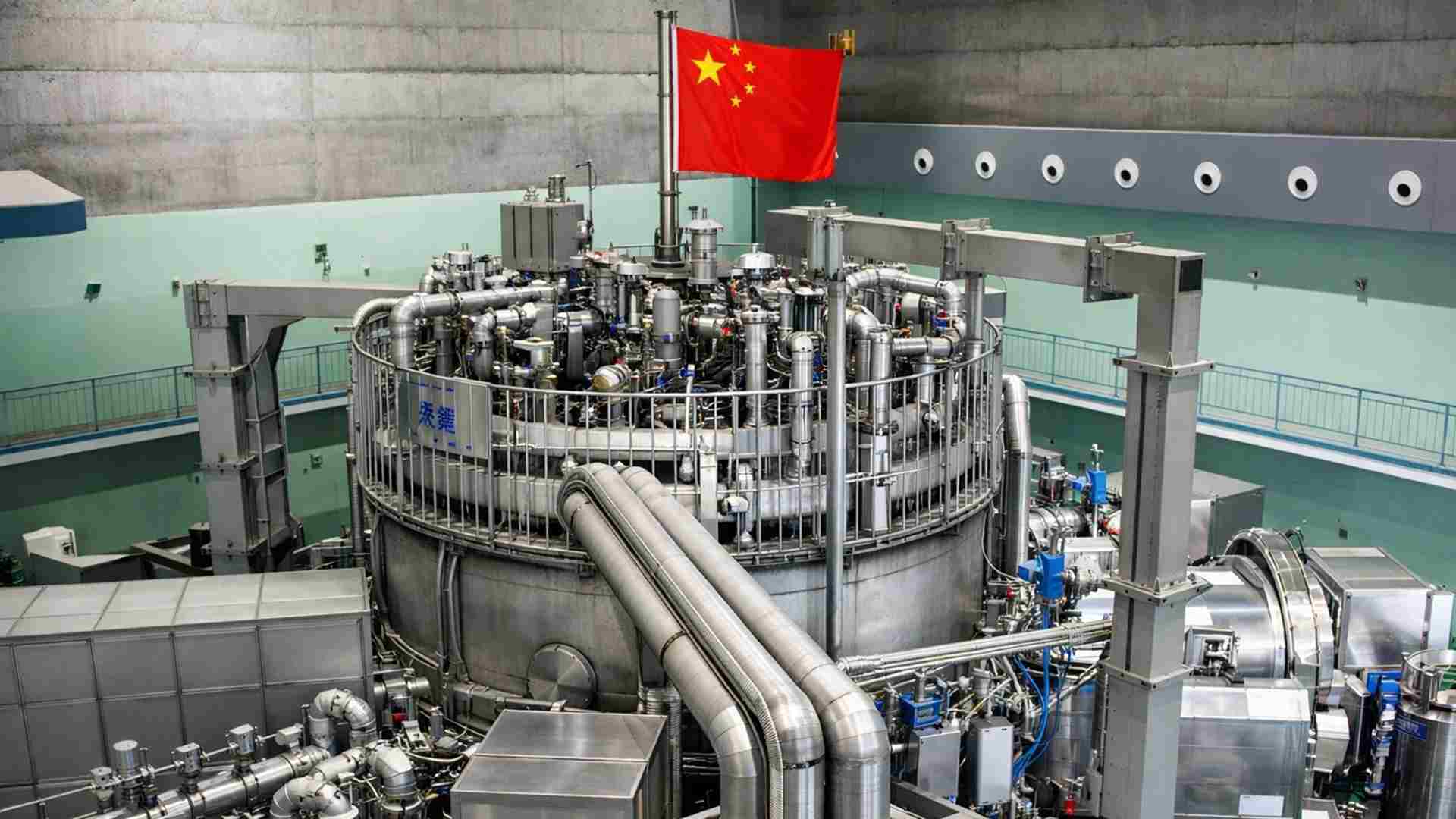


Experiment Conducted at the EAST Tokamak Maintained Stable Plasma at Densities of Up to 1.65 Times Above the Greenwald Limit, Result Published in January That Reinforces Scientific Advances After Decades of Research and Supports International Nuclear Fusion Projects
The Chinese nuclear fusion reactor known as “artificial sun” surpassed a critical limit by maintaining stable plasma at extreme densities, broadening the scientific basis of nuclear fusion and reinforcing international efforts that seek, in the long term, a clean and virtually limitless energy source.
The advance was achieved by the Advanced Experimental Superconducting Tokamak, the Advanced Experimental Superconducting Tokamak (EAST), which managed to sustain plasma beyond the traditional operational range of these devices. According to a statement from the Chinese Academy of Sciences, the experiment maintained the fourth state of matter stable even under conditions previously considered a central obstacle to controlled nuclear fusion.
The findings were detailed in a study published on January 1 in the journal Science Advances and indicate a path considered practical and scalable for increasing density limits in tokamaks and next-generation reactors. The work has as its lead co-author Ping Zhu, a professor at the University of Science and Technology of China.
-
China Develops Custom 140-Ton Electric Mining Truck with 770 kWh Swappable Battery, Deploys 290 Units in Xinjiang’s Largest Zinc Mine

-
Meta to Launch Arena, a New Prediction App Targeting 3.56 Billion Users, Competing with Polymarket and Kalshi

-
Scientist Challenges Famous Human Evolution Theory, Argues Homo Sapiens Evolved Gradually Over Thousands of Years
-
15-Year-Old American Builds Ocean Generator with PVC Pipe and 3D-Printed Propeller for $12, Wins National Prize, Presents at White House, and Makes Forbes 30 Under 30 List




Nuclear Fusion and the Potential for Long-Term Clean Energy
Nuclear fusion is often pointed out as a possible source of clean, virtually limitless energy, as it does not generate large volumes of nuclear waste or greenhouse gas emissions associated with fossil fuel burning. The process replicates, on a controlled scale, the reactions that occur inside the Sun, fusing light atoms into a heavier atom through extreme heat and pressure.
Despite this potential, the technology remains experimental. For over 70 years, fusion reactors have been developed without achieving self-sustaining ignition. Generally, these machines still consume more energy than they can produce, which limits their practical application at present.
Meanwhile, climate scientists advocate for immediate reductions in greenhouse gas emissions, in light of already observed impacts of climate change in different regions of the planet.
In this context, nuclear fusion is unlikely to become a solution to the current climate crisis, although it may play a significant role in the future global energy landscape.
How the EAST Tokamak Works and Plasma Confinement
The EAST is a magnetic confinement reactor of the tokamak type, designed to maintain plasma in continuous combustion for prolonged periods. The device heats the plasma to extremely high temperatures and traps it in a helical-shaped chamber using intense magnetic fields.
As the Sun has pressures far superior to those that can be replicated on Earth, scientists compensate for this difference by raising the plasma temperature well beyond solar levels. The central challenge is to maintain this hot plasma confined stably, avoiding energy losses and interruptions of the reaction.
Although tokamaks have not yet achieved ignition, EAST has been progressively increasing the time it sustains stable and highly confined plasma cycles. This progress is seen as an important step in the development of more efficient fusion reactors.
The Greenwald Limit and the Challenge of Extreme Density
One of the main obstacles to nuclear fusion is the so-called Greenwald Limit, a density limit beyond which plasma tends to become unstable. Higher densities are desirable because they increase the frequency of collisions between atoms, reducing the energy cost of ignition.
However, exceeding this limit typically leads to instability that interrupts the fusion reaction. In the Chinese experiment, researchers managed to maintain stable plasma at densities ranging from 1.3 to 1.65 times above the Greenwald Limit, surpassing the usual operational range of a tokamak, which varies from 0.8 to 1.
The control was achieved through careful management of the interaction between the plasma and the reactor walls. Two initial parameters were decisive: the pressure of the fuel gas and the cyclotron resonance heating of electrons, which adjusts the frequency of microwave absorption by the plasma electrons.
Density-Free Regime and Theoretical Foundations
By surpassing the traditional limit, EAST scientists managed to heat the plasma to a previously theorized state known as the “density-free regime.” In this regime, the plasma remains stable even with continuous increases in density, something never before demonstrated in this type of reactor.
The research is based on the theory of plasma-wall self-organization, or PWSO, which proposes the possibility of this regime when the interaction between the plasma and reactor walls reaches a carefully balanced equilibrium. According to the statement, this condition was achieved for the first time in EAST.
Although this is not the first time the Greenwald Limit has been surpassed, the result is distinguished by the stability obtained. In 2022, the DIII-D tokamak in the United States exceeded the limit, and in 2024, researchers from the University of Wisconsin-Madison reported stable plasma at about 10 times the limit using an experimental device.
International Impact and the Path to ITER
The advances achieved in EAST and other international experiments are expected to serve as a basis for the development of new fusion reactors. China and the United States are part of the International Thermonuclear Experimental Reactor (ITER) program, a collaboration among dozens of countries to construct the largest tokamak in the world, located in France.
ITER will also be an experimental reactor, designed to create sustained fusion at a scale relevant for research. Although it is not a commercial plant, the project is seen as a decisive step toward making future fusion power plants viable.
According to the current timeline, ITER is expected to begin producing real-scale fusion reactions in 2039. Until then, results like those obtained at EAST continue to be considered essential for reducing technical uncertainties and consolidating the knowledge needed for the next phase of nuclear fusion, even with significant challenges still to be overcome.







O ser humano é muito criativo e **** isso ainda vai dar uma grande ****
Em breve, o pendente não vai ser gerar energia, e sim resfriar o planeta.
A cada ano que passa, geramos mais calor do que o planeta consegue absorver.
As mudanças climáticas vão se intensificar ainda mais com o aumento do número de super data centers.
O consumo de água está aumentando vertiginosamente para resfriar esses equipamentos.
Não acho que a intervenção humana está mudando o planeta, por mim estamos passando por uma transição idêntica a todas que já aconteceram no mundo.
não acredito que temos esse potencial, os maiores controladores de temperatura na terra são os ciclos solares e os oceanos, cremos que causamos impactos isolados e alteramos micro climas que de forma alguma interfere no clima global, resumindo, somos uma cisco no palheiro