Portuguese
  Spanish


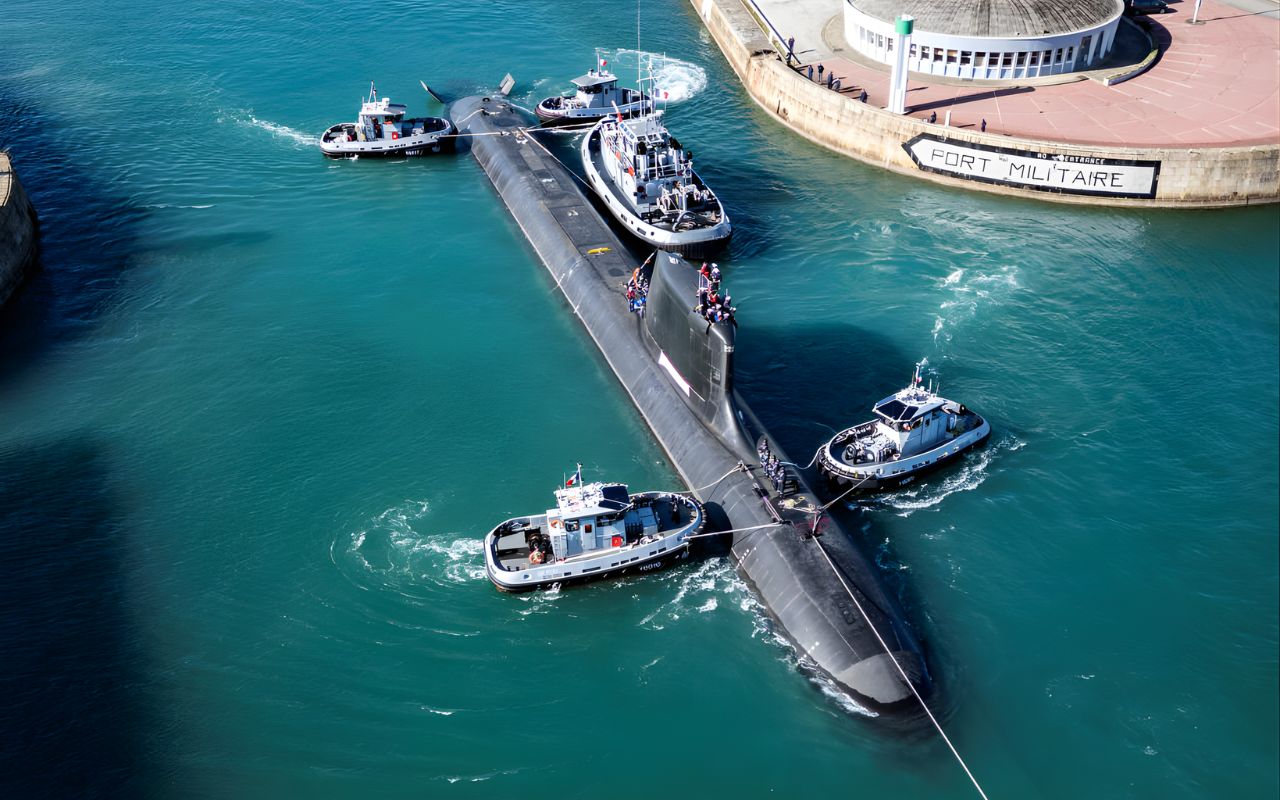


The Nuclear Submarine De Grasse Began Sea Trials in February 2026, After Reactor Activation in December, Strengthening the Barracuda Program and the Renewal of the French Fleet Until 2060.
The modernization of the French submarine force has gained a new chapter with the start of sea trials for the nuclear submarine, De Grasse, the fourth unit of the Barracuda class.
The vessel left the shipyard on February 24, 2026, to begin a series of operational evaluations in a real environment.
This stage represents a milestone within a strategic project that envisions six nuclear attack submarines, intended to gradually replace the old Rubis class, in service since the 1980s.
-
U.S. Military Intervention Risk in Brazil Raises Alarm, Highlights National Sovereignty Amid Tensions Over Washington’s Terrorist Designation of PCC and Comando Vermelho

-
Brazilian Air Force’s Sole KC-30 Aircraft Completes Strategic Mission to Spain for 105mm Anti-Tank Ammunition for Leopard 1A5 Tanks

-
Brazilian Air Force Seeks to Acquire More Gripen Fighter Jets
-
U.S. Air Force Launches Air-to-Air Missile Project with Range of Up to 1,850 km for Indo-Pacific Operations




Sea Trials Validate the Performance of the Nuclear Submarine
Even before thinking about official incorporation, each system of the De Grasse needs to undergo rigorous testing.
During the maritime campaign, navigation, propulsion, combat, safety, and structural performance systems are evaluated.
The goal is to confirm that the vessel meets the operational requirements of the French Navy. Only after this validation will the submarine be officially integrated into the fleet, a forecast that should materialize still in 2026.
The Reactor Activation Marked a Turning Point
Although the sea trials attract attention, one of the most sensitive moments in the schedule occurred in December 2025: the activation of the nuclear reactor.
The propulsion system of the nuclear submarine, De Grasse, uses a pressurized water reactor, technology similar to that used in the strategic submarines of the Triomphant class and the aircraft carrier Charles de Gaulle.
This stage confirmed that the energy core of the vessel was ready to operate.
Months earlier, in May 2025, the hull had been launched into the sea, initiating the final phase of system integration.

Industrial Structure Mobilizes Thousands of Professionals
Behind the progress of the De Grasse, there is a broad industrial mechanism.
The Barracuda program is led by the Directorate General for Armaments (DGA), with support from the French Atomic Energy and Alternative Energies Commission (CEA), responsible for nuclear oversight.
The Naval Group leads the construction of the units, as well as producing nuclear components in partnership with TechnicAtome.
Currently, about 2,500 professionals are directly involved in the program, with approximately 800 linked to subcontracted companies.
After delivery, the Naval Group will also be responsible for the maintenance and logistical support of the vessels in Toulon.
What Differentiates the Nuclear Submarine De Grasse?
The nuclear submarine, De Grasse, combines robust dimensions and high operational capacity. Measuring about 99 meters in length and displacing over 5,000 tons when submerged, the vessel is designed for long patrol missions.
Its propulsion integrates a nuclear reactor, a main turbine, two turbo-generators, and two electric motors.
This configuration allows for operation for over 270 days a year, reducing the need to return to base.

The crew consists of 63 military personnel, along with specialized commands. In the offensive field, the submarine can deploy naval cruise missiles (NCM), heavy F21 torpedoes guided by wire, and upgraded SM39 Exocet anti-ship missiles.
Furthermore, the project prioritizes stealth and the ability to infiltrate special forces, expanding the spectrum of strategic missions.
Strategic Renewal Until 2060
The Barracuda program has been structured to ensure French submarining capability for the coming decades.
With an estimated lifespan of over 30 years per unit, the new submarines are expected to remain in operation until at least 2060.
Currently, three units are already in service: Suffren (since June 2022), Duguay-Trouin (April 2024), and Tourville (July 2025). The last two — Rubis and Casabianca — are still under construction.
In this scenario, the start of sea trials for the nuclear submarine is not just a technical stage.
It is a strategic move that consolidates the transition to a new generation of nuclear submarines, reinforcing the French naval presence in an increasingly challenging global environment.
With information from Poder Naval