Portuguese
  Spanish


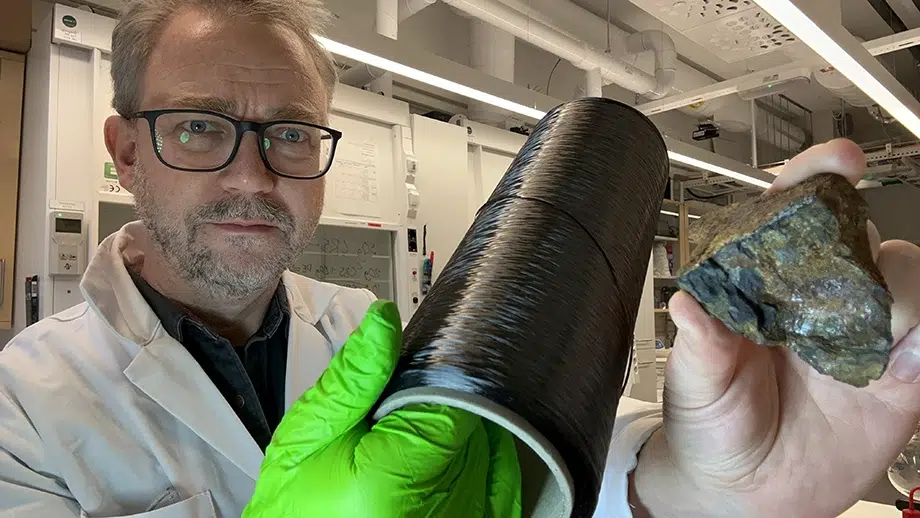

New Solution Developed in Sweden Utilizes Carbon Fibers to Create Lighter and More Sustainable Batteries, Reducing Environmental Impact and the Need for Mineral Extraction
Researchers from KTH Royal Institute of Technology in Sweden announced an important advance in the synthesis of sustainable nanomaterials. They created a scalable method to produce graphene oxide (GO) nanosheets from commercial carbon fibers. This approach represents a more eco-friendly alternative to traditional graphite mining.
Graphene oxide is a versatile nanomaterial with diverse applications, including in the electric vehicle sector. Professor Richard Olsson, the leader of the research, highlighted the importance of the innovation for the automotive industry. “The future of automobile manufacturing will be built with battery-based energy, and the question is where the graphite will come from? They will need alternatives,” he stated.
Carbon Fibers: An Alternative to Graphene Extracted from Graphite
GO is traditionally derived from extracted graphite, a process that involves harsh chemicals and can lead to inconsistencies in the quality of the final material. KTH scientists sought a solution to these problems using readily available carbon fibers as the base material.
-
Unprecedented achievement in India: a colossal 650-ton, nearly 3,000 hp excavator is transformed into 100% electric, marking a new phase in heavy mining.

-
Frightened by the speed of Chinese manufacturers, Renault decided to mimic the pace, made the new electric Twingo in just 21 months, wants to repeat the feat with 36 models by 2030, and along the way, will cut up to 2,400 engineering positions.

-
Chinese battery from Dongfeng promises to exceed 1,000 km without relying on liquid electrolyte, and the detail behind the technology could change the electric car competition.

-
The end of the automotive combustion era has already begun, but many in Brazil have not yet realized the magnitude of the shift towards Chinese electric cars.



The team managed to exfoliate the carbon fibers using nitric acid. This process generated high quantities of graphene oxide nanosheets, with properties similar to the material produced through mining.
The researchers used carbon fibers derived from polyacrylonitrile (PAN), a widely accessible polymer, suggesting that the method can be adapted to other sources, such as biomass and byproducts from the forestry industry.
Olsson explained that the functionality of graphite in batteries comes from the layered graphene within them, which can be obtained from commercial carbon fibers through this new technique.
Electrochemical Oxidation Process
The researchers’ innovative method uses electrochemical oxidation in a bath of water and nitric acid. During the process, an electric current is sent through the carbon fiber, causing the loss of electrons.
This effect transforms the surface of the material, allowing for the separation of graphene oxide layers on a nanoscale.
The team found that a 5% nitric acid solution is ideal for generating nanosheets ranging from 0.1 to 1 micrometer in size, with a uniform thickness of approximately 0.9 nanometer.
Additionally, the obtained nanosheets presented circular and elliptical shapes, contrasting with the polygonal shapes commonly found in GO extracted from graphite.
Efficient Production and Commercial Viability
The study indicated that the new method has a yield of 200 milligrams of GO per gram of carbon fiber. This efficient conversion rate makes the technique viable for large-scale production, addressing one of the main challenges in the synthesis of nanomaterials.
To analyze the structure and properties of the synthesized nanosheets, the scientists utilized advanced techniques, confirming the quality of the obtained material.
Effective methods were also developed to remove protective polymer coatings from the carbon fibers before oxidation. These processes included heating at 580 °C for two hours and shock heating at 1200 °C for three seconds, both demonstrating efficiency.
The researchers emphasized the importance of electrical conductivity within the fibers for the success of the electrochemical exfoliation. The next step will be to explore sources of biologically derived carbon fibers and deepen the studies on the mechanisms of the process.
The advancement represents a significant step in the sustainable production of advanced materials. The discovery could impact sectors such as energy, electronics, and transportation, providing an eco-friendly alternative to the use of mining-derived graphene.
With information from Interesting Engineering.