





 Portuguese
  English
  Spanish
  3 min of reading
  0 comments


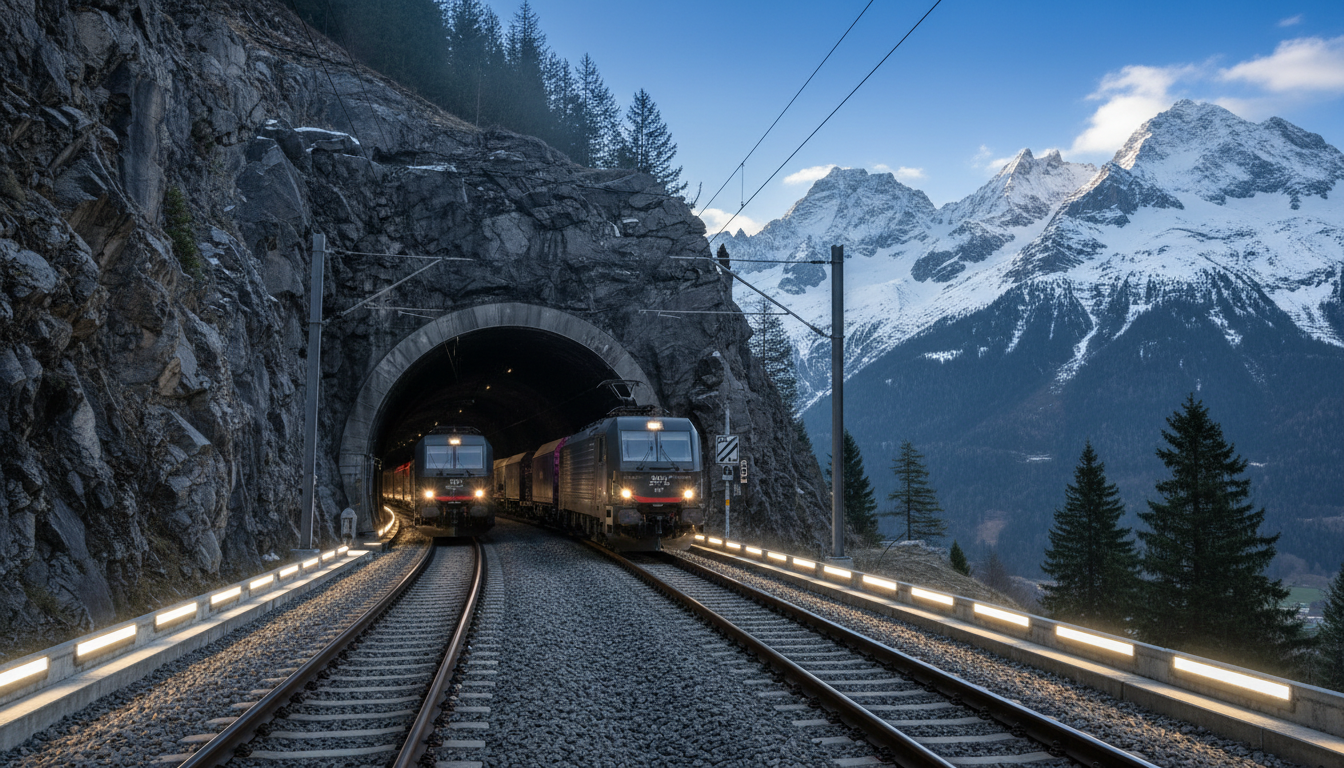
The largest railway tunnel network on the planet crosses the Swiss Alps with 2,000 km of underground tracks, including the Gotthard with a length of 57 km, and has already transferred 72% of freight transport to the rails
While most European countries are still trying to solve the problem of trucks on mountain roads, Switzerland has hidden more than 1,400 tunnels beneath the Alps and created a railway network that has changed the logistics of the continent.
The project, called the New Rail Link through the Alps (NRLA), took more than 14 years to build. Engineers extracted approximately 28 million tons of rock to clear a path.
The total investment exceeded $10 billion. This amount makes the Swiss underground network one of the most expensive infrastructure projects in European history.
-
Hong Kong built 1,800 housing units in just 12 months using prefabricated modules in China, while the same type of traditional public housing would take an average of 4.1 years. The United Court project was the first fully completed transitional housing in the city.

-
Goodbye common block: learn how to make manual bricks with 8 holes and dimensions of 10x19x19 cm using a wooden mold, 32 mm PVC, and a 4:1 mix to build spending much less and with a surprising finish.
-
20-foot container house is delivered ready in Bertioga with an elevated base against humidity, metal deck, tiled bathroom, ventilated bedroom, living room for a sofa bed, individual entrance, and electrical and plumbing installations prepared for compact accommodation on land near the beach on the São Paulo coast.

-
Santos has 319 leaning buildings constructed on former mangroves filled in between the 1950s and 1970s with foundations that never reached solid ground, and now the city government is negotiating with BNDES for a multimillion-dollar solution to straighten the buildings.



Currently, 72% of freight transport in the Alps already occurs by rail. In addition, the number of trucks on the roads has decreased by approximately 33%.
Gotthard Base Tunnel: 57 km under the mountains that trains traverse in just 20 minutes
The main highlight of the network is the Gotthard Base Tunnel, which is 57 kilometers long. Inaugurated in 2016, it is the largest railway tunnel in the world.
Freight trains cross the Alps in approximately 20 minutes. Previously, the same crossing required hours on winding roads.

The underground railway crosses the Alpine massif at depths of up to 2.3 kilometers. This structure eliminates climbs and descents, creating a flat passage for trains.
Before the tunnels, more than 650,000 trucks per year needed to cross the Gotthard Pass. Daily, 3,000 heavy vehicles crossed the Alps.
As reported by Terra Brasil Notícias, the project was created to reduce the impact of heavy traffic on alpine highways.
The 33% reduction in trucks improved air quality and preserved the alpine landscapes
The decrease in the number of trucks has significantly improved air quality in the mountains. Noise pollution has also decreased on the roads.

The natural landscapes of the region, known as some of the most beautiful in the world, have been less impacted by heavy vehicle traffic.
The legal foundation of the project dates back to a law passed in 1990, called the Alpine Initiative. This legislation mandated the reduction of road traffic in the Alps.
Other megaprojects like the Lower Thames Crossing in the United Kingdom follow the same principle of transferring traffic to underground routes.
The next step: 500 km of tunnels with autonomous capsules transporting goods
In addition to the NRLA, Switzerland is developing Cargo Sous Terrain. It is a network of 500 kilometers of tunnels for goods connecting cities with autonomous capsules.
The system would function like a “hidden conveyor belt under the entire country.” It would be an evolution of the underground logistics already tested in the Alps.

China is also investing in megaprojects, but focusing on bridges and surface railways, not underground ones.
According to Correio do Estado, cost data varies between $10 billion and $12 billion depending on the scope. Data on CO2 avoided has not been quantified in official sources.
However, the transfer of 72% of goods to rail represents a significant reduction in emissions. The Swiss experience proves that investing in underground infrastructure solves logistics, pollution, and environmental preservation all at once.








Be the first to react!