Portuguese
  Spanish


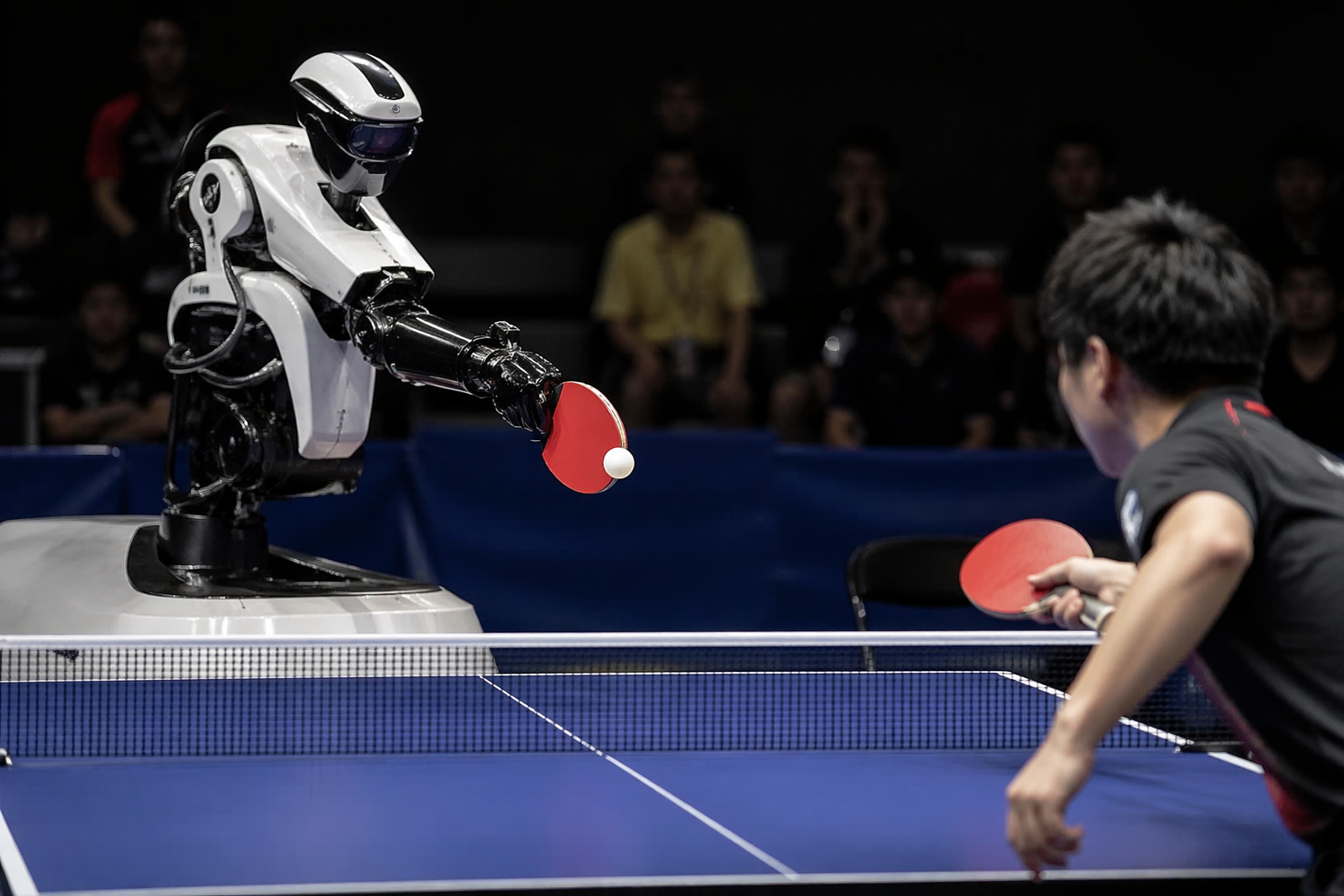

Autonomous system Ace surpasses high-level players and marks a significant technical advance in the integration between AI and competitive physical sports
A table tennis robot with artificial intelligence, named Ace, marks a relevant advance in sports robotics.
The experiment takes place in Tokyo, Japan, where the system faces high-level human athletes.
The performance draws attention for combining quick decisions, technical precision, and real-time adaptation.
-
NASA Rover Captures “Tired Face” on Mars, Highlighting Human Brain’s Tendency to See Faces in Rock Formations

-
Ancient Stone City in the Desert, Once Home to 30,000, Puzzles Scientists with Nabateans’ Water Mastery 2,000 Years Ago

-
Ancient Creature Thought Extinct Since Dinosaur Era Reappears, Baffling Scientists
-
India Deploys Giant Fabric Tubes Filled with Sand to Combat Coastal Erosion and Rebuild Disappearing Beaches





Technical advance places robot at the level of human athletes
The Ace robot wins three out of five matches against elite players in April 2025.
The system also loses two matches against professionals, considered the highest level of the sport.
The matches follow the official rules of the International Table Tennis Federation, with licensed refereeing.
Researchers publish the results in a study published in April 22, 2025, in the scientific journal Nature.
The performance consolidates a consistent advance of artificial intelligence applied to competitive sports.


Advanced technology enables high-level performance
The research division of a Japanese electronics company develops Ace.
The robot utilizes high-speed perception, capable of identifying movements in fractions of a second.
The system applies AI-based control, which adjusts strategies during matches.
The project integrates a state-of-the-art robotic mechanism, responsible for the precise execution of strokes.
This technological combination allows the system to reach a level comparable to that of human experts.

Evolution of robots in table tennis changes historical landscape
Engineers have been developing ping-pong robots since 1983.
These systems have not been able to compete evenly with skilled players until now.
The emergence of Ace represents a significant change in the performance of these machines.
The robot operates in real matches, following official rules and with professional supervision.
The advance demonstrates a consistent evolution in the application of robotics in physical sports.
Global context reinforces the advance of competitive robotics
Companies around the world are increasing investments in advanced robotic technologies.
On April 19, 2025, robots surpass human runners in a half marathon held in Beijing.
The scenario indicates that machines are achieving competitive performance in complex physical activities.
The case of Ace integrates a global movement of technological evolution in the sector.
The evolution of artificial intelligence raises a relevant question: how far will robots be able to compete with humans in sports in the future