Portuguese
  Spanish


At the Port of Santos, Ibama authorized rock removal without explosives and preparatory dredging in the navigation channel, with the removal of 12,000 m³ of sediments, reuse of rocks, and specific pauses for vessels between July and October, in a stage that prepares Brazil’s largest port to receive larger ships in the estuary.
The Port of Santos received environmental authorization to begin a decisive stage in the navigation channel: the removal of three rock formations that have been limiting the progress of conventional dredging. The license was granted by Ibama to APS, Santos Port Authority, and the intervention is scheduled to occur between July and October, in the Santos estuary.
The information comes from Agência iNFRA, in a publication dated 06/16/2026, at 7:02 PM. According to the investigation, the work targets three specific points in the channel, Pedra do Barroso, Pedra do Itapema, and Pedra do Teffé, and is part of the preparation for deepening the route used by vessels in Brazil’s largest port.
Three rock formations were in the way of dredging
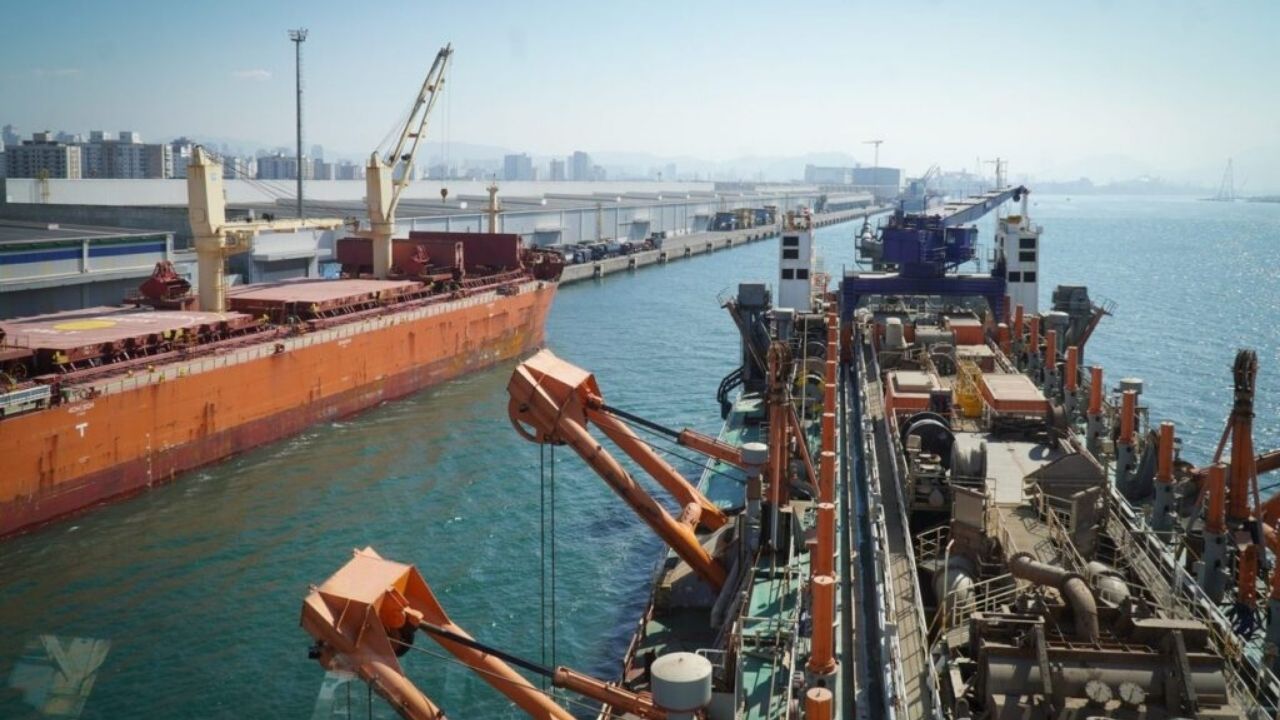
The project draws attention because it does not only involve the removal of sediments from the channel’s bottom. Before proceeding with conventional dredging, it will be necessary to remove rock sections that hinder the deepening of navigation in the Port of Santos. These rocks acted as physical obstacles at strategic points in the estuary.
-
Mexico Develops 3D-Printed Concrete from Corn Waste, Cutting Emissions by 70% and Reducing Construction Waste by 90%

-
Traditional Mortar to Decline by 2026: ACIII-E Solution for Large Porcelain Tiles Offers Better Adhesion and Reduces Risk of Loose Pieces in Floors and Facades

-
72-Year-Old Man Spends Six Years Building a Rotating House for His Wife, Completing a Full Turn in 22 Seconds
-
Chinese Residential Building Surrounded by Circular Overpass After Residents Reject Compensation



The formations are located in areas known as Pedra do Barroso, Pedra do Itapema, and Pedra do Teffé. Their removal is considered a preparatory stage because it creates space for the channel to be deepened more safely and efficiently in later phases.
Removal will be done without explosives at the Port of Santos
The technique chosen for the service is called cold breaking. In practice, the method involves the mechanical fragmentation of rocks without the use of explosives, followed by the removal of the material by dredging equipment. The choice reduces operational impact and avoids a more aggressive intervention in the channel.
In the Port of Santos, this type of procedure requires strict control because it occurs in a busy navigation area. Therefore, the operation must follow safety protocols and include environmental monitoring during the execution of the authorized services.
Before the rocks, 12,000 m³ of sediments will be removed
The license also provides for the removal of about 12,000 m³ of accumulated sediments in the channel. This material will be removed before the breaking stage and sent to an authorized ocean disposal area, as informed by APS.
This point is important because it shows that the intervention is not limited to the rocks. The channel needs to undergo preparatory cleaning before the removal of rock formations, creating the necessary conditions for the planned deepening work for the Port of Santos.
Rocks may be reused in public works
Another relevant detail is the destination of the removed material. While the sediments will have authorized ocean disposal, the fragmented rocks may be reused in public works. This prevents part of the material from being treated only as waste from the operation.
The reuse, however, depends on the logistics and destination defined by the responsible authorities. Even so, the possibility reinforces the strategic nature of the intervention: what currently hinders the advancement of dredging can become input for other works.
Vessel traffic may have occasional pauses
During the execution of the services, vessel traffic may experience occasional interruptions in the affected sections. The measure should occur locally, according to the needs of the operation and navigation safety protocols.
In the case of the Port of Santos, any pause draws attention due to the weight of the port complex in the Brazilian economy. Even so, the forecast is for occasional interruptions, not a widespread stoppage, as the intervention will be carried out in specific areas of the channel.
Deepening prepares the channel for larger ships
The removal of rocks and sediments paves the way for the deepening of the navigation channel. This type of work is essential to expand the operational capacity of ports that receive large vessels, especially on increasingly demanding cargo routes.
In Port of Santos, the expectation is that the intervention will help create better conditions for larger ships. The change does not happen all at once, but begins in stages invisible to the public, such as the removal of submerged obstacles that limit the channel’s depth.
What changes in the Port of Santos channel by October
The Ibama license marks an important stage for the Port of Santos, as it allows the removal of three rock formations that prevented the advancement of conventional dredging. Without explosives, with the prior removal of 12,000 m³ of sediments and the possibility of reusing the rocks, the work prepares the channel for a new phase of deepening.
Now, the question is to monitor how the intervention will be executed by October and what practical impacts it will have on port routine. Do you think works like this justify occasional pauses in vessel traffic or does the operational risk still concern you? Leave your opinion in the comments.