Portuguese
  Spanish



DNIT Adopts An Innovative Method With Seed Muvuca at BR-285’s PRAD in São José dos Ausentes (RS) to Restore Vegetation and Stimulate Natural Regeneration.
Since May 2025, the National Department of Transport Infrastructure (DNIT) has been executing an innovative method for environmental recovery along the construction fronts of BR-285 in São José dos Ausentes (RS).
The action is part of the Degraded Areas Recovery and Environmental Liabilities Program (PRAD) and uses seeds and organic soil from the vicinity of the highway.
The goal is to restore the vegetative cover and stimulate natural regeneration in areas impacted by infrastructure interventions.
-
Humanoid Robots Begin Replacing Factory Workers in China, Working 64-Hour Shifts and Driving Industrial Automation Forward

-
Miniature Nuclear Reactor to Be Installed in South Wales, Powering 20,000 Homes and Reviving UK’s Nuclear Industry After Nearly 50 Years

-
San Andreas Fault Reaches “Highest Tension in 1,000 Years,” Raising Fears of the “Big One,” but New Study Identifies Key Zone Near Los Angeles Influencing Earthquake Impact

-
French Scientists Set Sail on Ice-Trapped Ship for 18-Month Arctic Climate Study



The initiative is taking place in the Campos de Cima da Serra, a region that requires environmentally adapted solutions.
Monitoring Assesses Effectiveness of the Innovative Method Adopted by DNIT
The treated areas undergo continuous technical monitoring. Indicators such as seedling establishment, soil cover, and dynamics of spontaneous species are analyzed.
This process allows for the evaluation of results over the medium and long term. Thus, the performance of the innovative method can be measured based on ecological parameters.
During a recent inspection, the Brazilian Institute of Environment and Renewable Natural Resources (Ibama) assessed the application of the technique.
The agency pointed out that the collection and sowing yielded promising results.
Moreover, it recommended the continuation of the practice. It also suggested increasing the number of species used.
What Characterizes the Innovative Method Adopted by DNIT?
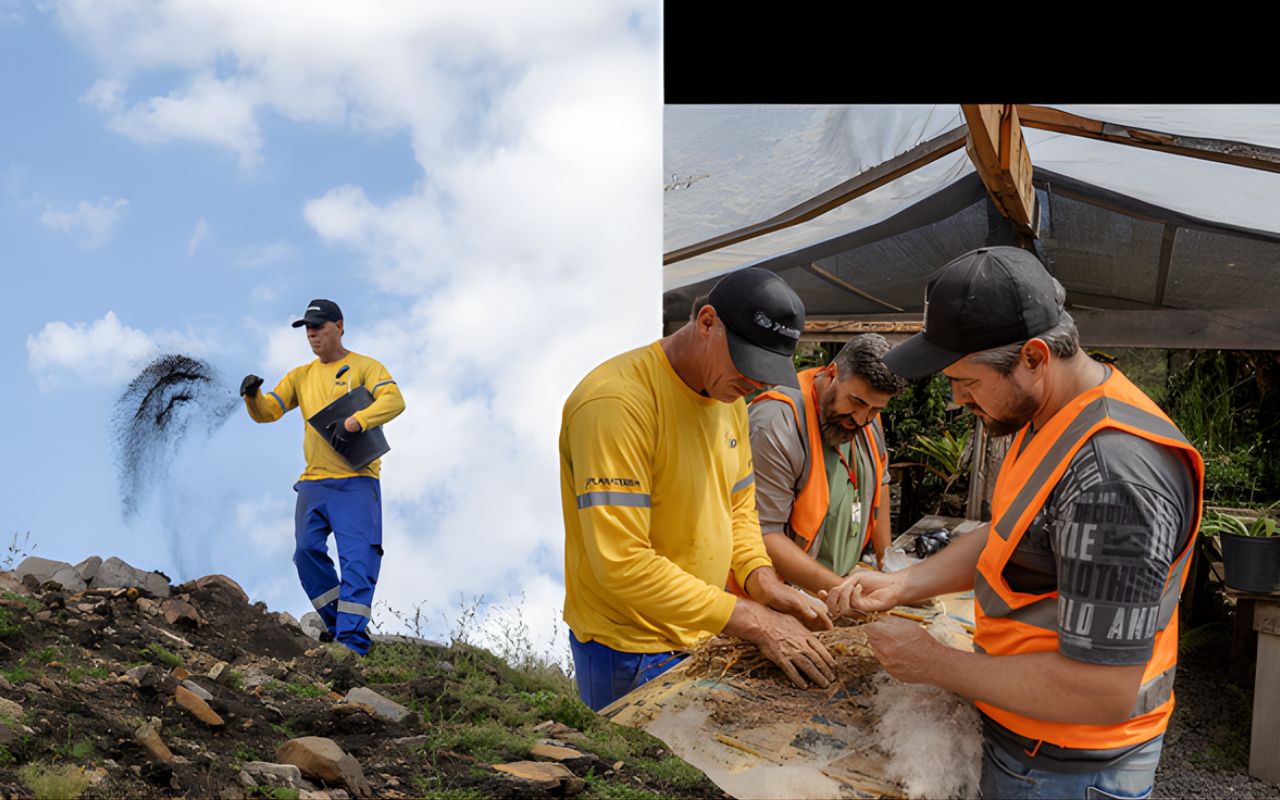
The innovative method is based on the seed muvuca technique. The methodology consists of distributing a diverse mixture of native seeds from different species.
The application can occur manually, by broadcasting, or mechanically. The choice depends on the field conditions and the construction logistics.
How Are the Seeds Prepared?
The process begins with collecting native seeds in the field. Then, the material undergoes careful selection.
After that, preparation occurs on the benches of the botanical nursery’s greenhouse. This stage ensures greater quality and genetic diversity in the mix.
The technique is recognized for its ecological efficiency. At the same time, it offers operational feasibility in large-scale projects.
Another advantage is its potential for cost reduction. Therefore, the innovative method emerges as a strategic complement to conventional approaches.
Although innovative, the muvuca does not act in isolation. DNIT maintains techniques widely used in environmental restoration.
Among them are hydroseeding and containment. Thus, the innovative method expands the range of available solutions.
Ancestral Roots Inspire the Innovative Method
The seed muvuca has origins in ancestral and indigenous practices. Initially, it was revived in forested areas of the Amazônia, Cerrado, and Mata Atlântica.
More recently, it has been applied in open environments. Today, it is also used in the recovery of degraded agricultural areas.
According to biologist Marcel Tust, “what has been done is experimentation with adaptations of what is being developed in the Pampa, for example, to the reality of the work”.
Why Apply the Innovative Method in the Campos de Cima da Serra?
The region presents challenging environmental conditions. High altitude, harsh climate, and specific soils influence plant regeneration.
In this context, the innovative method favors adapted native species. Thus, vegetative recomposition tends to be more sustainable.
Innovative Method Dialogues with Global Agenda
The initiative also connects to the international debate on environmental restoration. The project follows the principles of the United Nations Decade on Ecosystem Restoration (2021–2030).
The program aims to prevent, halt, and reverse ecosystem degradation. Therefore, the use of an innovative method reinforces practices aligned with sustainability.
By incorporating an innovative method into the BR-285 PRAD, DNIT expands environmental recovery strategies in road works.
The seed muvuca combines scientific knowledge, ecological efficiency, and inspiration from ancestral practices.
Although definitive success depends on continuous monitoring, initial results and the positive assessment from Ibama indicate a promising alternative for restoring degraded areas in Brazil.
Source: GOV