Portuguese
  Spanish




New Synthesis Process Developed in South Korea Promises to Transform Diamond Production with Application in Technology and Industry
A group of scientists made a remarkable discovery by developing a technique that allows to create diamonds from scratch in just 15 minutes, without the need for a starting gem and under normal atmospheric pressure. This innovation could revolutionize diamond production, making it easier and faster to grow in the lab, according to the website Megacurioso.
Natural Process vs. New Technology Created in South Korea
Naturally, diamonds are formed in the Earth’s mantle, where extreme pressure and temperatures over 1,500 °C are required. Until recently, lab diamond synthesis tried to replicate these conditions through methods like high pressure and high temperature (HPHT), which requires complex equipment to generate these extreme conditions. Another method, chemical vapor deposition, eliminates the need for high pressure but still requires a “seed” diamond to start the process.
The Innovation of South Korean Researchers
Researchers from the Basic Science Institute of South Korea, led by Rodney Ruoff, developed a new technology that significantly simplifies the diamond synthesis process. After more than a decade of research, the team managed to create diamonds in a chamber maintained at sea level atmospheric pressure, using electrically heated gallium and a little silicon inside a graphite container.
-
A fossil kept for years in a small museum in Montreal concealed 450-million-year-old soft tissue, a discovery that has only happened once before in history.

-
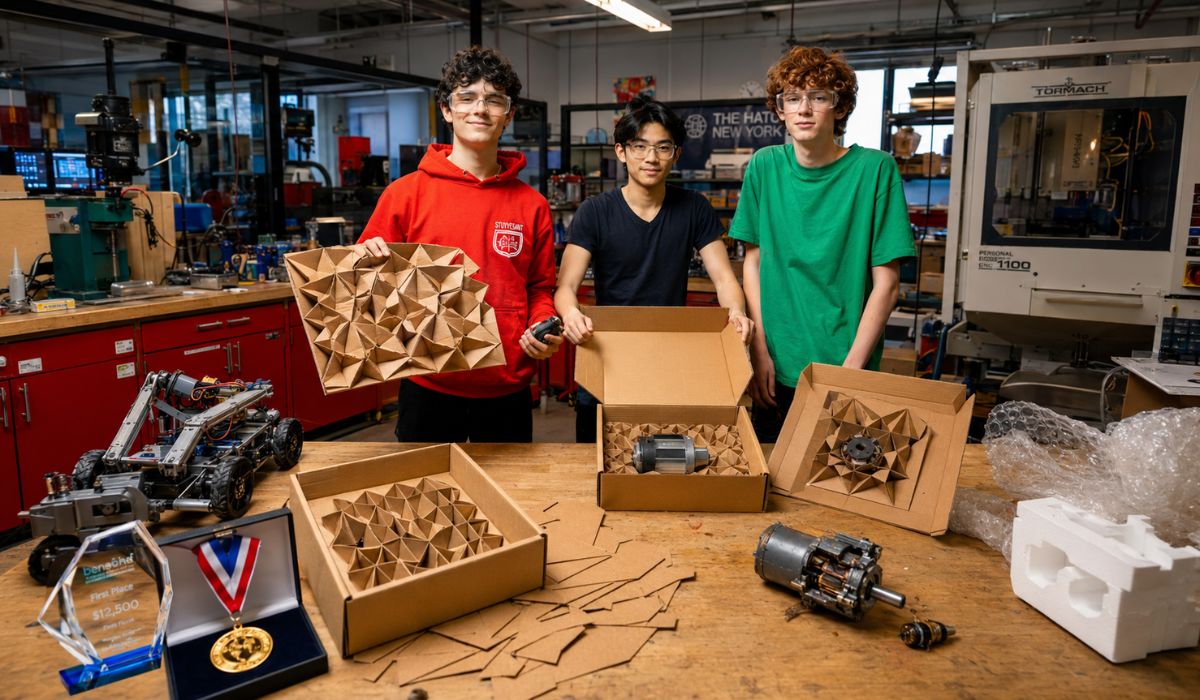
Three teenagers transform cut cardboard into Japanese origami-style packaging that promises to retire styrofoam and bubble wrap, win a $12,500 prize, and target giants like Amazon, FedEx, and Home Depot after a robot motor arrived broken.

-
The large jar blender has a rival: Oster Ultra Power bets on 1,000 W, six stainless steel blades, and two portable cups with leak-proof lids.

-
Tesla injected an additional $250 million into the German factory, doubled the battery cell target, and opened its own production line for startups.



How the New Technique Works to Create Diamonds from Scratch
To initiate the synthesis, South Korean scientists heated gallium electrically, added silicon, and used a graphite container. Gallium was chosen for its ability to catalyze the formation of graphene from methane. By releasing superheated, carbon-rich methane gas into the chamber, a reaction was triggered, resulting in the formation of diamonds.
The chamber used has 9 liters and can be prepared in just 15 minutes. Through adjustments, the researchers determined that a mixture of gallium, nickel, and iron was ideal for catalyzing diamond growth. In experiments that lasted two and a half hours, the first diamonds created with the technology were formed.
Challenges and Future Applications
Although this new technology produces significantly smaller diamonds than those created by traditional HPHT methods, it offers great advantages in terms of simplicity and speed. The diamonds produced are hundreds of thousands of times smaller than those used in jewelry but may have important technological applications, such as in polishing and drilling.
Scientists also discovered that using small amounts of silicon can act as a seed, helping carbon crystallize more quickly.