Portuguese
  Spanish




New Technologies Transform Construction Projects into Fast and Accurate Processes, with Installation in Minutes, Less Labor, and High Structural Performance
The cold appearance of concrete is starting to make way for solutions that combine advanced engineering, speed, and efficiency. Modern systems cease to be mere coverings and instead act as structural protection, eliminating time-consuming steps and drastically reducing time on the construction site.
These technologies replace traditional processes with panels, blocks, and modules manufactured in a controlled environment, ready for immediate installation. The impact is direct on productivity, safety, and final quality, with fewer errors and less physical effort.
The advancement reaches everything from facades and retaining walls to floors, walls, complete structures, and housing modules. The construction industry enters a phase marked by industrial precision, automation, and accelerated execution.
-
Giant Robots Build Entire Neighborhood of 100 3D-Printed Homes in the U.S., Showcasing Technology’s Impact on Construction Industry

-
Helsinki Residents Receive Water That Travels 120 Kilometers Through a Hidden Rock Tunnel from a Lake Before Treatment

-
Brazil’s Sertão Region Nears Completion of Latin America’s Longest Artificial River, Transforming Water Access in Drought-Prone Ceará
-
Pre-mixed stabilized mortar set to revolutionize construction in 2026: extends usability to 36 or 72 hours, boosts productivity, and minimizes waste in building projects.



Facade Panels Eliminate the Need for Mortar and Speed Up Installation

Facade systems no longer rely on mortar, scaffolding, and long curing times. The panels are precisely prepared in the factory and arrive ready at the construction site, being fixed directly to the structure in a few minutes.
The combination of real brick resistance with modern engineering creates an outer layer that protects and reinforces the building. The process reduces interruptions on-site, minimizes rework, and ensures a uniform finish from the first fit.
In addition to speed, the method enhances site organization and reduces workers’ exposure to common risks of traditional masonry.
Retaining Walls Stand by Geometry, Without the Use of Mortar

Some containment systems completely eliminate the use of mortar, even with extremely heavy concrete blocks. Each piece mechanically fits into the previous one, forming a structure that stands by the geometry of the set, not just by weight.
This type of wall acts as a soil anchorage, supporting large loads with high stability. The absence of mortar reduces execution errors and speeds up the assembly process on-site.
The result is a robust, durable, and highly predictable solution, ideal for terrain with high structural demands.
Accelerated Execution Demands Extreme Precision and Memorized Movements
In many of these methods, the speed of execution is impressive, with tasks performed in seconds. The critical factor shifts from physical strength to reflex, coordination, and precise repetition of movements.
Each stage is exhaustively trained, with minimal tolerance for errors. The pieces are cut, adjusted, positioned, and fixed in a continuous sequence, avoiding breaks and later corrections.
This approach reduces accumulated errors and ensures uniformity in the final result, even in complex applications.
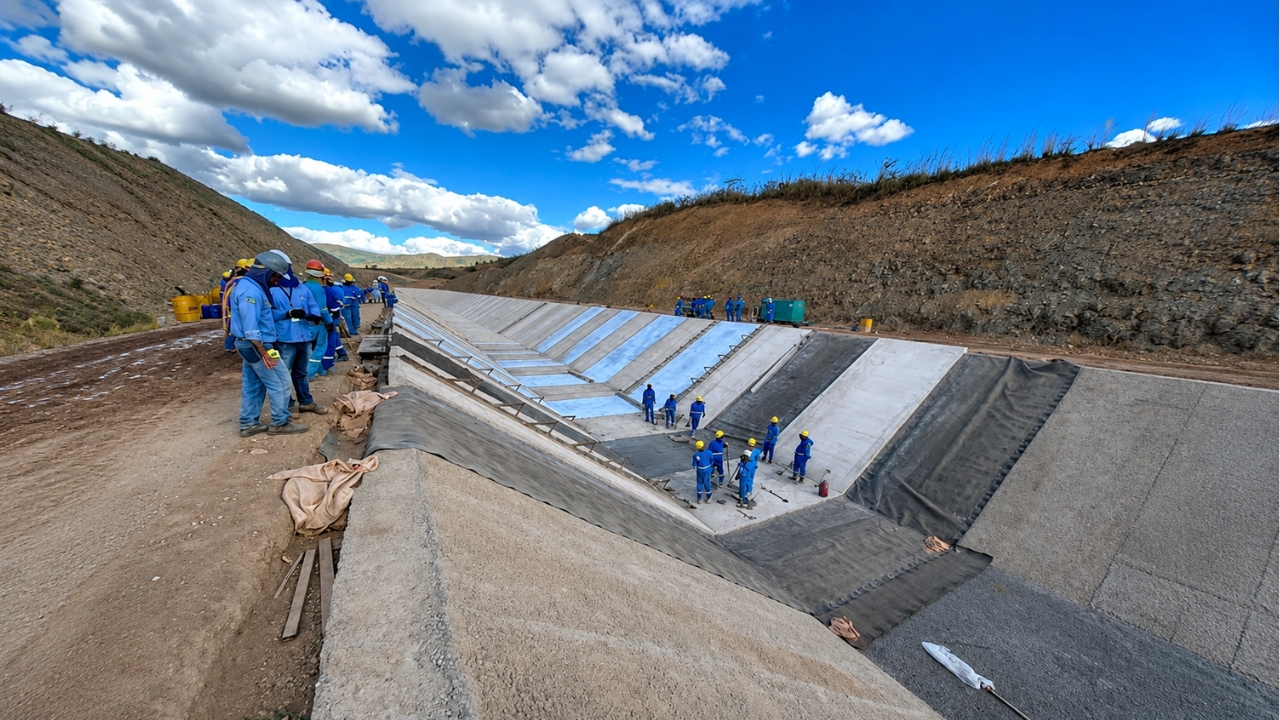
Floor Protection Systems Create a Barrier Against Moisture and Impact

Some techniques utilize flexible membranes applied directly over the floor before covering. The material is rolled out, overlapped at joints, and quickly covers large areas, creating a continuous protective layer.
The main advantage lies in the resistance to moisture and impacts, preserving the base and increasing the durability of the finish. The quick application reduces waiting time between construction stages.
This type of solution minimizes future problems, such as leaks and damage from intense use.
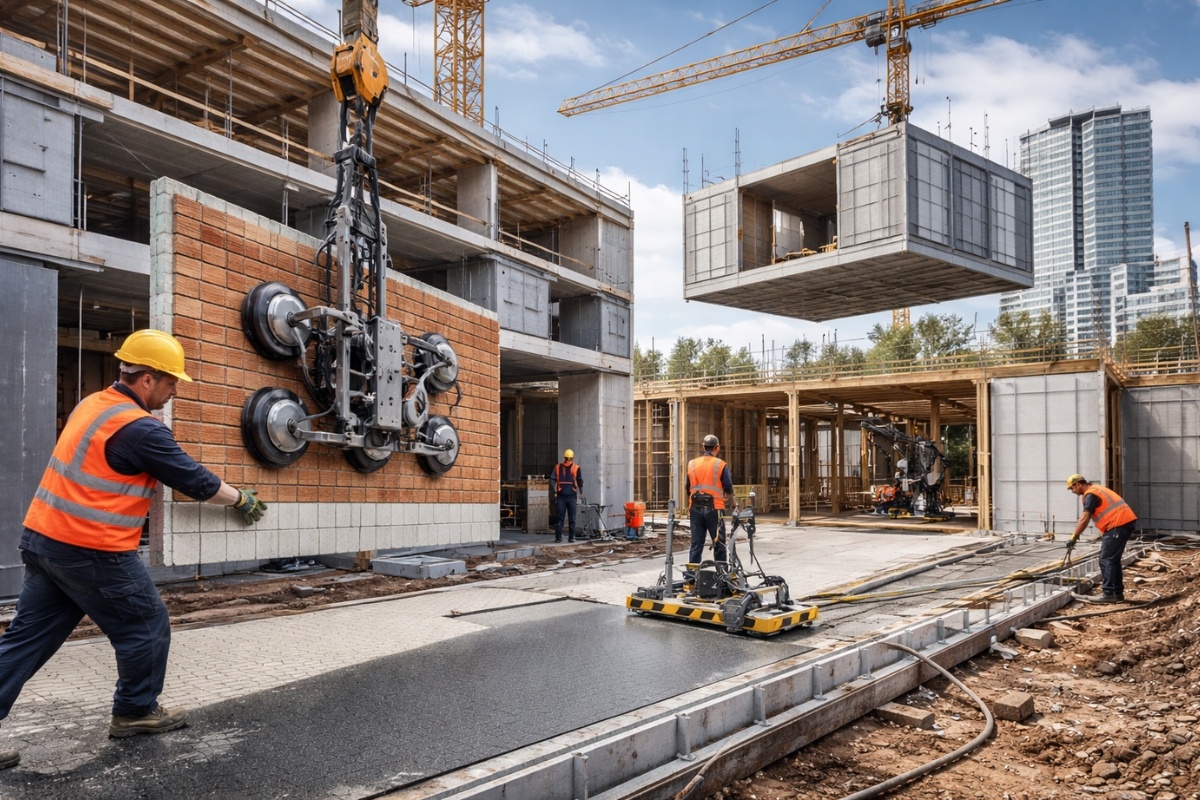
Vacuum Suction Cups Allow Individual Installation of Heavy Panels

Vacuum suction equipment allows a single person to lift and position large panels. The method eliminates the need for large teams and reduces physical effort during installation.
The use of these tools speeds up the application of drywall, wood panels, and large-format coverings. The risk of breakage, cracking, and workplace accidents drops significantly.
The precision in positioning also improves the alignment and finishing of surfaces.
Modular Constructions Reduce Construction Time by 50 to 70%

In industrialized systems, buildings are not erected from scratch on-site. Large modules are manufactured in a factory, already with walls, floors, ceilings, electrical installations, and plumbing completed.
On-site, the work is reduced to positioning and assembling these parts with the aid of cranes. This model reduces the total construction time by 50 to 70% compared to conventional methods.
In addition to speed, there is greater quality control and less reliance on weather conditions.
Specialized Manual Techniques Outpace Traditional Methods in Speed
Some processes maintain a focus on manual work, but with highly refined techniques developed over the years. In these situations, production relies more on the skill of the professional than on the use of heavy machines.
Measuring, cutting, transporting, and assembling occur in a single flow, with minimal margin for error. The decisive factor is not strength, but correct execution at the right moment.
This approach combines agility with precision, especially in tasks requiring quick adaptation on-site.
Lightweight Blocks with Controlled Pores Reduce Load and Improve Insulation

New types of concrete blocks incorporate controlled air pores, resulting in extremely lightweight pieces that can still support structural loads. The porous structure improves thermal and acoustic insulation.
Being lighter than conventional concrete, these blocks reduce the total load of the building and contribute to better seismic performance. The larger shape and smooth surface accelerate wall assembly.
The amount of mortar decreases and the execution time is shortened.
Automated Floor Leveling Eliminates Human Errors
Modern machines spread and level the subfloor in a continuous and controlled manner. Laser sensors automatically adjust the level, ensuring a uniform surface.
The process nearly eliminates human error and delivers a smooth floor ready for covering. In large areas, time savings are significant compared to the manual method.
Standardizing the result facilitates the following construction stages.
Digital Planning Prevents Undulations, Errors, and Misalignments
These techniques are based on digital measurements taken before application. Reference lines are defined, and each stage is planned in advance, avoiding improvisations.
Materials follow a strict order of application, which prevents common issues like unevenness, gaps, and displacements. Control from the beginning ensures more stable and durable final surfaces.
Discipline in the process reduces rework and waste.
Compact Housing Modules Arrive Ready at the Installation Site
Compact construction models create fully functional spaces with reduced area. The structures, usually made of steel or wood, are nearly fully completed in the factory.
Thermal insulation, installations, and internal finishes come ready. On-site, only installation and connection to existing infrastructure occur.
The method allows for swift delivery and cost predictability.
Mechanical Tools Ensure Millimeter-Level Floor Leveling

Leveling devices act as rails over the floor, automatically removing excess material. The result is a flat surface with millimeter precision.
When used with lasers or reference guides, these systems practically eliminate leveling errors. The necessary labor is reduced, and application time significantly drops.
The final floor is ready to receive the covering without further corrections.
Structural Connections Are Already Integrated into the Concrete
In some solutions, the connection points of structures such as bridges are positioned in the mold before concreting. These inserts ensure precise fittings after the concrete cures, with no need for cuts.
The method avoids time losses and weakening of the structure, common in systems that require later drilling. All connections come integrated with the structural element.
This increases the durability and reliability of the whole.
Industrial Robots Assemble Wooden Structures with Millimeter Precision
Automated processes utilize multiple robots to cut, process, and assemble structural wood components. The entire system is computer-controlled, reducing measurement and assembly errors.
The load-bearing structures, panels, and beams are assembled with millimeter precision and high speed. Standardization improves quality and accelerates large-scale production.
The construction industry begins to operate with industrial logic, combining efficiency, safety, and structural performance.