Portuguese
  Spanish


Coxilha Negra Wind Farm Is Built by Brazil in an Area Claimed by Uruguay for Decades, Reigniting a Historic Diplomatic Dispute.
The construction of a large Brazilian wind farm in a disputed area with Uruguay has rekindled an old territorial tension between the two countries. The region known as Coxilha Negra, or Rincón de Artigas, located between the Uruguayan departments of Artigas and Rivera, has been claimed by Montevideo since the 19th century.
Even so, the Brazilian government started and advanced the works without officially notifying the neighboring country.
Works Continue Without Consultation
The state-owned Eletrobras is implementing the Coxilha Negra Wind Farm in the municipality of Santana do Livramento (RS), in an area of over 8,000 hectares, within the zone considered contested.
-
European Parliament Approves Digital Euro, Aiming to Challenge Visa and Mastercard’s Dominance and Transform Payments Across Europe by 2029

-
Israel finds Hezbollah militarized tunnel over 200 meters long under village, with 4 missile launch shafts, 12 chambers, anti-tank missiles, drones, and weapons depots at a depth of 25 meters.

-
Ukraine launches largest drone attack on Moscow since 2022, Russia claims to have intercepted nearly 200 aircraft near the capital, Kapotnya refinery targeted again, and offensive reignites alert about war reaching the Russian energy heart just a few kilometers from the Kremlin.

-
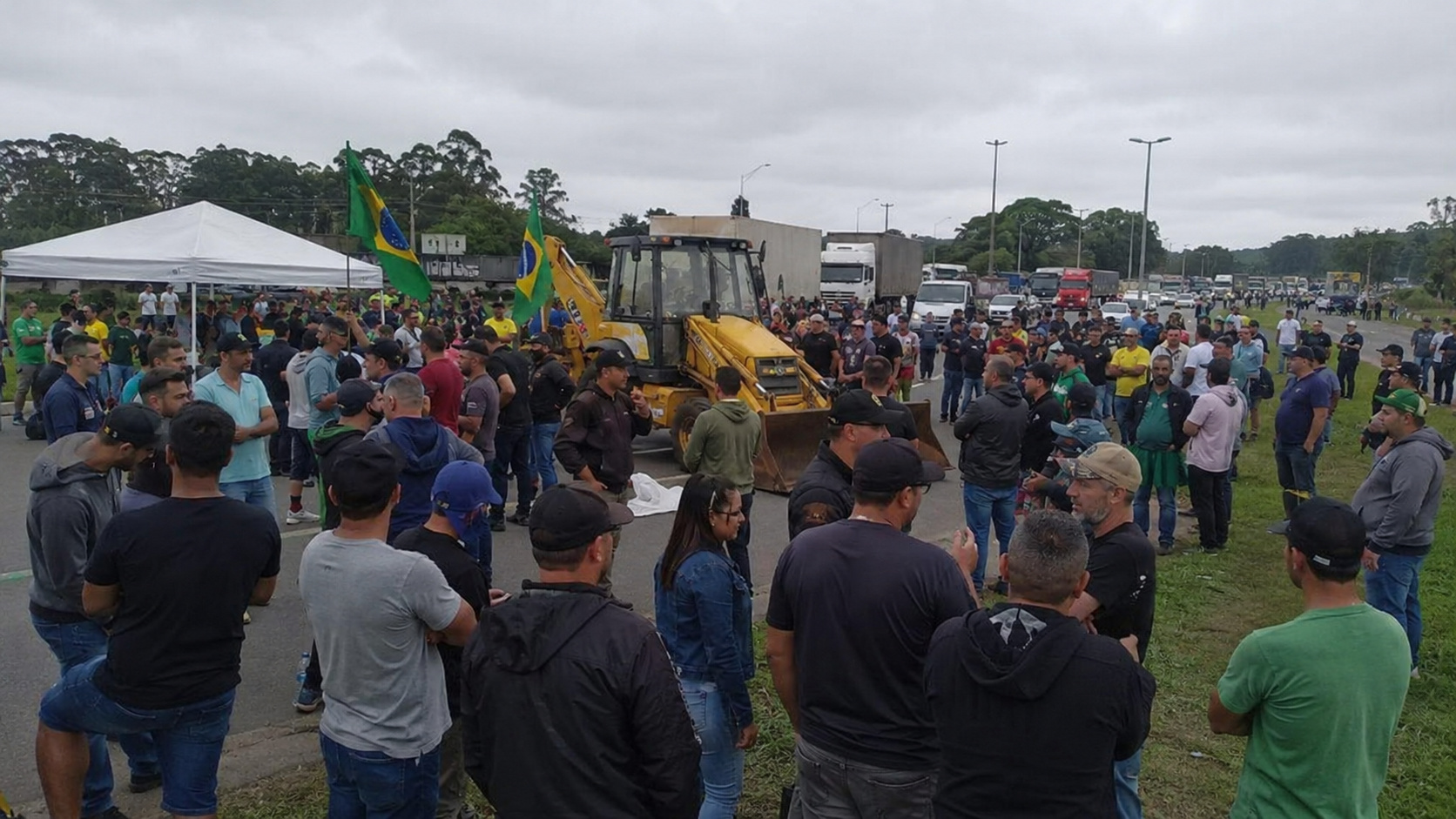
Truck drivers, freight, and fines from 2022 take center stage in politics: Chamber approves MP with amnesty, mandatory tracking by CIOT, million-dollar penalties, and new minimum wage for those who spend more than 24 hours on the road.


According to Telemundo, a Uruguayan broadcaster that visited the site, structures are already installed, including several windmills.
The project includes 72 wind turbines distributed across three plants – Coxilha Negra 2, 3, and 4 – with a total capacity of 302.4 MW, enough to supply 1.5 million consumers. The construction, which began in 2022, involves an estimated investment of 2.4 billion reais.
Despite the magnitude of the project, the Brazilian government did not request authorization or maintain dialogue with Uruguayan authorities.
This is because it considers the area to be an integral part of national territory and does not need to provide clarifications to any other country.


Centennial Dispute
In 1934, Uruguay officially questioned, for the first time, part of the boundary treaty established with Brazil in 1851.
According to the Uruguayan government, the stream indicated as a border reference was incorrect, and therefore the region should belong to Uruguay.
At the time, Brazil countered, stating that it relied on the demarcation made in the 19th century and expressed surprise that the neighboring country only raised the issue decades later.
Later, in 1974, during the military dictatorship, Uruguay began to include two areas classified as “contested boundary zones” in its official maps. Brazil, for its part, has never recognized this claim.
As a result, an area of about 22,000 hectares remained under Brazilian control, although Uruguay considers it its own.
The first formal challenge was only made in 1931, with new communication in 1933 and reinforcement in 1934. Since then, Brazil has reaffirmed its sovereignty over the region, ignoring Uruguayan protests.
Reactions and Diplomatic Silence
Despite the delicate situation, until recently there had been no effective movements from Uruguay. International law specialist Edison González Lapeyre stated that the country should have acted more firmly. “It should present a diplomatic note explaining how this error occurred and insist on a solution,” he declared.
However, Telemundo confirmed that there had been no formal protests from the embassies, foreign ministries, or the state-owned UTE in recent years. This changed with the advancement of the works.
The Uruguayan Ministry of Foreign Affairs sent a verbal note to Brazil, reinforcing that the construction of the wind farm does not mean, under any circumstances, recognition of Brazilian sovereignty over the disputed territory.
The statement references the diplomatic note of August 17, 1988, when Uruguay had already expressed concern over the situation. According to the text, the country hopes that the issue can be revisited in the near future, “in the appropriate forums,” within the spirit of justice and friendship between the peoples.
Old Project Resumed Under New Government
The plan to build a wind farm in the region is not recent. In 2011, still during the administrations of José Mujica and Dilma Rousseff, the state of Rio Grande do Sul presented a similar project, which also reached the contested area. However, at that time, both presidents chose to suspend the project in respect to the bilateral relationship.
More than a decade later, the project was revived without consultation with Uruguay. The resumption occurred in 2021, and the works effectively began in August 2022, with significant public investment. The project is currently the largest of CGT Eletrosul, a subsidiary of Eletrobras, and encompasses three sets of plants.
Extensive and Strategic Region
The area in question encompasses approximately 22,000 hectares, with some sources pointing to as much as 25,000 hectares. The location is considered to have great wind potential, which justifies the Brazilian government’s interest in investing in the installation of the turbines.
For Uruguayans, it is the territory known as Rincón de Artigas, and its legitimate possession is defended based on the original reading of the 1851 treaty.
However, Brazil’s presence there has been consolidated for decades. Marker 49, placed in a location considered incorrect by Uruguay, marks the beginning of the border line heading north, using the Maneco stream as a reference. Uruguay, on its part, argues that this reference should have been the Moiroes stream.
No Concrete Negotiation Foreseen
So far, there is no forecast for opening a concrete dialogue between the two countries on the issue. The Uruguayan diplomatic note is seen more as a symbolic gesture than as an effective step towards resolving the dispute. The absence of formal protests for decades weakens Uruguay’s position from an international perspective.
At the same time, the advancement of the wind farm reinforces Brazilian occupation in the region, further complicating any reversal of territorial control.
The presence of fixed structures, such as wind towers, tends to further consolidate the de facto sovereignty exercised by Brazil over the contested area.
The construction of the park continues at a rapid pace. CGT Eletrosul claims that Coxilha Negra already has some of the wind turbines installed and that the three plants will be fully operational soon.
The project has become a central piece of the energy transition in the Western Frontier of Rio Grande do Sul.
For now, Uruguay is counting on diplomatic dialogue and possible future negotiations. But the scenario points to a solidified occupation by Brazil, in a territory where the dispute, even if silent, spans centuries.