






 Portuguese
  Spanish


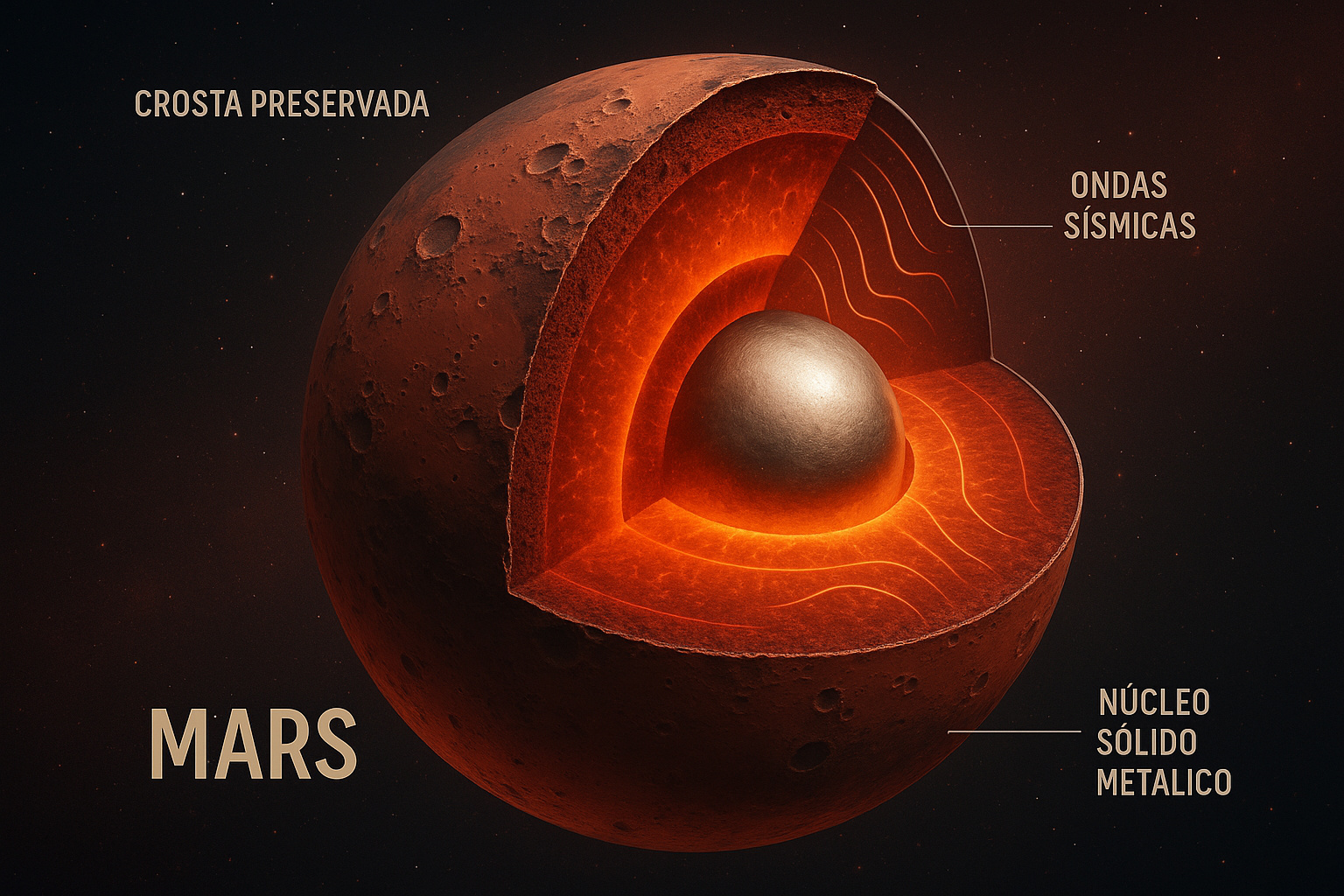

Research Based on Data from the InSight Mission Confirms That Mars Has a Solid Core and a Preserved Crust for Billions of Years, Offering New Keys to Understand the Geological and Magnetic Evolution of the Red Planet
The earthquakes on Mars continue to reveal crucial information about the planet’s interior. Three years after the retirement of the InSight mission, which monitored over 1,300 seismic events between 2018 and 2022, scientists confirmed that the Martian core is not liquid but solid, similar to Earth’s, and that its crust remains virtually unchanged since its initial formation, according to the Global Times.
The data collected by NASA’s module allowed for the identification of how seismic waves propagate through the interior of the red planet. This analysis showed that the solid core is made up of metal alloys and that the Martian crust acts like a “stagnant cap,” preserving ancient characteristics that contrast with the constant movement of Earth’s tectonic plates.
-
Viral Video of Giant Gold Nugget in Brazil’s Oiapoque Revealed as Painted Rock by French Guiana Miner

-
18th-Century Treasure Uncovered in Brazilian Amazon: 20 Réis Coin and Dutch Pipes Found at Construction Site
-
New York Resident Uncovers Complete Mastodon Jawbone in Backyard After Spotting Teeth Emerge from Ground
-
Young Treasure Hunter from Brazil’s Balneário Camboriú Finds $22,000 in Jewelry with Metal Detector, Aims for $1 Million, and Returns iPhone Found in Ocean


Solid Core and Absence of Magnetic Field
The core of Mars, contrary to previous belief, does not exhibit significant fluidity. This discovery helps to explain the absence of a global magnetic field, which was lost billions of years ago, leaving the surface exposed to cosmic and solar radiation. This process had a direct impact on the loss of much of the atmosphere and water, reducing the chances of habitability today.
According to information released by international agencies, the study of Mars’ internal vibrations broadens the understanding of how rocky planets evolve after their formation. The comparison with Earth and Venus allows for the identification of patterns regarding the cooling of cores and the consequences for atmospheric protection.
Preserved Martian Crust
Another important revelation is that the crust of the red planet functions as a geological record frozen in time. Unlike Earth, where tectonic plates constantly recycle material, Mars preserves evidence of ancient cosmic collisions and internal processes that shaped its surface. This stability enables the study of the primitive history of the Solar System.
Researchers highlight that part of this crust preserves signs of impacts from giant asteroids, events that may have influenced the loss of the magnetic field. This condition makes Mars a true natural laboratory for investigating how catastrophic events shape planetary evolution.
Lessons for Habitability
The discoveries about Mars also offer lessons for the search for life on other rocky worlds. The comparison between its internal structure and that of Earth allows for criteria to be established regarding which characteristics are fundamental for maintaining magnetic fields, stable atmospheres, and environments conducive to life.
The red planet, therefore, continues to play a central role in space exploration, helping to design future colonization scenarios and to understand the limits of habitability in the Solar System and beyond.


