Portuguese
  Spanish


What seemed like just a piece of bone stuck on the slope turned into one of the rarest finds in recent paleontology in the United States
Two brothers and a cousin were walking through a fossil region near Marmarth, North Dakota, when they noticed a bone protruding from the rock. The discovery, made in July 2022, was only later confirmed by paleontologists as part of a young Tyrannosaurus rex, nicknamed Teen Rex.
The fossil was in the Hell Creek Formation, one of the world’s most well-known areas for dinosaur remains from the end of the Cretaceous period. The material was removed in 2023, taken to the Denver Museum of Nature & Science, and began to be prepared in front of the public in a special exhibition.
The find draws attention because adolescent T. rex fossils are uncommon. They help scientists understand how this predator grew before reaching adult size.
-
Company Develops World’s Thinnest Chocolate at 0.03 Millimeters Using Exclusive Machine Designed in Japan

-
Brothers Build Sustainable Bamboo and Earth House in Brazil, Sharing Secrets of Eco-Friendly Living

-
At 22, Andréia left law school to become a truck driver; six years later, she travels across Brazil transporting grains with 130,000 followers.
-
81-Year-Old Brazilian Farmer Preserves Working Sugarcane Mill and Centuries-Old Tools, Showcasing Rural Heritage



Liam Fisher, Jessin Fisher, and Kaiden Madsen were not on a professional expedition when they found the bone. They were walking with Sam Fisher, father of Liam and Jessin, on public lands managed by the Bureau of Land Management, on the outskirts of Marmarth.
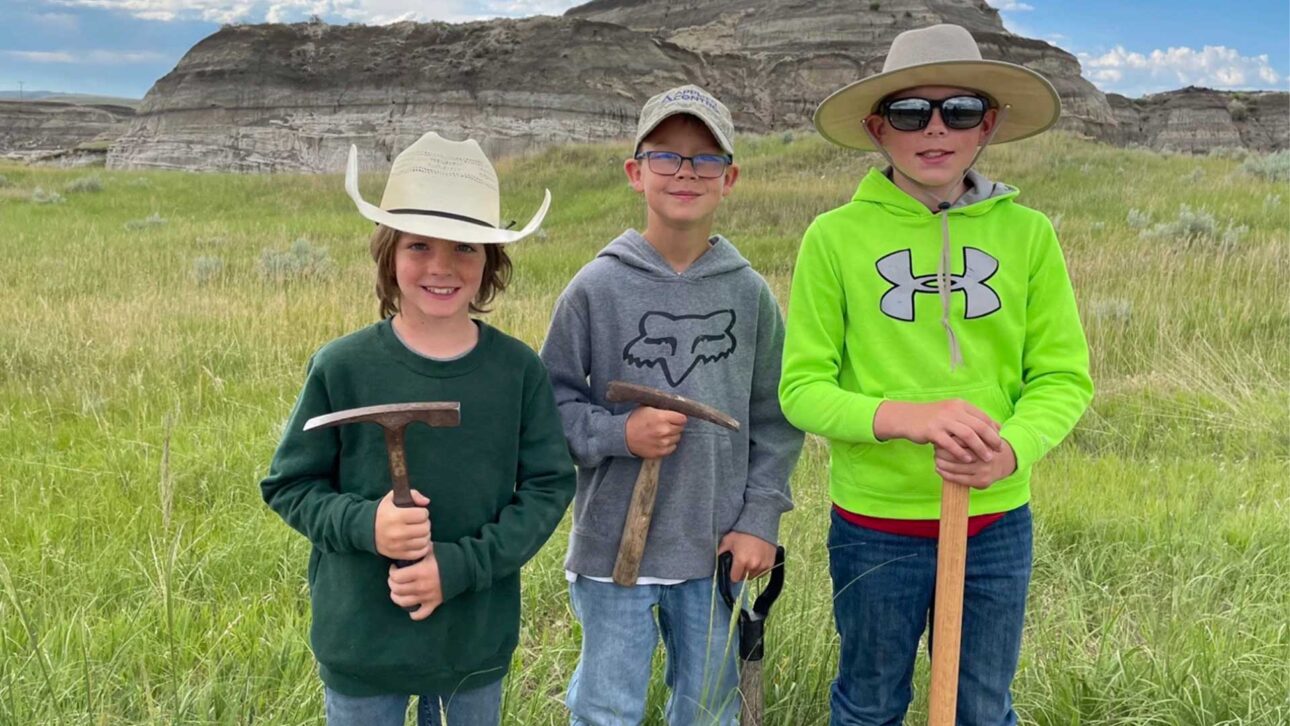
At the time, Liam was 7 years old, Jessin was 10, and Kaiden, their cousin, was 9. The group was in a region of dry hills, exposed slopes, and sedimentary rocks, where fossils can appear after natural erosion.
According to the Associated Press, Liam and his father were the first to notice the bone stuck in the rock. The first impression was not of a historic discovery. Liam even imagined it was a “chunk-osaurus,” a name he invented for fossil pieces without clear identification.
Even without knowing what it was, Sam Fisher photographed the material and sent the image to Tyler Lyson, a paleontologist at the Denver Museum of Nature & Science and a family acquaintance. The initial response was cautious. Lyson suspected it might be a duck-billed dinosaur, much more common in the region.
The jaw with teeth changed the investigation early in the excavation
The confirmation came only in the field, during an excavation organized in the summer of 2023. Lyson returned to the site with a technical team, authorization to excavate on public lands, and the participation of the boys themselves in the work.
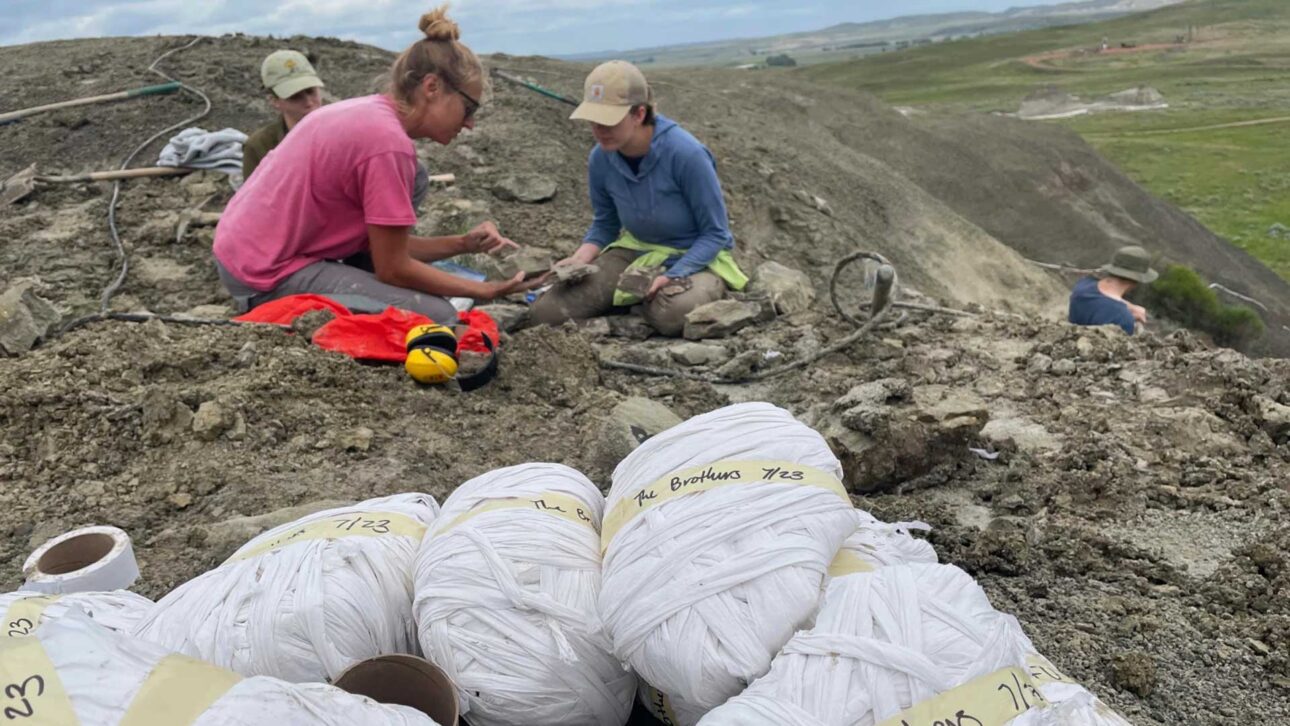
The initial expectation was to find bones compatible with a herbivore. But the team found something much more specific. While excavating an area where a neck vertebra was expected, the researchers uncovered a lower jaw with large tyrannosaurus teeth.
This type of piece quickly changes the reading of a fossil. Teeth, jaw, and bone proportions allow for a much safer identification than isolated fragments of rib, vertebra, or limbs.
The fossil was nicknamed The Brothers, in reference to the boys who participated in the discovery. A team from Giant Screen Films was accompanying the work and recorded the moment for the documentary “T.REX”, narrated by actor Sam Neill, known for the film Jurassic Park.
The young T. rex was between 13 and 15 years old when it died
According to information from the Denver Museum of Nature & Science, the fossil preserves about 30% of the skeleton. The set includes parts of the skull, leg, hip, pelvis, and some tail vertebrae.
Estimates indicate that the animal was between 13 and 15 years old when it died. It was not yet an adult T. rex, but it was already enormous by any modern comparison.
The museum estimates that the Teen Rex measured about 7.6 meters in length and approximately 3 meters in height. The living weight was estimated to be around 1,600 kilograms, just under two-thirds the size of a full adult.
Reuters reported that the T. rex reached adulthood around 18 to 21 years. This makes the specimen especially useful for studying the species’ rapid growth period, a stage less represented in fossils already found.
The rock block had to be removed by helicopter
The removal of the fossil required a heavy and careful process. The team removed layers of rock, isolated the bones, and wrapped the material in a plaster and burlap jacket, a method used to prevent the fossil from breaking during transport.
The final block weighed about 2.7 tons. Due to the terrain and weight, a Black Hawk helicopter was used to lift the piece to a truck, which transported the material from the Badlands region in North Dakota to the museum in Denver.
This transport explains why much of the discovery is still not fully visible. Many bones remain trapped within the original rock and need to be gradually freed by preparators, with small tools and constant control to avoid damaging the material.
Preparation should take months. The museum chose to show part of this process to the public in the exhibition Discovering Teen Rex, allowing visitors to follow the cleaning and study of the fossil in real time.
The Hell Creek Formation helps to reconstruct the last days of the dinosaurs
The fossil came from the Hell Creek Formation, an area that spans parts of Montana, Wyoming, North Dakota, and South Dakota. The region preserves rocks from the end of the Cretaceous period, just before the extinction of non-avian dinosaurs, about 66 million years ago.
In this same formation, some of the most well-known T. rex fossils have been found, including much more complete adult specimens. The difference, in this case, lies in the age of the animal.
Juvenile fossils can reveal body proportions, growth rate, and changes in bite before adulthood. They also help answer how a young T. rex hunted, moved, and competed for space with other predators in the same environment.
The site where the Teen Rex was found suggests that the body may have been preserved in an ancient river system. The fine sand and sediments helped cover the bones, creating the conditions for fossilization over millions of years.