Portuguese
  Spanish


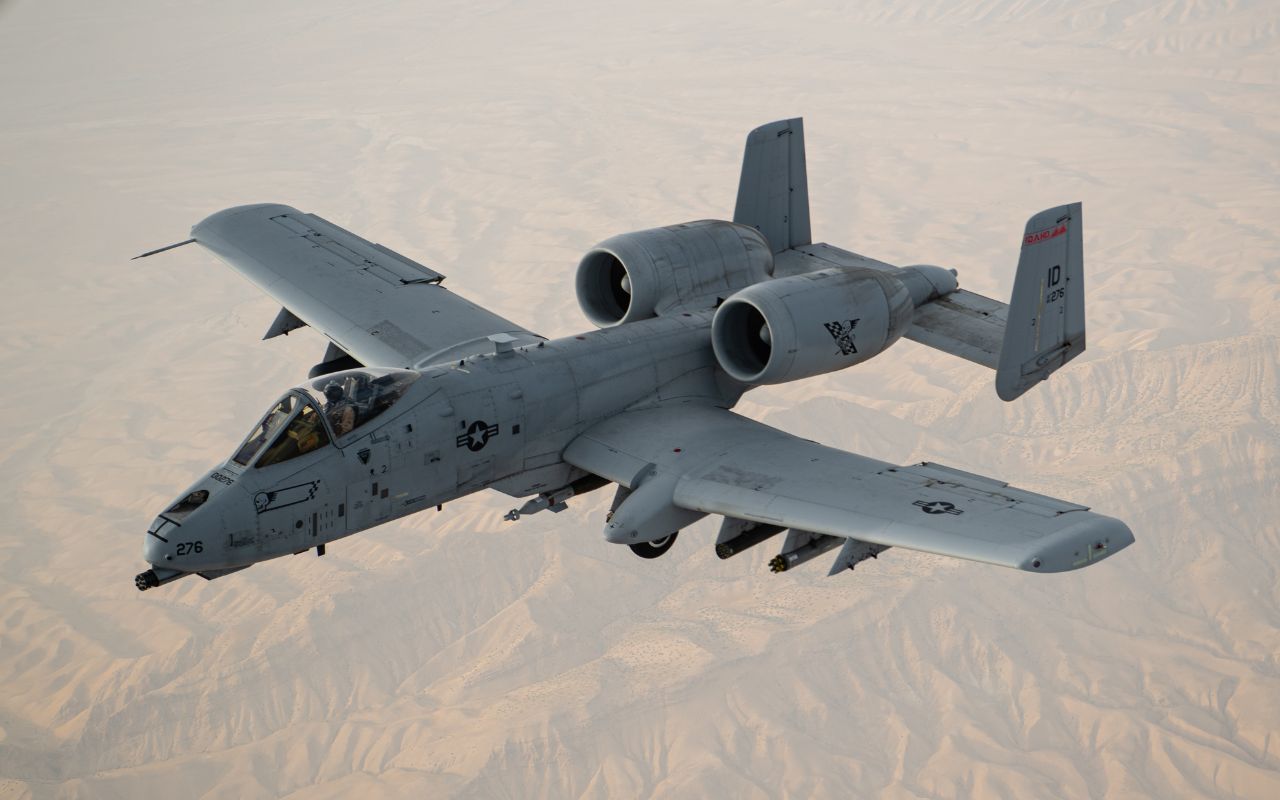

A-10 Thunderbolt II: air support aircraft that marked wars with destructive power and is expected to operate until 2030.
The A-10 Thunderbolt II, a military aircraft developed in the United States between 1972 and 1984 by Fairchild Aircraft, was created to operate directly on the battlefield supporting ground troops. Designed to fly low and slow, the model gained prominence for its ability to attack armored vehicles, buildings, and enemy forces with precision. Despite facing initial resistance within the United States Air Force itself, the aircraft proved its effectiveness in real conflicts, especially during the Gulf War in 1991, when it destroyed thousands of targets. With recent updates, it is expected to remain in operation until 2030.
Origin of the A-10 Thunderbolt II and its mission
Developed during the Cold War, the A-10 Thunderbolt II emerged with a clear objective: to provide direct air support to ground troops. Unlike other military aircraft focused on speed or aerial combat, this model was designed to operate at low altitudes, with high precision and resilience. The initial proposal did not completely please the United States Air Force.
At the time, the preference was for high-performance aircraft, such as fighters and high-altitude bombers. Furthermore, there was an intention to transfer this type of mission to helicopters. Nevertheless, the project moved forward, focusing on confronting potential Soviet armored forces in Eastern Europe, a scenario considered critical during that period.
-
Brazil Faces Norway in World Cup at Stadium Linked to Jimmy Hoffa’s Mysterious Disappearance

-
Retired Woman Leaves French Public Housing Due to Fear, Lives in Van for Weeks, Prompting Response from Local Authorities and a Priest
-
9-Year-Old Fabio Isaac Wins Gold at Copernicus Math Olympiad in Singapore, Representing Peru Against Global Young Talents
-
Brazilian Physics Student Builds Realistic Cardboard Replica of Honda Africa Twin Using Mathematical Calculations






| Credit: Nellis AFB Public Affairs
Impressive numbers
The performance of the A-10 Thunderbolt II was decisive during the Gulf War in 1991. The aircraft demonstrated, in practice, its efficiency in direct combat.
The recorded numbers show the extent of the impact:
- More than 900 armored vehicles destroyed
- Around 2,000 military vehicles neutralized
- Approximately 1,200 artillery pieces eliminated
- Loss of only 5 aircraft (with alternative estimates pointing to up to 11)
This performance surprised even the military itself, who initially had doubts about the model’s effectiveness.
Participation in subsequent conflicts
After its success in the Gulf, the use of the A-10 Thunderbolt II extended to other important conflicts. The aircraft returned to operate in different war scenarios over the following decades.
Among its main operations are:
- Kosovo War (1999)
- Invasion of Afghanistan (2001), with operations from Bagram Air Base
- Operation Anaconda (March 2002)
- Iraq War (2003), with about 60 units used
During the campaign in Iraq, only one aircraft was lost, near Baghdad International Airport, at the end of operations.
Structure and armament capacity of the A-10 Thunderbolt II
One of the main differentials of the A-10 Thunderbolt II is its powerful armament and the capacity to carry a large quantity of equipment.
Main armaments:
- GAU-8/A Avenger 30 mm 7-barrel rotary cannon
- Capacity for up to 1,350 rounds
- Missiles:
- AGM-65 Maverick
- AIM-9 Sidewinder
- Bombs:
- Mk 82, Mk 83, Mk 84
- Laser-guided bombs (Paveway II and III)
- Rockets:
- Hydra 70 mm
- Zuni 127 mm
- Electronic systems:
- Countermeasure pods (ECM)
- Flares and chaff dispensers
Additionally, the aircraft has 11 hardpoints for armaments, with 8 on the wings and 3 on the fuselage, with a total capacity exceeding 7,300 kg.
A-10 Thunderbolt II Technical Table
| Characteristic | Specification |
| Length | 16.26 m |
| Wingspan | 17.53 m |
| Height | 4.47 m |
| Maximum takeoff weight | 23,000 kg |
| Maximum speed | 833 km/h |
| Cruising speed | 560 km/h |
| Maximum range | 4,150 km |
| Service ceiling | 13,700 m |
| Engines | 2 TF34-GE-100A turbofans |
| Thrust per engine | 4,111 kgf |


Recent updates and future of the A-10 Thunderbolt II
In 2019, the A-10 Thunderbolt II fleet underwent an extensive modernization process. Among the improvements are the replacement of wings and updates to electronic systems, known as avionics.
These changes aim to extend the aircraft’s lifespan and ensure its efficiency in modern combat scenarios. The current forecast indicates that the aircraft will remain in operation until 2030, when it may be replaced by newer models, such as the F-35.
Although countries like Israel, Turkey, South Korea, and Egypt have shown interest in the model over the years, the A-10 Thunderbolt II continues to be operated exclusively by the United States.
This exclusivity reinforces the aircraft’s strategic role within the American armed forces. Since its creation, the A-10 Thunderbolt II faced distrust and resistance. However, its performance in real conflicts consolidated its importance in close air support.
Designed for specific missions and challenging environments, the aircraft stood out for its robustness, attack capability, and reliability, characteristics that ensured its active presence for decades.