Portuguese
  Spanish


Detected in 2021 and still an enigma, the Amaterasu particle carried an absurd amount of energy for something so tiny. The cosmic ray seems to have come from the Local Void, and recent investigations attempt to link its origin to a distant blazar or nearby galaxies, without solving the mystery of how it reached Earth.
On May 27, 2021, a single subatomic fragment crossed the sky over the United States carrying more energy than anything of that size should be able to carry. The detectors of the Telescope Array experiment, in the Utah desert, recorded the impact, and scientists took time to believe what they saw. The Amaterasu particle, named after the Sun goddess of Japanese mythology, had just hit Earth as the second most energetic cosmic ray ever captured by science.
The astonishment didn’t stop at its arrival. When researchers tried to trace where it had come from, the answer pointed to the wrong place: the Local Void, a vast bubble almost without galaxies next to the Milky Way. In other words, the Amaterasu particle seemed to have come from a region where, in theory, there is nothing capable of producing such energy. Years later, in 2026, new studies continue trying to solve the enigma of this visit from nowhere.
An energy that doesn’t fit in the head
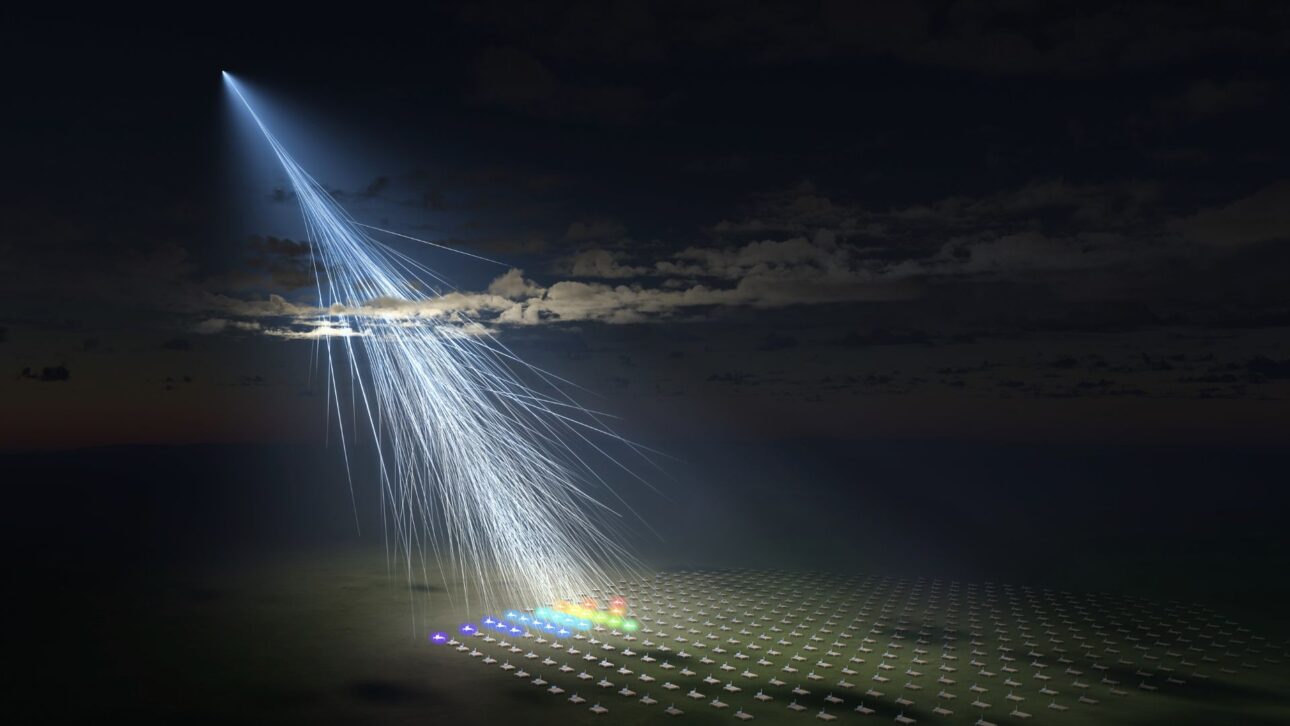
It arrived with about 240 exa-electron-volts, or 240 EeV, which is equivalent to 2.4 followed by twenty zeros in electron-volts. This value is millions of times greater than the energy that the world’s largest particle accelerator, the LHC, in Europe, can achieve with all its kilometers of structure. And here we are not talking about an entire beam, but a single particle.
-
She heard for decades that space was not a place for women, became a pioneer in aviation, was part of the Mercury 13, and at 82, finally traveled with Jeff Bezos before dying at 87.

-
Scientists investigate microplastics in the airways of patients with sleep apnea and reveal a new focus for research on environmental pollution, human exposure, and possible impacts on breathing quality.
-
For the first time, scientists have seen the ocean floor open up in real-time—plates moving apart by two meters in a few days and 160 million cubic meters of lava emerging on the seafloor.
-
Iraq floats and sinks under an arm of the Euphrates 10 giant concrete boxes of 46,000 tons and 125 meters each to assemble a 2.4 km submerged tunnel and open a new land route between Asia and Europe.





A comparison helps ground the idea. The energy concentrated in this tiny particle is roughly equivalent to that of a brick falling to the ground from waist height. It seems little for a brick, but it’s absurd for something invisible and subatomic. It is precisely this contrast that makes each ultra-high-energy cosmic ray a puzzle: nature, somewhere in the universe, is acting like a giant accelerator, and no one knows exactly where this machine is located.
Came from where nothing should exist
The arrival direction of the cosmic ray points to the Local Void, a region of space neighboring our galaxy that is basically a cosmic desert, with very few stars and galaxies. Tracing the trajectory back and landing in an empty place is the astronomical equivalent of receiving a letter without a sender from an address where no one lives.
The scientists themselves admit the discomfort. According to researcher Toshihiro Fujii, involved in the study, no promising astronomical object was identified in the direction from which the cosmic ray came, which opens space for unknown phenomena or even new physics, beyond the Standard Model that currently describes particles. When a particle with such energy emerges from the Local Void without giving clues, science needs to consider that perhaps something is missing in our understanding of how the universe works, and that is what keeps the case open.
The hunt for the origin, from a distant blazar to nearby galaxies
Since the case was disclosed, several teams have taken on the mission to discover the sender. One of the most discussed clues points to a blazar called PKS 1717+177, an active galaxy nucleus with a supermassive black hole at the center, capable of firing particles at speeds close to the speed of light. This blazar is about 2.5 degrees from the reconstructed arrival direction of the Amaterasu particle, and under the hypothesis that the cosmic ray is a proton, it is a strong candidate for the source.
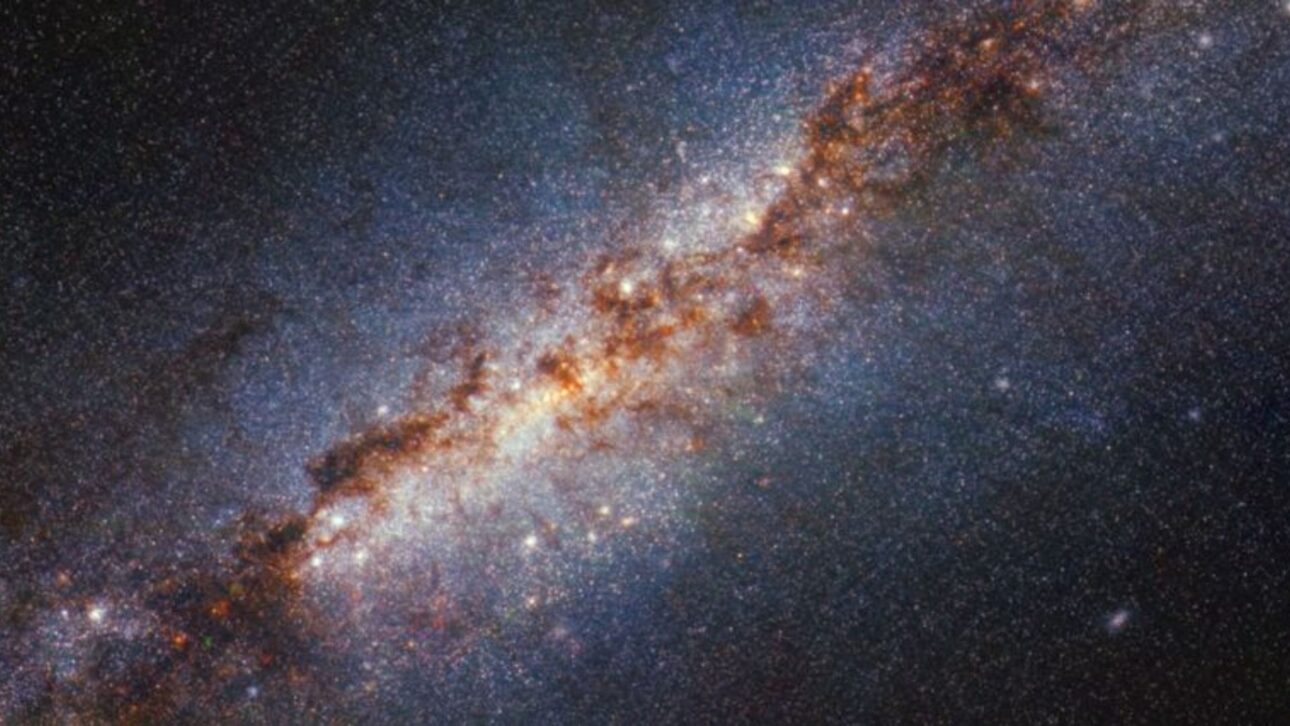
The investigation, however, is not unanimous, and that is where the richness of the case lies. In 2026, a new study recalculated and suggested that the most likely origin would not be in the Local Void nor necessarily in the blazar, but in nearby galaxies with intense star formation, like the famous M82. In other words, instead of a closed address, today science works with more than one suspect, each requiring a different path for the particle to have crossed space and reached Earth. The mystery, far from dying, has become more sophisticated.
Why a cosmic ray like this shakes physics


Cases like the Amaterasu particle matter far beyond curiosity. Ultra-high-energy cosmic rays test the limits of what we know about the universe because such energetic particles should lose strength when traveling long distances, interacting with the radiation that fills space. When one of them reaches Earth almost intact and coming from an empty point, the result challenges models and forces physicists to revise their calculations about energy, distance, and origin.
That’s why the Telescope Array experiment exists and is being expanded. Each new extreme cosmic ray recorded helps to create a map of where, in the sky, these immense energy bullets originate. The Amaterasu particle joins a very rare club, right behind the legendary Oh-My-God, detected in 1991 with even greater energy. Together, these detections suggest that there are natural accelerators scattered throughout the cosmos, capable of surpassing any machine built on Earth, and discovering what they are could rewrite entire chapters of physics.
What we still don’t know
In the end, the Amaterasu particle is more than an energy record. It is a reminder that the universe still holds phenomena that our best technology is just beginning to touch. A cosmic ray that seems to have come from the Local Void, with no clear source, and that carries the equivalent of millions of times the energy of the world’s largest accelerator, is the kind of mystery that drives science forward. Whether it’s a blazar or a distant galaxy, the answer promises to be as extraordinary as the question.
And you, what do you think sent this sun goddess particle to Earth: a monstrous black hole in a blazar, a galaxy in turmoil, or something that physics doesn’t even have a name for yet? Share in the comments which hypothesis about the Local Void most captures your imagination.