Portuguese
  Spanish


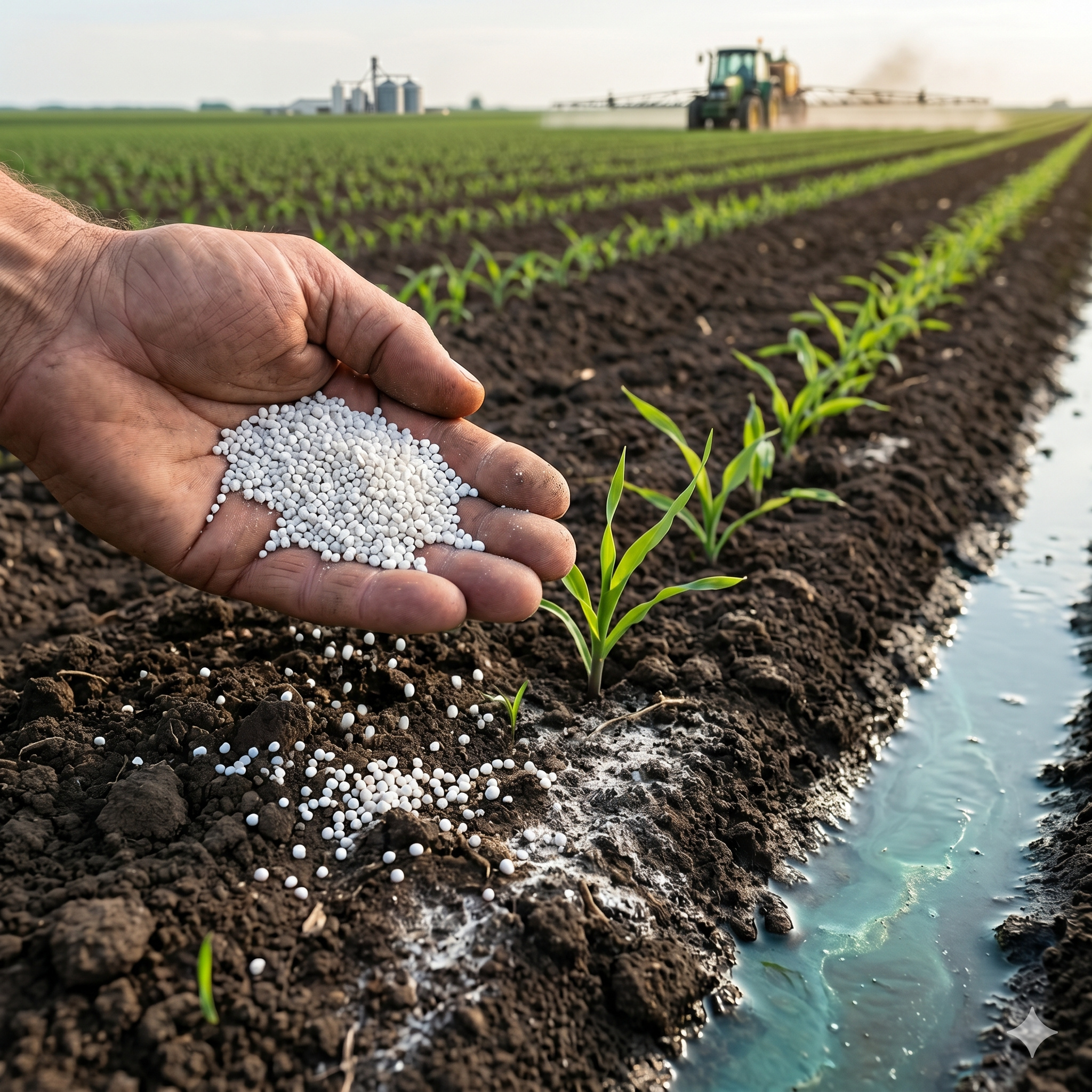


Nitrogen fertilizers sustain half of the world’s population, but excess already exceeds safe limits and threatens rivers, soils, and oceans.
In 1909, German chemist Fritz Haber demonstrated a route to transform atmospheric nitrogen and hydrogen into ammonia, the essential base of modern nitrogen fertilizers. A few years later, on September 9, 1913, according to BASF‘s historical chronology, engineer Carl Bosch scaled up the process to industrial level in Oppau, Germany, creating the technology that would become known as the Haber-Bosch process.
This advance changed global agriculture because it broke the almost exclusive dependence on natural sources of nitrogen, such as organic decomposition, biological fixation, manure, and mineral deposits. With the industrial synthesis of ammonia, the supply of reactive nitrogen grew decisively throughout the 20th century, sustaining fertilizers that today help feed approximately half of the world’s population, according to estimates compiled by Our World in Data.
With industrial synthesis, the supply of nitrogen increased exponentially, allowing agricultural production to keep pace with population growth throughout the 20th century.
-
Producer receives news and had to cull almost the entire herd, bounced back with the help of compensation, and is now producing 450 liters of milk per day in SC.

-
Quail Eggs Reveal a “Secret Code” on Their Shells Explaining Unique Patterns and Colors

-
Rare Tropical Fruit Canistel, with Egg Yolk Color and Caramel Flavor, Gains Interest from Researchers and Small Producers in Brazil
-
Brazilian Farmers Develop Wheeled Metal Lever to Ease Cassava Harvesting Without Heavy Machinery



Synthetic nitrogen sustains at least half of the world’s population
Recent studies indicate that about half of the current human population directly depends on synthetic nitrogen fertilizers for food.
Research associated with the Stockholm Resilience Centre indicates that, without this technology, Earth would be able to produce food for approximately 3.5 to 4 billion people, far below the current more than 8 billion.


This means that billions of lives are directly linked to a single chemical process developed at the beginning of the last century.
Global population growth is directly linked to fertilizer use
The expansion of agricultural production driven by synthetic nitrogen allowed the world population to increase rapidly.
Throughout the 20th century:
- food production grew on a global scale
- agricultural productivity increased significantly
- regions previously limited by nutrients began to produce in large volumes
Without fertilizers, the population growth observed over the last few decades would hardly have been possible.
Nitrogen’s planetary boundary is the most transgressed among all natural systems
Despite the benefits, intensive nitrogen use has created a profound imbalance in the Earth system. According to research published in journals such as Science Advances and analyses by the Stockholm Resilience Centre, the nitrogen cycle is today the most transgressed planetary boundary.
This boundary has already been exceeded by more than 200%, surpassing other critical systems such as climate, biodiversity, and land use.
This indicates that the amount of nitrogen introduced into the environment is far beyond the planet’s natural absorption capacity.
Excess nitrogen contaminates rivers and compromises water quality
Much of the nitrogen applied in agriculture is not absorbed by plants. This excess ends up being transported to rivers and lakes.

This process can cause:
- eutrophication, with excessive algae growth
- reduction of oxygen in the water
- death of aquatic organisms
The result is the degradation of entire ecosystems and the loss of quality of water sources used by human populations.
Over 400 dead zones have already been recorded in the oceans
When nitrogen reaches the sea, the impact can intensify. Excess nutrients stimulate the proliferation of algae, which, as they decompose, consume oxygen from the water. This creates areas known as dead zones, where marine life cannot survive.
Today, there are over 400 dead zones identified around the planet, many of them associated with the intensive use of fertilizers.
These regions represent one of the most visible signs of the imbalance caused by excess nitrogen.
Soil also suffers from acidification and loss of quality
The impact of nitrogen is not limited to water. In the soil, the continuous use of fertilizers can lead to acidification, altering its chemical composition and reducing fertility over time.
This can affect:
- future agricultural productivity
- microorganism balance
- nutrient retention capacity
The same element that increases production in the short term can compromise soil health in the long term.
Toxic algal blooms threaten water supply
Another critical effect is the increase in toxic algal blooms in freshwater reservoirs. These blooms can release dangerous substances, making the water unfit for human consumption and agricultural use.

In some cases, supply systems serving millions of people can be affected. This type of impact extends the problem beyond the environment, directly affecting water security.
The scenario creates a clear paradox: the same technology that sustains billions of people is the one that puts the most pressure on the planet’s natural systems. Without synthetic nitrogen, food production would drop drastically. With it, the planet faces a growing imbalance.
Humanity depends on a system that, at the same time, guarantees its survival and threatens environmental stability.
Research seeks alternatives to reduce impacts without compromising production
Given this scenario, scientists are looking for ways to balance nitrogen use. Among the strategies studied are:
- increased efficiency in fertilizer application
- development of more nutrient-efficient crops
- agricultural techniques that reduce losses
The challenge is to maintain food production without increasing environmental imbalance.
Given this scenario, how long can the planet sustain this model?
With an agricultural system highly dependent on synthetic nitrogen and a planetary boundary already widely exceeded, the future of food production becomes a central theme. The balance between productivity and sustainability becomes a critical issue.
The question that remains is direct: for how long will it be possible to sustain billions of people with a model that has already exceeded the planet’s natural limits?