





 Portuguese
  English
  Spanish
  5 min of reading
  0 comments


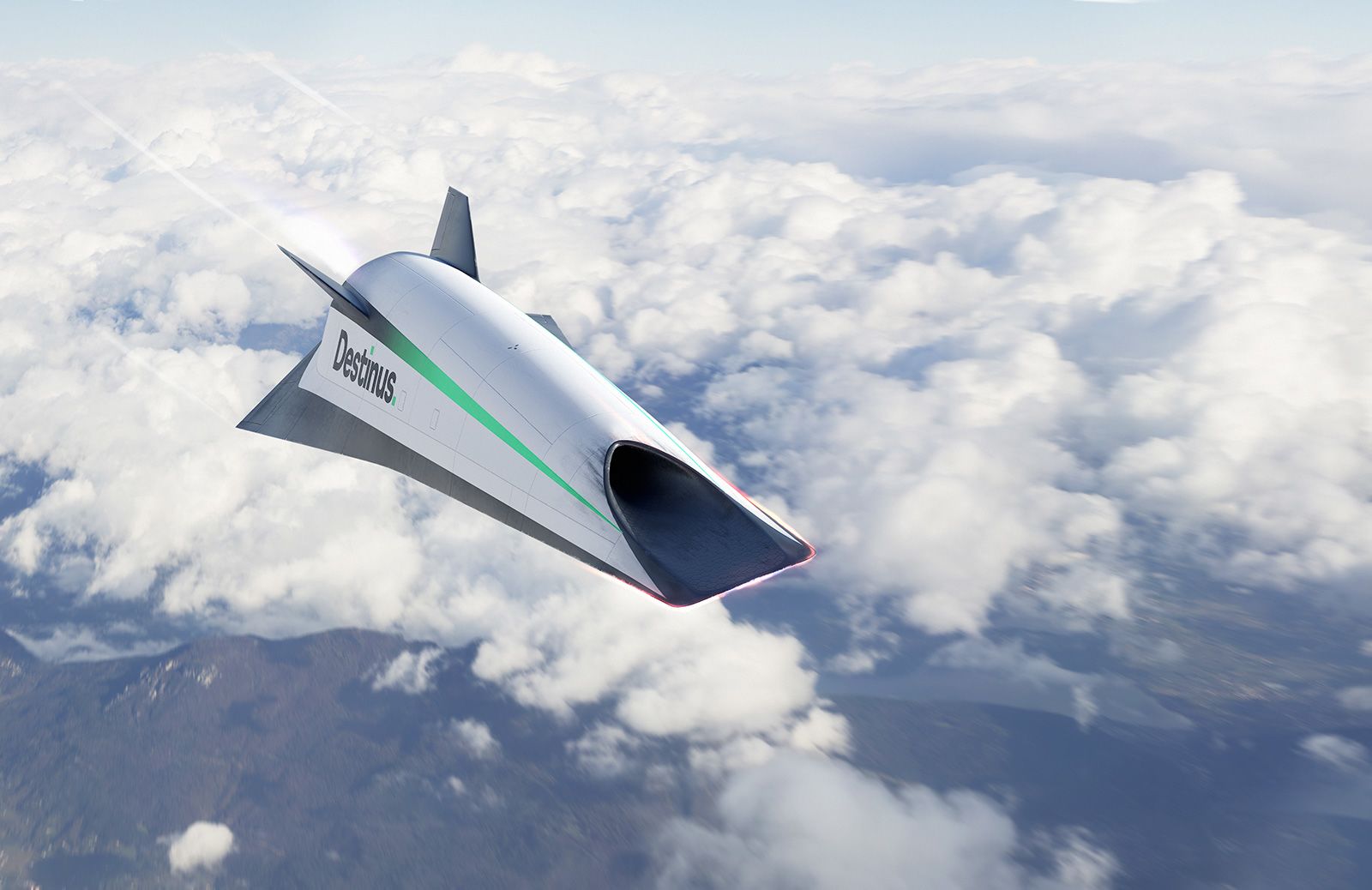
Destinus S wants to fly at Mach 5 with liquid hydrogen, carry 25 passengers, and reduce transatlantic trips to about 90 minutes.
Twenty years after the last commercial flight of the Concorde, a new generation of companies is trying to put ultra-high-speed aviation back at the center of the aerospace industry. But the proposal from the European company Destinus goes beyond the idea of simply resurrecting supersonic transport: the goal is to create a hypersonic aircraft powered by liquid hydrogen, capable of flying at Mach 5, about 6,100 km/h, a speed higher than that of the legendary SR-71 Blackbird, one of the fastest planes ever operated by the United States Air Force. Named Destinus S, the project envisions an aircraft for approximately 25 passengers, capable of connecting cities like London and New York in about 90 minutes.
The company claims that the aircraft will combine turbine technologies, hydrogen afterburning, and propulsion systems aimed at hypersonic regimes, in an architecture that mixes concepts of conventional aircraft, rocket, and high-altitude vehicle. The project is still in development and does not exist as an operational aircraft.
Destinus S wants to create an aircraft capable of flying five times faster than sound
The core of the project is speed. According to the company, the Destinus S was designed to operate at Mach 5, approximately five times the speed of sound and more than twice the cruising speed of the Concorde, which operated close to Mach 2.04.
-
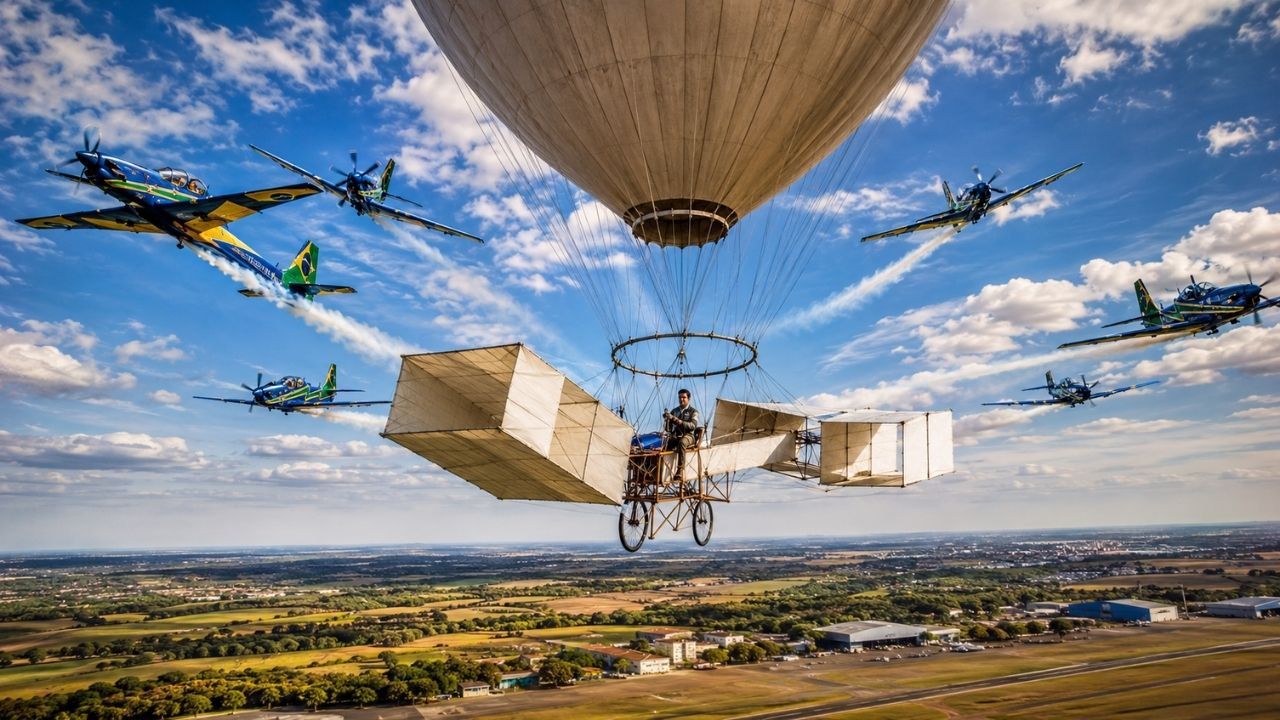
Replica of the 14-Bis returns to the skies almost 120 years after Santos Dumont’s flight, is hoisted by a 25-meter balloon and released up to 3,700 meters with Luigi Cani in an unprecedented tribute accompanied by the Esquadrilha da Fumaça.

-
France completes the largest 3D-printed residential building in Europe with 12 apartments in just 34 days, while a neighboring construction using the traditional method was still being erected.
-
Magnons last 100 times longer in the laboratory and pave the way for tiny, faster, cooler, and magnetism-powered chips.

-
Amazonian reef surprises scientists by surviving hidden under the muddy waters of the Amazon River in an ecosystem that seemed impossible.


At this level of performance, intercontinental routes could see a drastic reduction in time. The company itself uses as an example routes between Europe and North America completed in approximately an hour and a half.
Liquid hydrogen is the central piece of the strategy to achieve extreme speeds
Unlike conventional kerosene-powered aircraft, Destinus bets on liquid hydrogen. According to the company, the fuel offers high energy density per mass and can also be used as a thermal cooling element, something considered fundamental in hypersonic aircraft.
At speeds above Mach 5, aerodynamic heating becomes one of the greatest engineering challenges.
The friction with the air generates extreme temperatures on the aircraft’s structure, requiring advanced thermal management solutions.
Concept mixes turbojet engines and systems aimed at hypersonic flight
The company describes a hybrid propulsion architecture. According to information released by Destinus, the system uses air-breathing engines for takeoff and initial acceleration, combined with afterburner technologies powered by hydrogen.

The logic is similar to that used in several studies of hypersonic aircraft. The goal is to take advantage of different propulsion systems as speed increases throughout the flight.
Although the Destinus S still exists only as a project, the company has already put prototypes in flight. The first demonstrator, called Jungfrau (Destinus-1), made its maiden flight in 2021. Subsequently, the company tested the Eiger, a larger vehicle used to validate aerodynamic and operational concepts.
These vehicles are not hypersonic aircraft. They function as development platforms for systems that may be used in future models.
Destinus 3 was designed to test hydrogen afterburning
One of the company’s most important programs is the Destinus 3. Presented at the 2023 Paris Air Show, the demonstrator was described as a prototype approximately 10 meters long and about 2 tons, equipped with proprietary hydrogen afterburning technology.
According to the company, the vehicle was designed to validate systems related to the future generation of supersonic and hypersonic aircraft. The announced goal was to reach speeds close to Mach 1.3 during future flight campaigns.
Test with hydrogen-powered afterburner was presented as a technological milestone
In 2023, the company announced tests of an afterburner system powered by hydrogen. According to Destinus, the Jungfrau demonstrator conducted flights using a modified turbojet associated with a hydrogen-powered afterburner.
The company classified the experiment as the first use of this type of system in flight. The goal was to validate the operation, stability, and efficiency of the technology in a real environment.
These tests are part of the gradual strategy adopted by the company to mature technologies before attempting to reach much faster regimes.
Plan foresees commercial aircraft by the next decade
Destinus states that it intends to introduce a first hypersonic commercial aircraft between 2030 and 2032. According to materials released by the company and specialized reports, the Destinus S would be the first step in this strategy, with a capacity for approximately 25 passengers.

Subsequent projects include significantly larger aircraft. The company has already presented concepts such as the Destinus L, described as a model capable of transporting up to 400 passengers on long-distance flights. Destinus maintains that hydrogen can drastically reduce emissions related to propulsion.
According to the company, the use of hydrogen obtained from renewable sources would allow for operation without direct carbon dioxide emissions during fuel combustion.
However, experts point out that total sustainability depends on the entire hydrogen production chain, including generation, liquefaction, storage, and transportation.
The company presents hydrogen as a central element to make long-term hypersonic aviation viable.
Europe tries to return to the high-speed race after the end of the Concorde
The project also holds symbolic weight for the European aerospace industry. Since the retirement of the Concorde in 2003, no commercial aircraft has returned to regularly operate above the speed of sound on passenger routes.

Several companies are trying to fill this gap. Destinus is part of a growing group of programs betting on new propulsion technologies, advanced materials, and alternative fuels to try to reopen the era of ultra-fast air transport.
Technical Specifications of Destinus S
| Specification | Data |
|---|---|
| Model | Destinus S |
| Company | Destinus |
| Base Country | Switzerland / Europe |
| Category | Hypersonic aircraft in development |
| Planned Capacity | 25 passengers |
| Planned Cruise Speed | Mach 5 |
| Approximate Speed | About 6,100 km/h |
| Fuel | Liquid hydrogen |
| Type of Propulsion | Hybrid architecture with air-breathing engines and systems aimed at hypersonic flight |
| Operational Goal | Ultra-fast intercontinental transport |
| Example of Publicized Route | London–New York in about 90 minutes |
| Status | Conceptual project in development |
| Announced Service Entry | 2030s |
| Larger Derived Project | Destinus L (up to 400 passengers) |
Data compiled from information released by the company and specialized reports.
More than twenty years after the end of the Concorde, aviation is once again pursuing speeds that seemed to have been left in the past.
The Destinus S still needs to overcome enormous engineering, certification, and infrastructure challenges, but the ambition is clear: to transform intercontinental journeys of several hours into trips measured in minutes and to place hypersonic flight at the center of the global technological race.





-

1 person reacted to this.