Portuguese
  Spanish


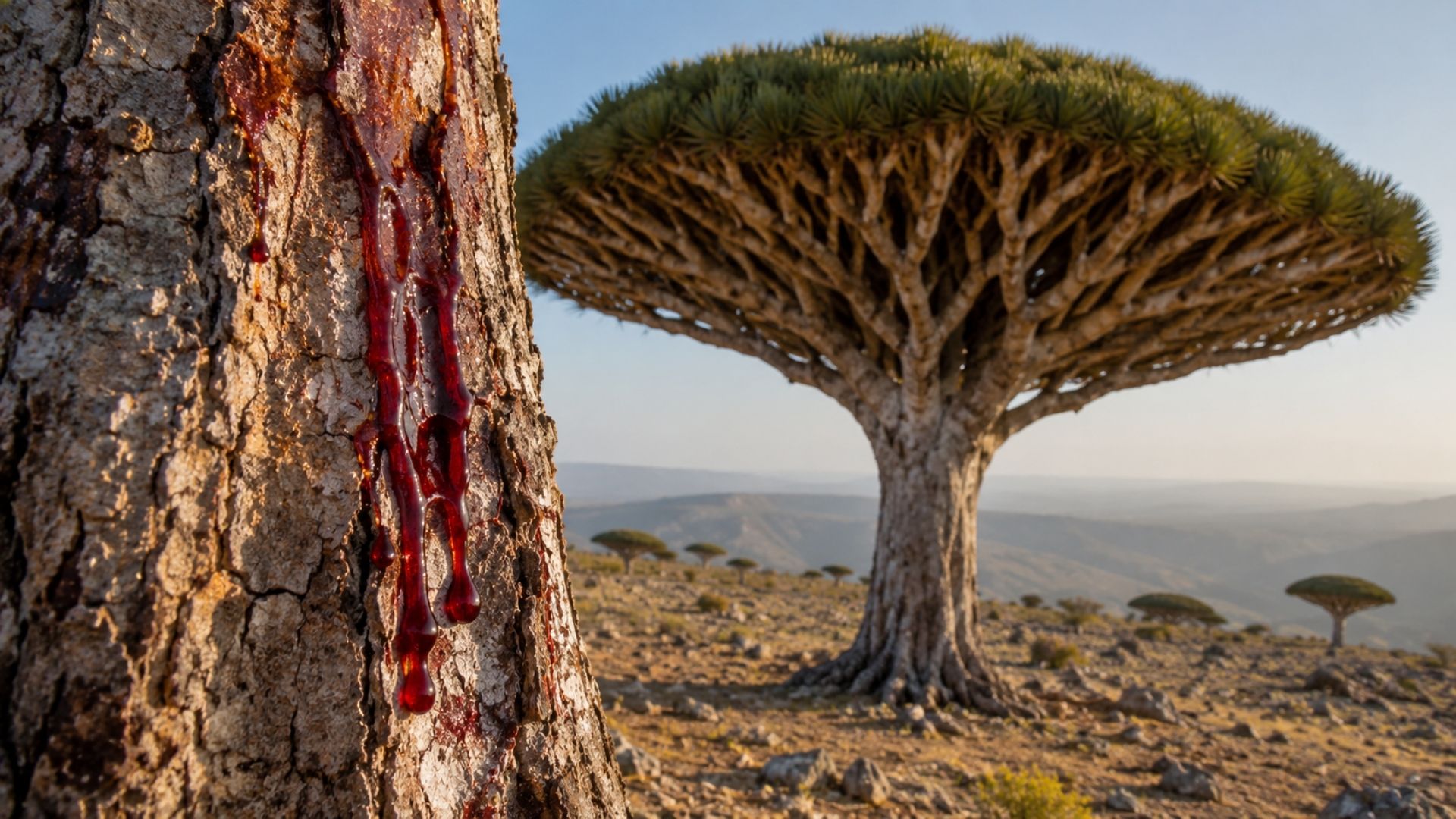

It only exists in Socotra, a Yemeni archipelago in the Indian Ocean: the dragon’s blood tree has an umbrella shape and oozes a blood-colored resin used for millennia as a remedy and pigment. With slow growth, it lives for centuries and now coexists with climate change and regional instability.
There are trees that seem to come from another planet, and the dragon’s blood tree is one of them. According to Live Science, the species with the scientific name Dracaena cinnabari only grows in Socotra, a remote island of Yemen in the Indian Ocean, where it boasts an umbrella-shaped crown and “bleeds” a blood-red resin whenever its trunk is wounded.
According to Live Science, this crimson resin, known as “dragon’s blood,” has been valued for millennia in natural medicine and as a pigment. More than a botanical curiosity, the dragon’s blood tree has become the symbol of one of the most biodiverse and isolated places on the planet and, at the same time, of everything that now threatens this paradise.
A tree that “bleeds” red when wounded
What first draws attention is the design of the dragon’s blood tree. Its branches grow upwards and outwards until forming a dense rounded crown, resembling an open umbrella or a giant mushroom — a shape that helps the species capture moisture from the fog and protect its own roots from the scorching sun. Not surprisingly, it has become the postcard of Socotra, an island recognized as a UNESCO World Heritage Site.
-
He dropped out of school at 13 to deliver clothes at a store in Spain; today, at 90, Amancio Ortega is the owner of Zara and is among the ten richest men in the world, according to Forbes.

-
He sweeps the street, collects discarded PET bottles, and transforms the plastic into PET brooms and clothesline rope: the recycling business of street cleaner Giorggio, in Paraíba, earns more than R$ 7,000 per month.
-
He spoke his first word at seven months and read an entire book aloud before the age of two: now the boy genius Joseph has become the youngest member in the history of Mensa, the club for the gifted.
-
Known as Nelita da Farinha, she wakes up at 4 a.m., goes to the fields to see the cassava being harvested, and runs a flour production business in Acajutiba, Bahia, which has become a heritage.



The nickname, however, comes from another detail. When the trunk is wounded, the tree releases a blood-red resin, the so-called “dragon’s blood,” used for centuries in natural medicine and as a dye. It is this crimson sap that names the species and is still collected by local residents, for whom the plant has practical and even spiritual value.
A slow life that spans centuries
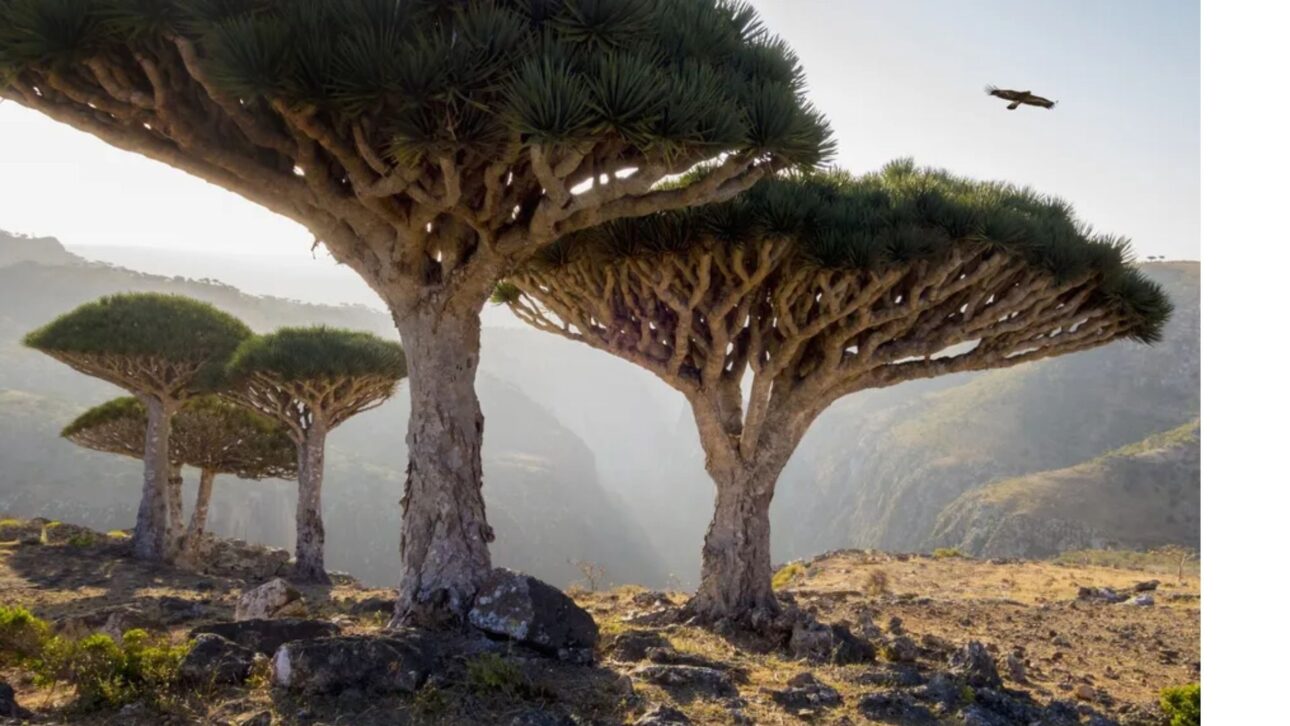
Dracaena cinnabari) is an endemic species of the island of Socotra, in the northwest Indian Ocean.
(Image credit: John M Lund Photography Inc/Getty Images)
If its appearance is impressive, the life pace of the dragon tree is even more so. The species grows only about 2 to 3 centimeters per year, an almost imperceptible advance that, accumulated decade after decade, allows it to live for centuries. Each large specimen is, therefore, a living witness to a time long before ours.
This slow growth is both strength and fragility. On one hand, it reveals a plant extraordinarily adapted to an arid and hostile environment. On the other, it means that a lost tree is not easily replaced: reforesting the species requires the patience of generations, making each loss even more severe.
Socotra, the “Galápagos of the Indian Ocean”
The home of the dragon tree is as unique as it is. The Socotra archipelago consists of four islands and two rocky islets that belong to Yemen, with the main island accounting for about 95% of the entire territory. It is located approximately 400 kilometers south of the Arabian Peninsula and 220 kilometers east of the Horn of Africa, housing around 60,000 people.
The nickname “Galápagos of the Indian Ocean” is no exaggeration. Among white sand dunes, a central mountain range, and limestone plateaus, species that exist nowhere else in the world sprout, such as the cucumber tree and the bottle tree, botanical neighbors of the dragon tree. All share the same history of isolation that shaped the island.
15 million years evolving in isolation
The explanation for such rarity lies in geology. Socotra is a fragment left over from the separation between Arabia and Africa, which occurred about 30 million years ago — the same movement that opened the Red Sea and the Gulf of Aden. Since then, life in the archipelago has evolved practically isolated for at least 15 million years, following its own paths.
The result is a true natural laboratory. According to UNESCO, more than a third of Socotra’s plants, 90% of its reptiles, and 95% of its land snail species are not found anywhere else on Earth. The surrounding sea follows suit, with marine turtles, whale sharks, and over 250 species of reef-building corals.
A paradise difficult (and dangerous) to reach
All this exuberance is surrounded by obstacles. Getting to Socotra has never been simple: in 2023, visitors depended on a single weekly flight departing from Abu Dhabi, in the United Arab Emirates — a ticket that needed to be booked via WhatsApp and was frequently canceled without explanation. Those who opt for the sea face a long and uncomfortable crossing.
It was precisely by ship that a National Geographic team arrived there, on a two-and-a-half-day journey aboard an Indian cargo ship, sharing nights with thousands of cockroaches. Besides the difficult access, the region coexists with the civil war in Yemen and the action of pirates, and several governments, including the United States, advise against any travel to the country, citing risks of terrorism, kidnapping, and even landmines.
The expedition that recorded the threatened paradise
Even in the face of so many risks, documenting Socotra became an urgent mission. Photographer Martin Edström, 30, alongside explorer Ella Al-Shamahi and filmmaker Leon McCarron, went to the island precisely to show how various crises are approaching this refuge. “There is a lot of political turbulence, a lot of climate change, many threats we want to expose,” summarized Edström.
On the island, the team followed translator Muhammed collecting resin from a tree he had known forever. For him, it was a routine gesture; for the visitors, a revealing scene. “You can clearly see the spiritual connection between him and that tree,” said the photographer — a reminder that the dragon tree is not just exuberant nature, but also part of the life of those who share the island with it.
The threats hovering over the dragon tree
Behind the beauty, there is a warning. Climate change alters the fog and rain regime on which the dragon tree depends to survive, while political instability hinders any organized conservation effort. Combined with the species’ slow growth, these pressures form a dangerous combination for the plant’s future.
Preserving the dragon tree, therefore, is more than saving a curiosity of nature. It is protecting a living symbol of 15 million years of natural history, of a people who have learned to live with it, and of an ecological balance that, once broken, may not return. What is at stake in Socotra goes far beyond the island’s limits.
And you, did you know about the dragon tree of Socotra?
An umbrella-shaped tree that bleeds red, grows very little each year, and has endured for centuries on one of the most isolated islands in the world: the dragon tree seems like fiction, but it is real — and threatened. Had you heard of this species and Socotra? Do you think there is still time to protect natural paradises like this, or are we losing these wonders too fast? Tell us here in the comments.