






 Portuguese
  Spanish


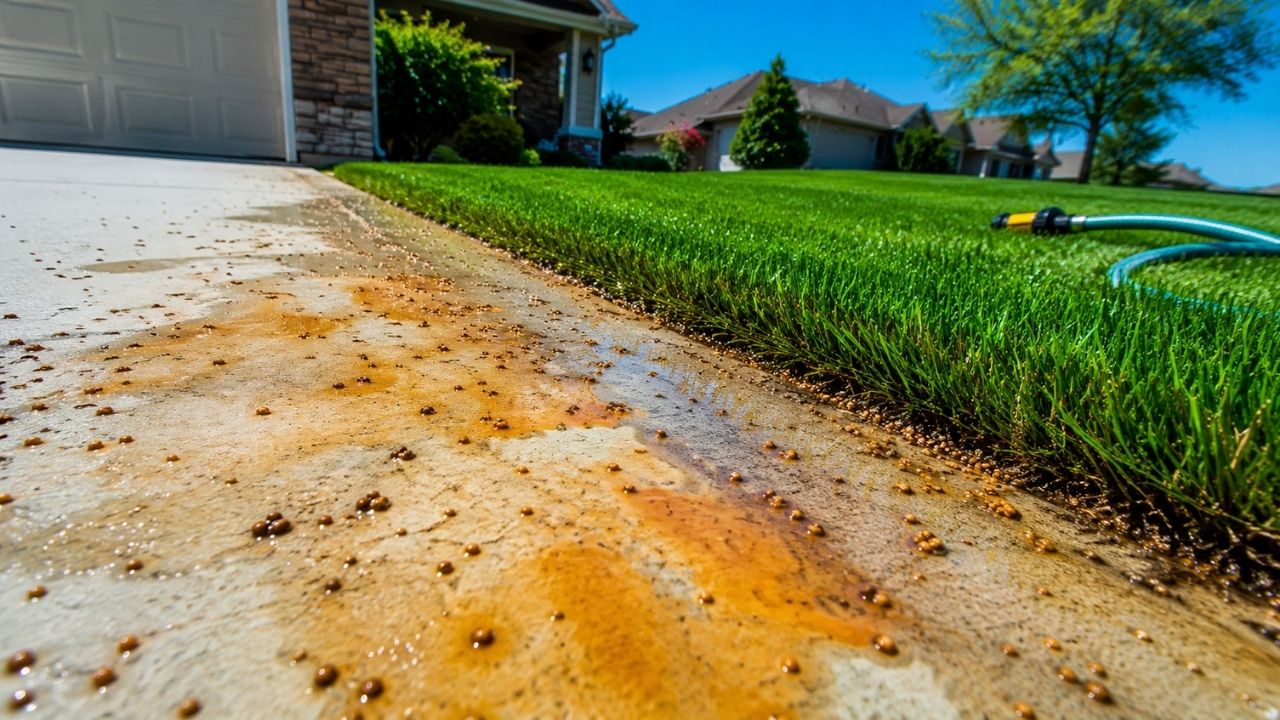

The grass fertilizer can enhance the green of the garden, but stain garage, sidewalks, and concrete floors when it contains iron. Granules forgotten outside the lawn oxidize with water, create orange marks similar to rust, and turn watering into a headache difficult to clean after domestic application.
The fertilizer used to make the grass greener can cause an unexpected problem outside the garden: orange stains on sidewalks, garages, and concrete floors. The risk arises when granules with iron fall on hard surfaces, get water, oxidize, and leave marks similar to rust.
According to content published by O Antagonista on June 11, 2026, the problem usually arises after application on the lawn, especially when part of the fertilizer escapes onto the concrete before watering, rain, or night humidity. The warning applies to houses, driveways, garden edges, and cemented areas near the grass.
The same product that makes the lawn beautiful can stain the concrete
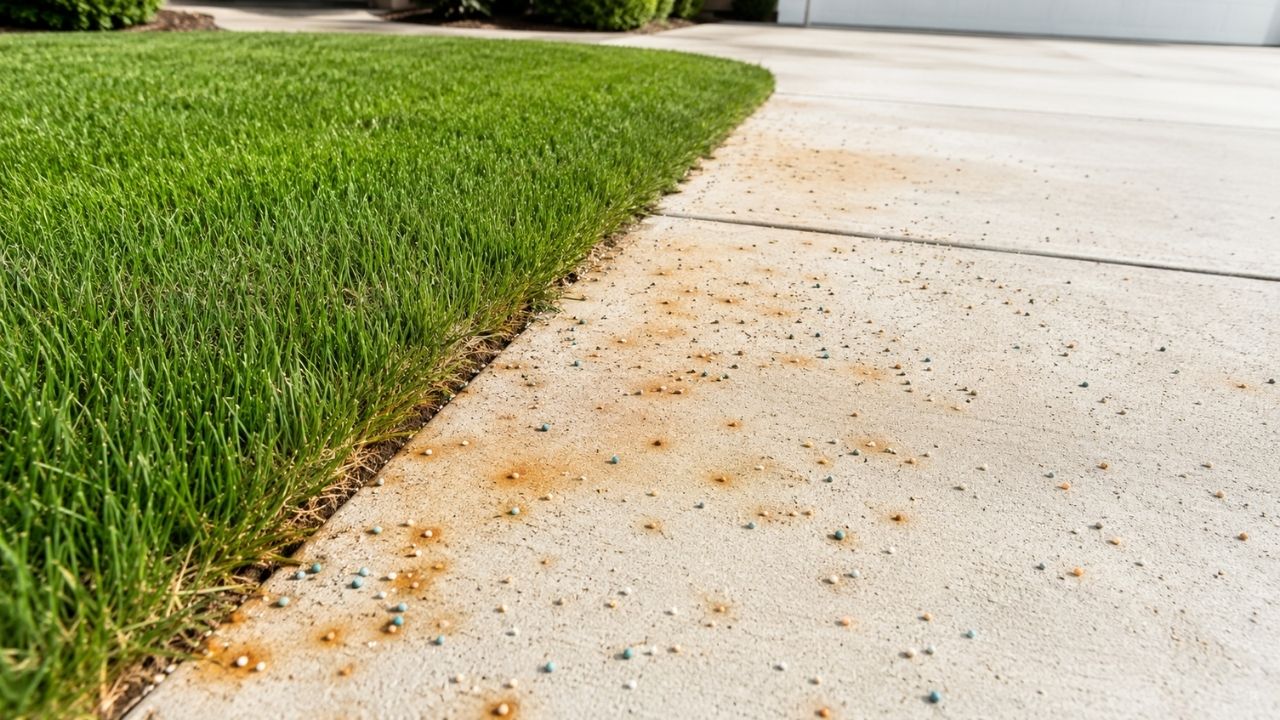
The granular fertilizer is used by many people to improve the appearance of the grass, strengthen the leaves, and give the garden a more intense green tone. The problem starts when the product is not confined to the lawn.
-
Failed Family Bakery Sparks Engineer’s Innovation, Leading to a $100 Million Energy-Efficient Oven Company in Brazil

-
Elon Musk Loses Trillionaire Status as SpaceX Shares Plummet, Wiping Out $61 Billion in a Day

-
New Railway in Mexico Diverted to Preserve 4,000-Year-Old Rock Art Resembling Aztec Rain God
-
Chinese Researchers Discover Largest Whale Graveyard in Indian Ocean: Nearly 500 Skeletons, Some 5.3 Million Years Old, Reveal Ecosystem Insights and Potentially Unknown Species



During application, some granules may fall on the sidewalk, garage, entrance floor, or concrete edges. Being small, they go unnoticed. The person finishes the job, turns on the hose, or waits for the rain, without imagining they left a risk spread on the ground.
The dangerous detail is that the problem does not appear immediately. At first, the grains just seem like common dirt. Then, when they come into contact with water and oxygen, they start to react and leave orange spots.
These marks draw attention because they resemble old rust. On light concrete, a new garage, or an unprotected sidewalk, the contrast can be even more visible and turn a simple gardening task into a concern with heavy cleaning.
Iron in the fertilizer explains the rust-like stain
The risk is linked to the composition of some products. When the fertilizer contains iron, manganese, or metallic minerals, these elements can oxidize upon contact with moisture. It is the same principle that causes metals to rust.
On the lawn, iron can help intensify the green color of the leaves. Outside of it, however, the same component can become a problem. When it falls on concrete, the granule remains on a porous surface and reacts when it receives water.
The concrete absorbs part of this oxidized residue. Therefore, the stain does not behave like common dust, which can be removed with a broom or damp cloth. It can penetrate the pores and require specific products for removal.
The stain does not happen by chance. It appears when three factors meet in the same place: fertilizer with metallic minerals, water, and a concrete surface capable of absorbing the residue.
Watering can turn forgotten granules into a headache
After applying fertilizer, many people water immediately. The habit is common in lawn care but can cause damage if there are granules scattered outside the grass.
If the product falls on concrete, water accelerates oxidation. What could have been easily removed with a dry broom becomes a more resistant mark, especially when the floor is light, old, or unsealed.
The same goes for heavy rain, drizzle, or nighttime humidity. Even without watering, the granule can react if it remains on the sidewalk long enough to absorb water.
Therefore, the decisive moment comes before the first water. Inspection should be done right after application, observing corners, joints, garden edges, garage, and house entrance.
Light sidewalks and new garages show the problem faster
Not all floors reveal the stain with the same intensity. Light sidewalks, porous floors, and unsealed concrete tend to show the marks left by the fertilizer more easily.
New garages can also suffer more visual impact because the orange color stands out on light gray surfaces. In areas with a more uniform finish, any point of false rust becomes evident.
The risk increases when fertilizer is applied near cemented areas. Poorly adjusted spreaders, wind during application, and refilling the equipment over the garage also favor the fall of granules outside the lawn.
The edge between grass and concrete is the most critical area. It is there that the product usually escapes, especially when the applicator tries to cover up to the garden’s edge without protecting the adjacent floor.
How to prevent fertilizer from ruining the garage
Prevention is simple, but it needs to happen at the right time. Before applying fertilizer, it is ideal to check if the lawn is touching the sidewalk, garage, porch, driveway, or concrete floor.
When there is this risk, it is worth protecting the edges with tarpaulin, cardboard, or temporary plastic. Another important measure is to fill the spreader always over the grass, never over the garage, because small leaks can occur even before the application begins.
It is also advisable to reduce the equipment’s opening near the edges. On windy days, extra care is needed, as the grains can be blown out of the desired area.
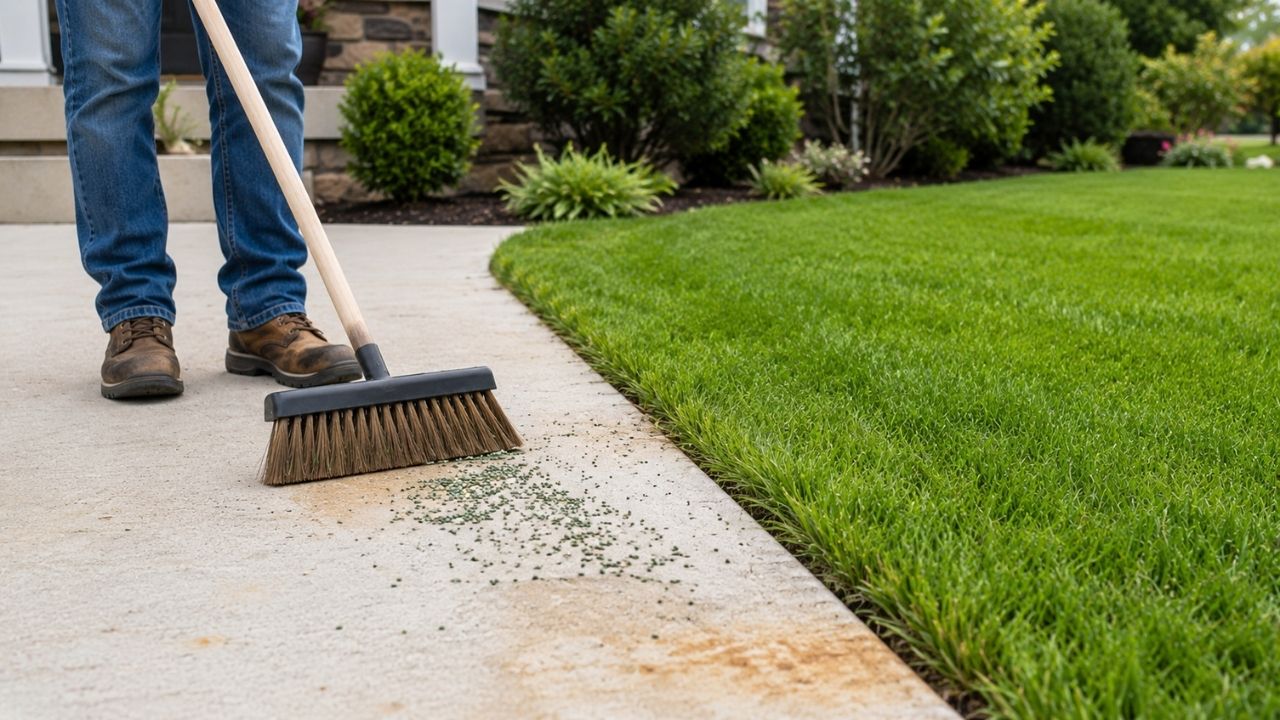
The golden rule is to sweep before watering. If any granule falls on the concrete, it should be removed with a dry broom before rain, irrigation, or floor washing.
Sweeping immediately can avoid hours of cleaning later
The most common mistake is to throw water to “clean” the granules. In the case of fertilizer with iron, this can worsen the problem, as it activates the reaction that generates the orange stain.
Preventive cleaning should be dry. First, sweep the excess. Then, if necessary, the area can be washed carefully. The goal is to prevent the minerals from staying long enough to oxidize on the concrete.
Tools, product bags, and spreaders also deserve attention. If washed over a light floor, concentrated residues can run off and leave marks in the wrong place.
A few minutes of inspection can avoid weeks trying to remove the stain. It is precisely this simple detail, ignored after fertilization, that often turns lawn care into a domestic nuisance.
When the stain has already appeared, scrubbing hard may not solve it


If the orange stain has already formed, scrubbing hard doesn’t always solve it. Since concrete is porous, part of the residue may be inside the surface, not just on it.
In this case, the best approach is to use a suitable product for removing rust from mineral surfaces, always testing first on a small area. Depending on the flooring, aggressive products can cause discoloration, corrosion, or even larger stains.
It is not recommended to mix cleaning products without guidance, especially on floors that have already received some type of sealer, paint, or finish. The attempt to solve it quickly can increase the damage.
Haste can turn a small stain into a bigger problem. Therefore, when the stain is extensive or the concrete is new, it may be safer to seek specialized guidance before applying any strong product.
Fertilizer is not a villain, but requires care outside the grass
Fertilizer remains a useful tool for keeping lawns more beautiful, green, and well-nourished. The problem is not in the use of the product itself, but in careless application near hard surfaces.
When used in the right place, in the indicated dose, and with attention to the surroundings, the fertilizer fulfills its role in the garden. The risk appears when the product falls where it shouldn’t and encounters water before being removed.
This type of problem shows how a simple household task can have unexpected consequences. The person thinks about the color of the grass but forgets that the floor next to it also needs protection.
The decisive care is outside the lawn. Protecting edges, applying on a windless day, and sweeping the concrete before watering are small actions, but they can prevent difficult stains and cleaning costs.
Have you ever seen fertilizer stain a sidewalk, garage, or concrete floor? Do you think this care should be clearer on the packaging? Leave your opinion in the comments.


