






 Portuguese
  Spanish
  5 min of reading
  0 comments


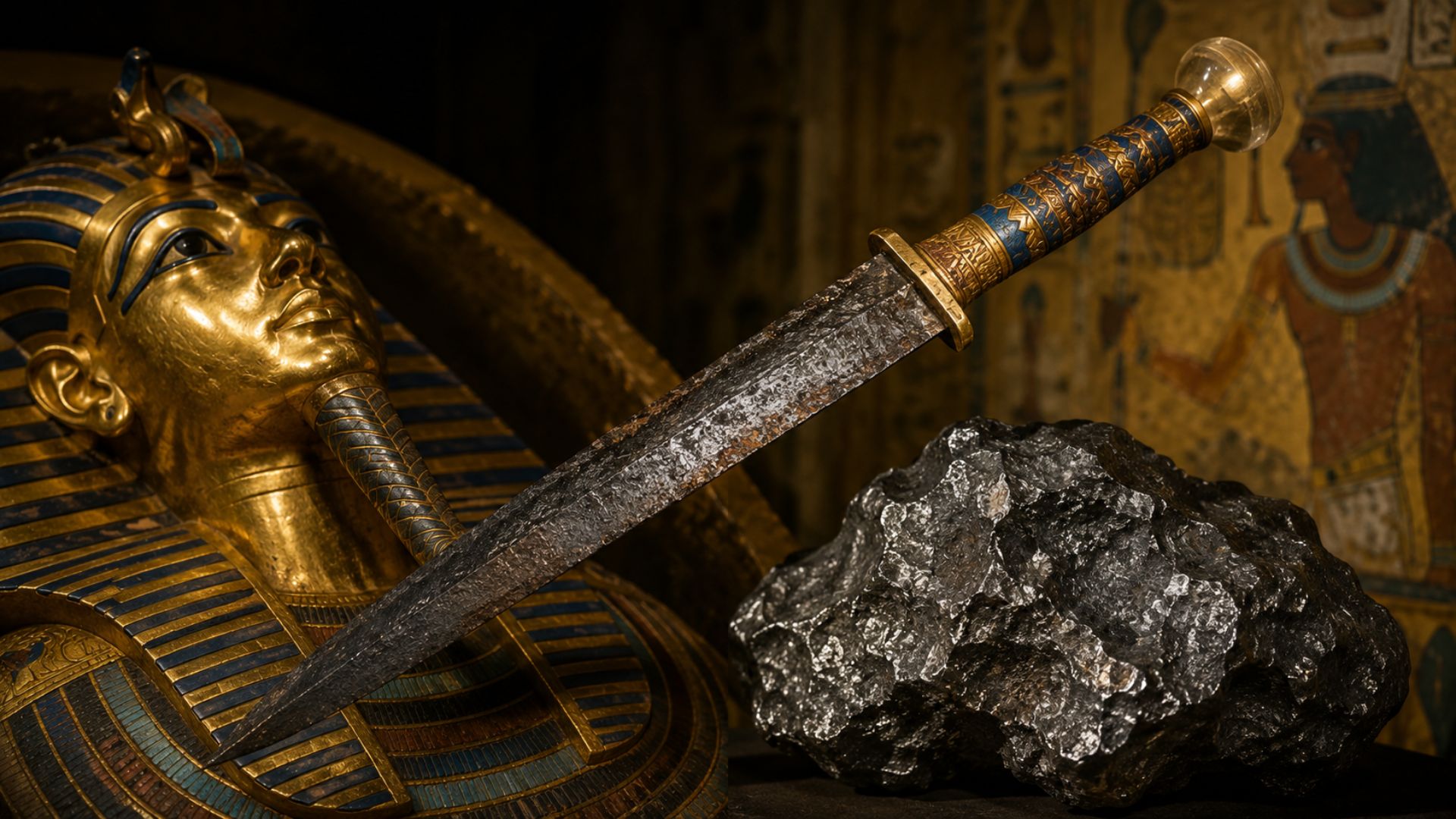
The clue was in the composition: much more nickel than any terrestrial iron, in addition to cobalt, the classic chemical signature of rocks that fall from the sky. The definitive analysis only came in 2016, but the suspicion had surrounded researchers since the 1960s, faced with a very rare metal in the time of the pharaoh.
The iron dagger found with the mummy of Pharaoh Tutankhamun was forged with metal from space. Scientists confirmed the extraterrestrial origin of the blade by detecting high levels of nickel and cobalt, typical of meteorites, in a material that, in Egypt over 3,000 years ago, was considered even more valuable than gold. The discovery continues to fascinate archaeologists and historians worldwide.
It is important to situate the chronology. The famous tomb of Tutankhamun was discovered by archaeologist Howard Carter in 1922, and the dagger appeared when the linen wrappings of the mummy were unwrapped in 1925. The suspicion that the blade had a meteoritic origin had existed since the 1960s, due to the high nickel content, but the definitive scientific confirmation only came in 2016, with a study published in the journal Meteoritics & Planetary Science. In other words, this is not a recent novelty, but one of the most striking confirmations of modern archaeometry.
How scientists confirmed the space origin

Technology was decisive in solving a decades-old mystery.
-
The world’s largest natural bridge cave is in China, impressing in Guizhou with almost 180 meters in height, a gigantic opening, and internal space used even for cars, becoming a cool tourist refuge within a monumental karst formation.

-
Goodbye, clothesline: new option for drying clothes utilizes walls, doors, and even room height with multiple drying levels, retractable model, and compact structure that promises to transform small laundries in 2026.

-
A discarded microwave may contain 22-carat gold in internal components; study recovered a 450 mg nugget from electronic boards.
-
Beach in the Northeast reaches a new level with a resort worth R$ 745 million, villas up to R$ 8.3 million, a complex of 2,347 hectares, and 6.5 km of beachfront in a destination still far from the hustle and bustle of Pipa.


An international team, led by researcher Daniela Comelli, used a non-destructive technique called X-ray fluorescence to analyze the composition of the blade at the Egyptian Museum in Cairo, without causing any damage to the millennia-old artifact.
The method bombards the object with X-rays and reads the radiation that each element emits in response.
The results were revealing: the blade is composed mainly of iron, with about 11% nickel and 0.6% cobalt.
This percentage of nickel is much higher than that of terrestrial iron, which has around 4%, and the ratio between nickel and cobalt is typical of iron meteorites.
It was this chemical signature, impossible to obtain with materials from Earth, that definitively confirmed the cosmic origin of the metal.
Why iron was worth more than gold
To understand the value of the piece, it is necessary to go back to the time when it was made.
In the 14th century BC, during the Bronze Age, iron was still extremely rare in Egypt, as the technology for smelting the metal practically did not exist, making this material more valuable and precious than gold itself in the eyes of royalty and the elite.
At that time, the few iron objects were reserved for artistic, ritual, ceremonial purposes, and as gifts between kings.
Diplomatic documents from the time, known as the Amarna letters, record that foreign rulers sent iron objects as precious gifts to Egyptian pharaohs.
All this reinforces why a dagger made of this metal, moreover of celestial origin, would be a treasure worthy of accompanying a pharaoh in the afterlife.
The fascination with the metal that fell from the sky

Although they did not understand the science behind meteorites, the ancient Egyptians certainly perceived that these fragments from the sky had characteristics different from anything that existed on Earth, associating them with celestial and divine phenomena, which further increased their prestige.
Not by chance, there are indications that the Egyptians even had an expression that linked iron to the sky, something like “metal of the sky”.
Possessing a blade forged with a material literally fallen from space was, therefore, a supreme symbol of power and connection with the divine, perfectly suited to a king who was seen as a bridge between the gods and men in Ancient Egypt.
The technical mastery of Egyptian artisans
The dagger impresses not only for its raw material but for the craftsmanship.
The high quality of the blade’s finish, compared to other more rustic meteorite iron objects of the time, suggests that Egyptian craftsmen already mastered advanced techniques for working with this rare material, at a level higher than many scholars imagined for the period.
Since they could not melt the meteorite metal, the craftsmen shaped it through hammering, known as forging.
The result, in the case of Tutankhamun’s dagger, is a piece of remarkable refinement, with a decorated gold handle and a rock crystal pommel.
Add to this the excellent state of preservation, guaranteed by the tomb’s dry environment, which prevented the common corrosion in such ancient iron artifacts, and it becomes clear why the piece is so unique.
A link between Earth and space
The story of the dagger ends up connecting archaeology to astronomy in a surprising way.
By comparing the composition of the blade with that of known meteorites in a vast area around Egypt, researchers found a candidate with similar levels of nickel and cobalt, a meteorite that would have fallen about 240 km west of Alexandria, although the exact origin of the rock is still under study.
This type of research, which combines history, chemistry, and space science, shows how the study of meteorites and rare minerals can reveal unexpected chapters of human civilization.
The same iron that today is one of the most common and fundamental metals of modern industry was, three millennia ago, a treasure worthy of pharaohs, precisely when it came from space.
It is a fascinating reminder of how the value of materials changes throughout history.
Tutankhamun’s iron dagger is much more than a ceremonial weapon: it is a tangible link between Ancient Egypt and the cosmos, forged with meteorite metal at a time when this material was worth more than gold.
Scientifically confirmed in 2016, its extraterrestrial origin reveals the ingenuity of Egyptian craftsmen and the fascinating relationship of that people with the sky and the divine.
More than three thousand years later, the blade continues to tell, in each detail, a story that unites the dust of the stars with the brilliance of one of humanity’s greatest civilizations.
And you, did you know that Pharaoh Tutankhamun was buried with a dagger made of meteorite metal? Were you impressed to discover that iron was once worth more than gold in Ancient Egypt? Leave your comment, tell us what fascinated you most about this story, and share the article with those who love Egypt, archaeology, astronomy, and the mysteries of history.


-

-

2 people reacted to this.