Portuguese
  Spanish


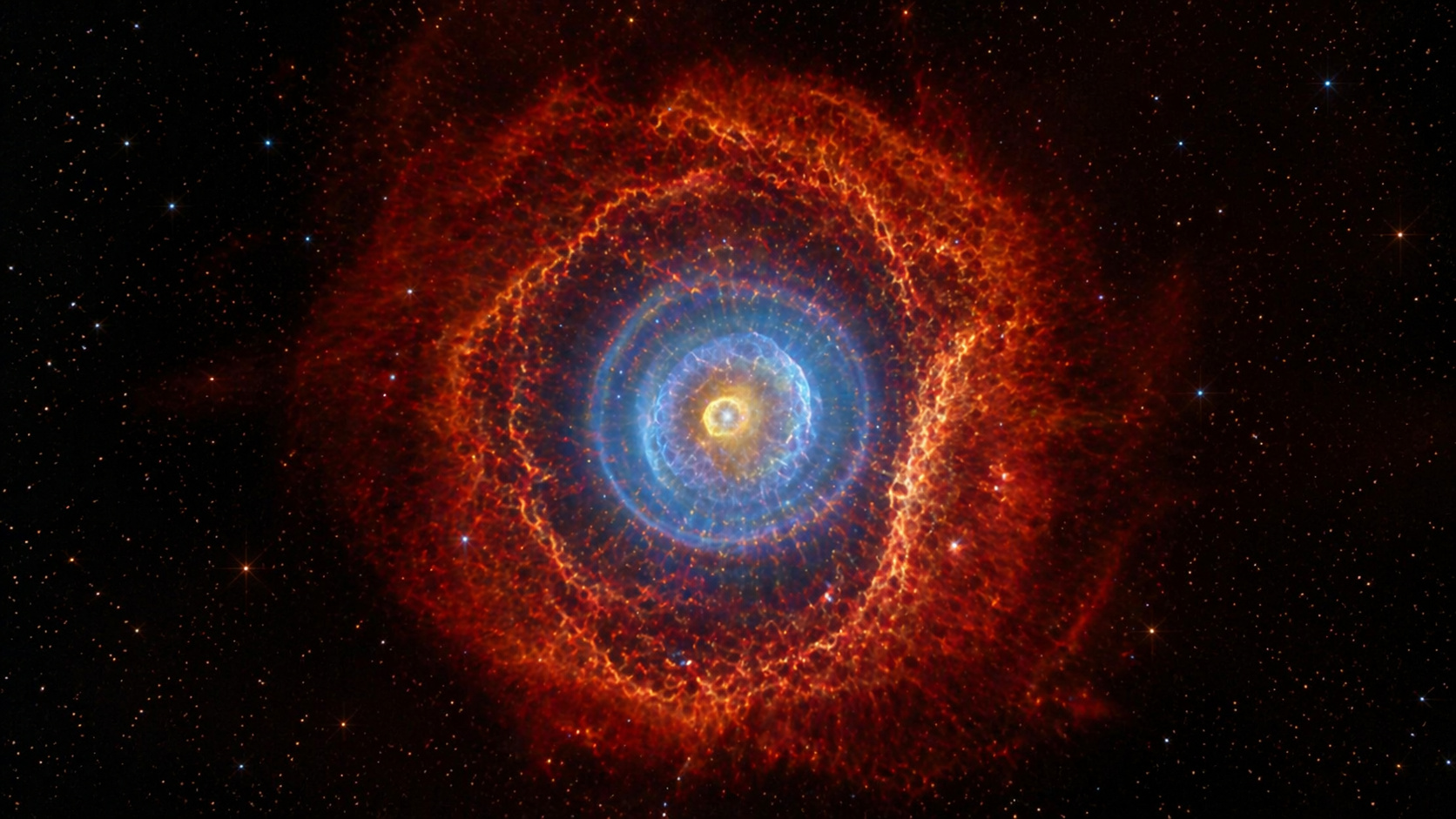


Unprecedented discovery reveals surprising cosmic patterns, connects chemical and visual data, and raises new questions about rare molecules that could redefine scientific knowledge
Science has just made another impressive leap towards understanding the universe. Thanks to the power of the James Webb Space Telescope, astronomers have revealed never-before-seen details of a star in its final phase of life, located more than 10,000 light-years from Earth. What once seemed like just another distant nebula has now transformed into a true cosmic laboratory, full of mysteries and discoveries capable of changing everything we know about space chemistry.
The information was released by “Western University”, based on new observations made with cutting-edge technology, drastically expanding the level of detail previously obtained by other telescopes.
The discovery of buckyballs in space and the journey that began in 2010

To understand the magnitude of this discovery, we need to go back in time. In 2010, scientists first identified “buckyballs” in space using the Spitzer Space Telescope. These fascinating molecules, composed of exactly 60 carbon atoms, have a structure similar to a soccer ball — formed by patterns of hexagons and pentagons.
-
Giant Phantom Halo Appears Around Remote Pacific Islands, NASA Reveals It’s Created by Tiny Marine Organisms

-
Scientists Develop Method to Store Wind and Solar Energy by Liquefying Air for On-Demand Power Generation

-
Brazilian Engineer Who Grew Up Without Electricity Develops Software, Expands AltoQi to 67,000 Clients, Aiming for $21 Million by Digitizing Brazil’s Construction Industry

-
Spain Launches World’s Largest Floating Dry Dock: 56-Meter Giant Produces Massive Concrete Structures in A Coruña Using Technology Proven in Brazil




However, although they had been known since 1985 — when they were synthesized in the laboratory and later awarded the Nobel Prize — their presence in space remained an enigma until that historic confirmation.
Now, with the technological advancement of the James Webb, researchers have returned to the Tc 1 nebula, located more than 10,000 light-years away, in the constellation Ara. And, surprisingly, what they found goes far beyond expectations.
The power of James Webb reveals previously invisible structures
This time, the big difference lies in the use of the MIRI instrument, which allowed for the capture of extremely precise details of the nebula. As a result, delicate filaments, bright shells, and multi-layered gas structures were identified, revealed at different temperatures — where blue tones indicate hotter regions, while red tones show cooler areas.
Furthermore, using the advanced technique of IFU (integral field unit) spectroscopy, scientists achieved something revolutionary: directly connecting every visual detail of the image with chemical and physical data of the nebula.
In other words, it’s not just about beautiful images — but rather a detailed map of the universe’s composition.
Buckyballs organized like never before seen intrigue scientists

Credit: Western Communications
One of the most surprising points of the research is the distribution of the buckyballs themselves. Contrary to what was imagined, they are not randomly scattered throughout space.
In fact, scientists discovered that these molecules form a kind of spherical shell around the central star — practically like a “giant buckyball” on a cosmic scale.
This organization raises a series of new questions: why do these molecules cluster in this way? What influences this specific distribution? And, most importantly, what role do these structures play in the evolution of nebulae?
These questions show that, although we have advanced, we are still far from fully understanding the chemical processes of the universe.
A mysterious detail in the shape of a question mark challenges science
As if that weren’t enough, the images also revealed a completely unexpected structure: a formation resembling an inverted question mark.
This intriguing detail made researchers even more curious. After all, structures of this type are not common and may indicate physical phenomena yet unknown.
Thus, the universe seems to respond to our discoveries with even more questions — reinforcing how much there is still to explore.


A new era in cosmic chemistry begins now
Finally, this discovery marks the beginning of a new phase in astronomy. After more than 15 years trying to understand why buckyballs shine so brightly in nebulae like Tc 1, scientists are now finally beginning to find concrete answers.
With the data obtained by James Webb, a promising path opens up to understand not only these molecules, but also the processes that shape the universe on a molecular scale.
Therefore, what was once just theory is now beginning to transform into solid knowledge — and, by all accounts, we are only scratching the surface of something much bigger.