Portuguese
  Spanish


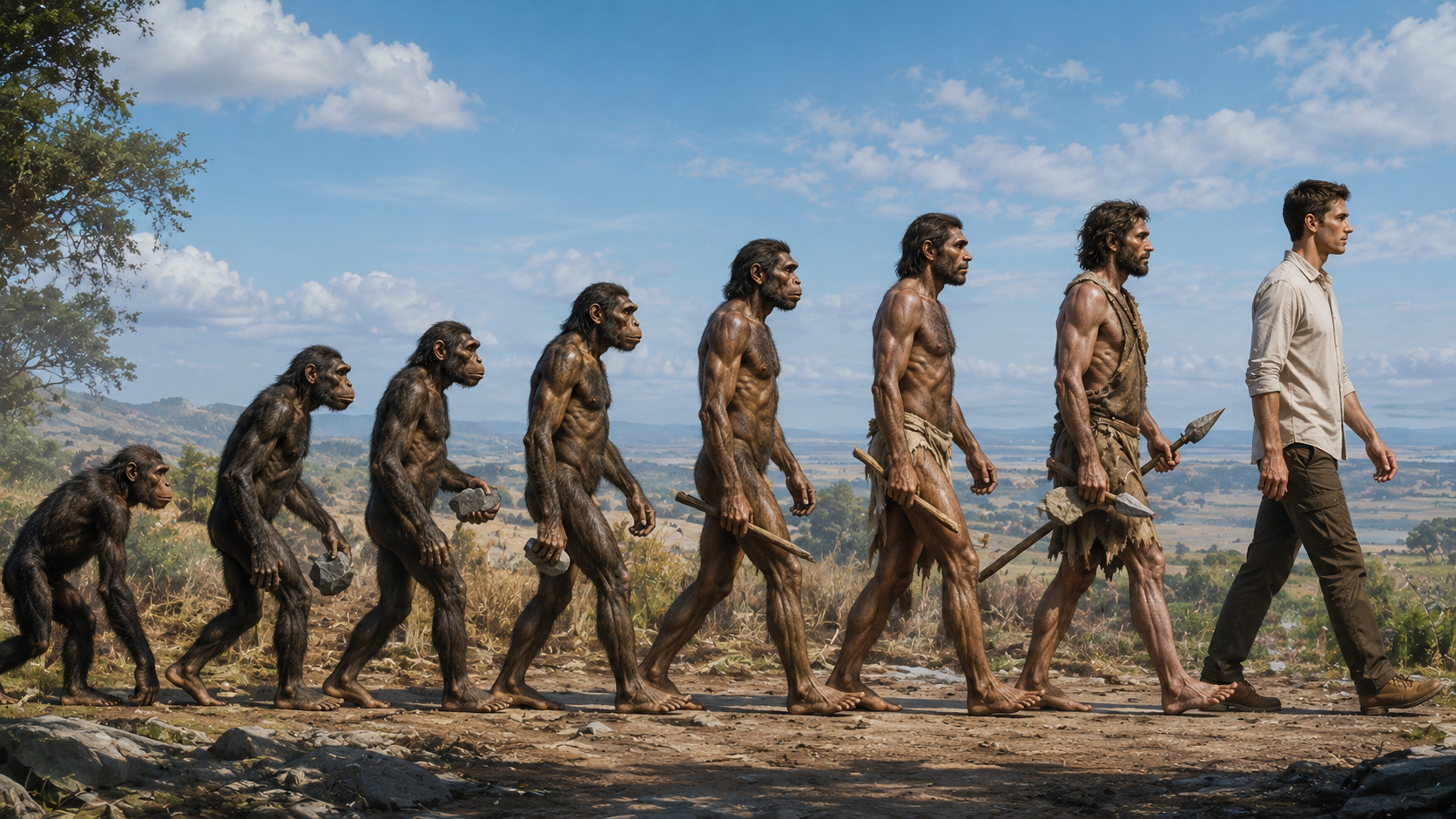

International study published by researchers from the University of Oxford indicates that right-hand dominance may be directly linked to bipedalism, brain growth, and the evolution of early hominids
Have you ever stopped to think about why the overwhelming majority of the world’s population writes, holds objects, and performs tasks with their right hand? Although this characteristic is present in about 90% of humans, science was still seeking definitive answers about the origin of this bodily dominance. Now, a new international study has provided important clues and revealed a surprising link between the brain, legs, and human evolution.
The information was released on April 27 by the scientific journal “PLOS Biology,” based on a study led by the University of Oxford in the United Kingdom. The researchers analyzed the behavior of dozens of primate species and discovered that the preference for the right side of the body is a strongly human characteristic, much rarer in monkeys and apes.
According to the scientists, the explanation may be directly related to the development of bipedalism — when human ancestors began to walk on two feet — and the progressive growth of the brain throughout evolution.
-
Brazil’s Largest Grain Port Faces Delays in the Hinterlands, Missing Rail Link Costs Agribusiness Billions

-
Astronomers Detect Excess Alcohol on Interstellar Comet 3I/ATLAS, Revealing Unique Chemical Signature from Another Star System
-
13-Year-Old Californian Girl Wins $25,000 Prize for Creating Low-Cost Water Filter from Discarded Animal Bones

-
Entrepreneur Secures $15 Million to Transform Steel Mill Waste into Concrete Material, Builds Demo Plant in the U.S. with a Goal of 10,000 Tons Annually



Furthermore, the researchers believe that this change occurred slowly over millions of years until it reached the pattern currently observed in Homo sapiens.
Research analyzed 41 primate species and compared brains, legs, and behavior
To reach the conclusions, the scientists analyzed behavioral, neurological, and social characteristics of 41 hominoid species, including humans, apes, and other primates.
The study used advanced statistical simulations focused on interspecific evolutionary relationships. Additionally, the researchers compared factors such as brain size, body structure, locomotion, tool use, habitat, diet, and social behavior.
One of the central points of the research was the so-called laterality, a term used by science to define the natural preference for using one side of the body more than the other.
The researchers included two main variables in the analyses: brain size and the ratio between leg and arm length, considered an important reference for bipedal movement.
According to the study, larger brains and longer legs showed a strong correlation with right-hand dominance.
Thomas Püsche, researcher at the University of Oxford and one of the study’s authors, stated in an official release that the results suggest a direct relationship between human laterality and some of the main characteristics that differentiate our species.
“The results are likely linked to upright posture and the evolution of larger brains,” explained the researcher.
Human evolution slowly strengthened right-hand dominance
The scientists also reconstructed estimates about the laterality of already extinct human ancestors. The analysis showed that ancient species like Ardipithecus and Australopithecus exhibited only a slight tendency to use the right hand.
However, this dominance began to increase more noticeably in species like Homo ergaster, Homo erectus, and Neanderthals.
The peak of this evolutionary process currently appears in Homo sapiens, a species in which approximately 90% of the population is right-handed and only about 10% is left-handed.
According to the researchers, this strengthening occurred in two major stages throughout human evolution.
The first began when hominids started walking on two feet. This freed the upper limbs for more complex tasks, such as object manipulation, tool-making, and fine movements.
Subsequently, as the human brain increased in size and complexity, the motor specialization of the right side progressively consolidated.
Furthermore, the scientists highlight that brain development may have favored a more efficient division of motor and cognitive functions within the human brain.
What do legs and the brain have to do with being right-handed?
Although the relationship seems curious at first glance, the researchers explain that bipedalism completely altered the body dynamics of early hominids.
Before that, the upper limbs played an important role in locomotion. When our ancestors began walking on two legs, the arms were freed for other functions.
Over time, the brain began to specialize in more precise movements, mainly on the right side of the body.
Moreover, scientists believe that neuroanatomical evolution played a fundamental role in the consolidation of manual dominance.
According to the research, these changes helped shape ecological and behavioral patterns not only in humans but also in other animals.
Another important point highlighted by the study involves the use of tools. As human ancestors began to manipulate instruments more frequently, the repetition of precise movements may have further favored motor specialization.
The team now intends to expand the research to understand how cultural factors also helped consolidate the predominance of the right hand throughout human civilizations.
The mystery of laterality still intrigues science
Despite the advances, researchers acknowledge that human laterality has not yet been completely understood.
This is because genetic, neurological, environmental, and cultural factors seem to act simultaneously in the development of body dominance.
Furthermore, scientists intend to investigate whether similar patterns may exist in other species not belonging to the primate group.
As published by the scientific journal PLOS Biology and disclosed by the University of Oxford on April 27, the study represents one of the most comprehensive analyses ever made on human laterality and evolution.
The discovery also reinforces how seemingly simple everyday characteristics can hide millions of years of biological adaptation.
And you, are you right-handed or left-handed? Have you ever imagined that this characteristic might be directly linked to the evolution of our ancestors over thousands of centuries?