






 Portuguese
  Spanish


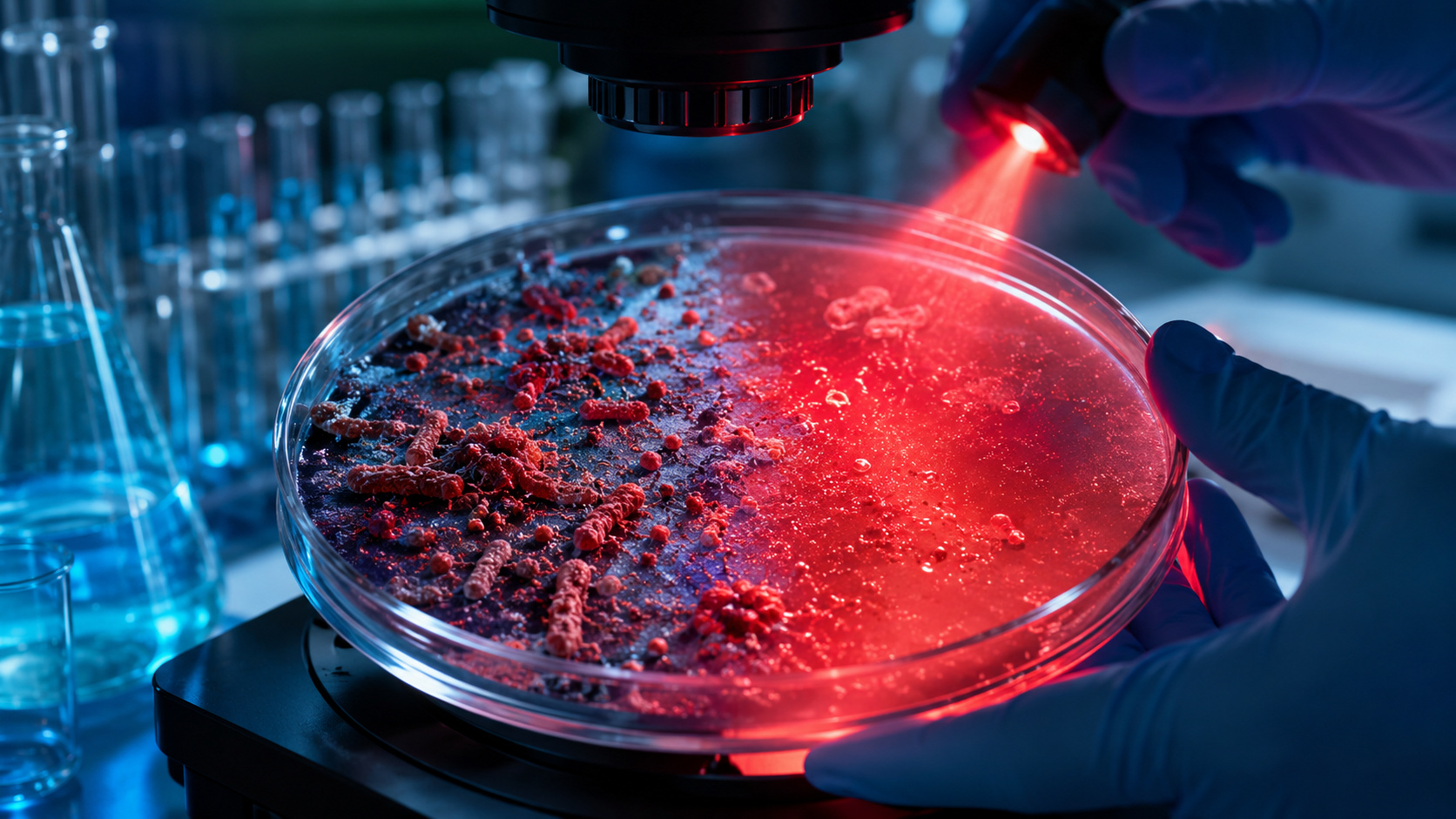


USP study combines photodynamic therapy, LED red light, and traditional antibiotics to weaken Klebsiella pneumoniae, one of the most dangerous superbugs in ICUs.
According to the Jornal da USP, researchers from the Institute of Physics of São Carlos, USP, in partnership with Texas A&M University, published on January 30, 2026, in the scientific journal Antibiotics, a study showing how the combination of photodynamic therapy with traditional antibiotics can enhance the fight against Klebsiella pneumoniae.
The bacterium is one of the most dangerous superbugs in Brazilian hospitals and worldwide. It is associated with pneumonia in patients on mechanical ventilation, severe hospital infections, and deaths caused by strains resistant to available antibiotics.
The group led by Koteswara Rao Yerra and Professor Vanderlei Salvador Bagnato tested two dyes, methylene blue and photoditazine, activated by LED red light at 660 nm, in combination with ciprofloxacin, gentamicin, and ceftriaxone.
-
Qatar Commissions World’s Largest Gas Ship, a 344-Meter Giant Now Under Construction

-
Expert Challenges Alarmism Over El Niño in Brazil: Atmosphere Yet to Respond to Warm Pacific, Advises Farmers Against Selling Cattle or Delaying Planting Before September
-
In a Degraded Atlantic Forest Area, a São Gonçalo Resident Transforms Land into a Living Eco-Museum, Now a Model for Environmental Education

-
World’s First Lithium-Sulfur Battery Factory Launches, Promising to Double Range Without Relying on China


USP photodynamic therapy enhances antibiotics against Klebsiella pneumoniae
The most significant result came from the combination of methylene blue and ciprofloxacin. In the tests, this association led to the complete eradication of Klebsiella pneumoniae after 18 hours, with a reduction in bacterial load by up to six times compared to the antibiotic alone.
The proposal of antimicrobial photodynamic therapy is to weaken the bacterium’s defense mechanisms before or during the antibiotic action. Instead of relying solely on higher doses of the drug, the light helps make the bacterium more vulnerable.


This point is crucial because hospital superbugs often resist conventional treatments. The combination of light, dye, and antibiotic can open a complementary route against infections that currently have few therapeutic options.
Klebsiella pneumoniae is a superbug associated with ICUs and mechanical ventilation
Klebsiella pneumoniae is a gram-negative bacterium, with a double outer membrane that makes it difficult for many antibiotics to enter. This type of structure already offers a natural barrier against several medications.
With the excessive and incorrect use of antibiotics over decades, some strains have developed even greater resistance. They produce enzymes that destroy antibiotics, use efflux pumps to expel drugs, and form protective biofilms.
In patients admitted to the ICU, weakened and dependent on mechanical ventilation, an infection by a resistant strain can be critical. In these cases, therapeutic options may be few, toxic, or insufficient to control the infection.
Bacterial resistance makes Klebsiella a critical priority for new treatments
The World Health Organization classifies carbapenem-resistant Klebsiella pneumoniae as a critical priority among pathogens for which new treatments are urgently needed.
Carbapenems are considered last-line antibiotics in many hospitals. When the bacteria develop mechanisms capable of resisting even these drugs, treatment becomes much more difficult.
The problem is that developing new antibiotics takes years and requires high investments. Meanwhile, resistant bacteria evolve rapidly and pressure hospitals to seek combinations, alternative therapies, and repurposing of already known technologies.
Red LED light at 660 nm helps the antibiotic enter the bacteria
Photodynamic therapy works in three steps. First, a photosensitizing dye, such as methylene blue, is applied, which is absorbed by bacterial cells more easily than by human cells.

Then, the treated area receives red LED light at 660 nm. When this light reaches the dye inside the bacteria, a chemical reaction occurs that produces reactive oxygen species.
These molecules damage essential structures of the bacteria, such as the outer membrane, DNA, and resistance proteins. With the membrane compromised, the antibiotic can enter more efficiently and act where it was previously blocked or expelled.
Methylene blue was the most effective dye in the study against superbug
The study compared two photosensitizers: methylene blue and photoditazine. Among the combinations tested, methylene blue showed the best performance against Klebsiella pneumoniae.
The practical advantage is that methylene blue has been known to medicine for more than a century. It is used as a surgical dye, tissue marker, antidote for methemoglobinemia poisoning, and treatment in some skin infections.

This matters from a regulatory standpoint. Since the safety profile of methylene blue is already widely known, research can progress more quickly than it would with a completely new molecule.
Ciprofloxacin had a better response when combined with methylene blue
The most potent combination in the study was methylene blue with ciprofloxacin. Ciprofloxacin is a widely used antibiotic in hospitals and belongs to the fluoroquinolone class.
When used alone, ciprofloxacin can have a limited effect against resistant strains. But, when associated with photodynamic therapy, its action was significantly enhanced in laboratory tests.
The researchers documented complete eradication of the bacteria after 18 hours. The combination was much more effective than the isolated use of the antibiotic under the tested conditions, showing potential to reduce bacterial load without solely relying on increasing doses.
Pulmonary surfactant hindered dye delivery in the lungs
A previous study by the same group, published in September 2025 in the journal Pathogens, had identified a significant obstacle to using photodynamic therapy in lung infections.

In the lungs, there is pulmonary surfactant, a natural layer that lines the alveoli and allows normal breathing. The problem is that this layer can trap the photosensitizer dye before it reaches the bacteria.
To overcome this barrier, the researchers combined methylene blue with Gantrez, a polymer safe for medical use. Gantrez acts as a carrier, helping the dye to cross the surfactant and reach the bacteria in the alveoli.
USP research combines dye delivery and increased antibiotic efficacy
The two studies form an important technical sequence. The 2025 work addressed the problem of delivering the dye to the bacteria in the pulmonary environment.
The January 2026 study advanced in another area: it showed that when the dye reaches the target and is activated by light, it can enhance traditional antibiotics against Klebsiella pneumoniae.
This combination creates a more coherent path for future application. First, the photosensitizer must reach the bacteria; then, it is necessary to use light to weaken the resistance and allow a stronger action of the antibiotic.
Photodynamic therapy may reach clinics faster than a new antibiotic
One of the most relevant points of the research is the use of already known substances and equipment. Methylene blue, ciprofloxacin, gentamicin, ceftriaxone, and 660 nm red LED are already part of the medical universe.
This can shorten steps compared to the development of an entirely new antibiotic. A new drug usually requires toxicity tests, animal studies, and long clinical phases before reaching patients.
In the case of combinations with already known components, the regulatory path can be shorter, although it still depends on validation. The next step documented by the researchers is to confirm the efficacy in animal models before advancing to clinical studies.
USP study shows national path against antimicrobial resistance
The fact that the research has the central participation of a Brazilian public university is relevant. IFSC-USP concentrates knowledge in biophotonics, photodynamic therapy, and medical application of light.
The partnership with Texas A&M reinforces international collaboration, but the technical advancement does not depend solely on foreign laboratories. An essential part of the solution was developed within the Brazilian scientific system.
The discovery does not yet represent a treatment available to patients, but it shows a promising route. By combining red light, methylene blue, and already known antibiotics, USP’s research points to a faster and more accessible strategy to tackle hospital superbugs.


