






 Portuguese
  Spanish
  6 min of reading
  0 comments


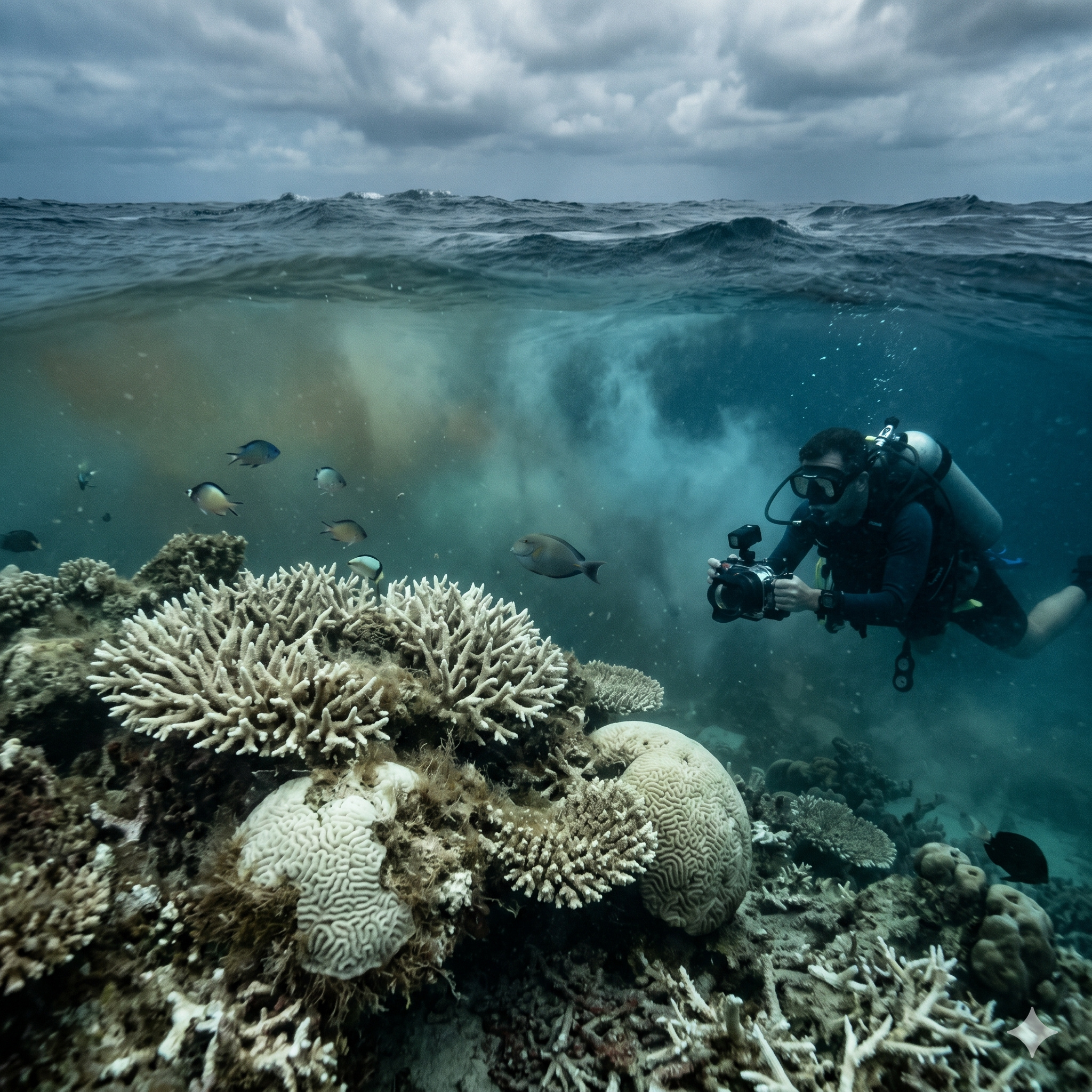
Study reveals that warming, acidification, deoxygenation, and salinity changes are acting together in the ocean, putting pressure on marine life.
On November 25, 2025, a study published in the scientific journal Nature Climate Change issued a technical warning about the current state of the oceans: climate pressure no longer appears as isolated warming but as a simultaneous combination of warming, acidification, oxygen loss, and salinity changes. The research analyzed physical and biogeochemical variables observed over six decades and identified large-scale composite changes from the surface to subsurface layers of the ocean. The data that makes this scenario even more concerning is well-known in climate science: according to the IPCC, the ocean has absorbed more than 90% of the excess heat accumulated in the climate system since 1970.
This heat does not remain just on the surface; it distributes throughout the water column, altering density, circulation, stratification, oxygenation, and marine chemistry, increasing pressure on ecosystems that already depend on very specific ranges of temperature, oxygen, and acidity to survive.
The study indicates that as these factors begin to act simultaneously, the total impact is not just the sum of the individual effects, but an interaction that can amplify risks and accelerate environmental changes.
-
Helicopter Drops 180 Tons of Sand and Gravel on Swedish River to Revive Ecosystem Damaged by Decades of Exploitation

-
Brazilian Company Launches Retro Smartphone with 48 MP Camera, T9 Keyboard, and Privacy Features for Social Media-Free Use

-
Self-Taught Chinese Farmer Builds 5-Ton Submarine from Scrap, Launches It in Anhui River
-
Invisible Induction Technology Enables Wireless Power for Blenders, Coffee Makers, and Air Fryers, Reducing Countertop Cables




Ocean warming is the basis of the problem and is altering the entire functioning of the marine system
Warming is the first vector of this set of pressures. As the water temperature increases, fundamental changes occur in ocean dynamics.
Warmer waters become less dense, which hinders vertical mixing between the surface and deep layers. This process intensifies the stratification of the water column, reducing nutrient circulation and directly affecting biological productivity.


Additionally, the accumulated heat influences the thermal expansion of water, contributing to sea level rise. It also alters ocean circulation patterns and can impact climate phenomena such as storms and global currents.
Warming is not just an isolated variable, but the element that triggers and intensifies other stresses.
Acidification alters water chemistry and affects organisms that depend on carbonate
Alongside warming, ocean acidification occurs. This process is linked to the absorption of carbon dioxide (CO₂) from the atmosphere. When dissolved in seawater, CO₂ forms carbonic acid, reducing pH and altering carbonate availability.
This compound is essential for organisms that build calcareous structures, such as corals, mollusks, and some types of plankton.
With less carbonate available, these organisms face greater difficulty in forming and maintaining their structures, which can compromise reefs, food chains, and marine habitats.
The study highlights that acidification, when combined with warming, increases the level of biological stress, making adaptation more difficult.
Deoxygenation reduces habitable areas and pressures marine species
Another critical component identified is the reduction of dissolved oxygen in the water, known as deoxygenation.
Warmer waters retain less oxygen, and increased stratification reduces renewal between layers. As a result, regions with low oxygen, called oxygen minimum zones, tend to expand.
This reduces the habitable space for various species, especially those that depend on higher oxygen levels.
Fish, crustaceans, and other organisms may be forced to migrate to more favorable areas, which alters food chains and can have direct impacts on fishing.
Changes in salinity indicate alteration in the global water cycle
Salinity is another important indicator of the ocean’s state. Changes in this parameter reflect alterations in the global hydrological cycle, including patterns of evaporation, precipitation, and ice melting.
Saltier regions tend to become even saltier, while more diluted areas receive more freshwater, either from intense rainfall or melting ice.

These changes affect water density and, consequently, ocean circulation, which depends on differences in temperature and salinity to move water masses around the planet.
When salinity changes, circulation can alter, impacting the transport of heat, nutrients, and even regional climate.
The main risk lies in the combination of stresses, not just in each one in isolation
The most relevant point of the study lies in the interaction between these factors. Traditionally, impacts were analyzed separately: warming on one side, acidification on another, oxygen loss on yet another front. What the research shows is that these processes are occurring simultaneously and in the same space.
This overlap creates an environment where organisms face multiple simultaneous challenges, reducing their adaptive capacity.
For example, a coral might withstand a moderate temperature increase or a slight pH change, but it may not survive when both occur together, especially if accompanied by low oxygen. This combined effect is known as compound stress and represents one of the main current concerns in marine science.
Impacts can spread from the base of the food chain to global economic systems
The effects of these changes are not restricted to isolated species. They can propagate throughout the entire food chain.
Phytoplankton, the base of marine life, can be affected by changes in nutrient and light availability. This impacts zooplankton, which in turn affects fish and larger predators.

Changes at the base of the system can be reflected at higher levels, including commercial fishing and food security.
Furthermore, many countries depend directly on the ocean for food, employment, and economy. Changes in marine ecosystems can generate significant economic effects, especially in coastal regions.
The deep ocean is also being affected, even far from the surface
Although many impacts are observed at the surface, the study indicates that changes also reach deeper layers.
Accumulated heat propagates slowly to the bottom, while changes in circulation affect the distribution of physical properties along the water column.
This means that the deep ocean, which was previously considered more stable, is also being transformed, albeit less visibly. This change is especially relevant because the deep ocean functions as a long-term reservoir for heat and carbon.
Scientists warn that adaptive capacity may be exceeded in various ecosystems
One of the main points of attention raised by the research is the limit of biological adaptation. Marine species have some capacity to adapt to environmental changes, but this capacity has limits.
When multiple stresses act simultaneously, these limits can be exceeded, leading to biodiversity losses and ecosystem reorganization.
The pace of change is also a critical factor. Rapid alterations reduce the time available for evolutionary adaptation or migration to new areas.
The ocean is changing on multiple fronts simultaneously and redefines the global climate scenario
The set of evidence presented by the study points to a systemic transformation of the ocean. It is not a single isolated phenomenon, but a set of interconnected processes that are altering the physics, chemistry, and biology of the planet’s largest system.

The ocean, which has always functioned as a climate regulator, is starting to operate under new conditions, with direct implications for climate, biodiversity, and human societies. This change does not occur uniformly, but is already detectable in different regions and depths.
In the end, the question that emerges from this scenario is inevitable: if the ocean is being simultaneously pressured by heat, altered chemistry, less oxygen, and changes in circulation, to what extent can marine ecosystems adapt before these transformations begin to permanently redefine the balance of life on the planet?





Be the first to react!