






 Portuguese
  Spanish


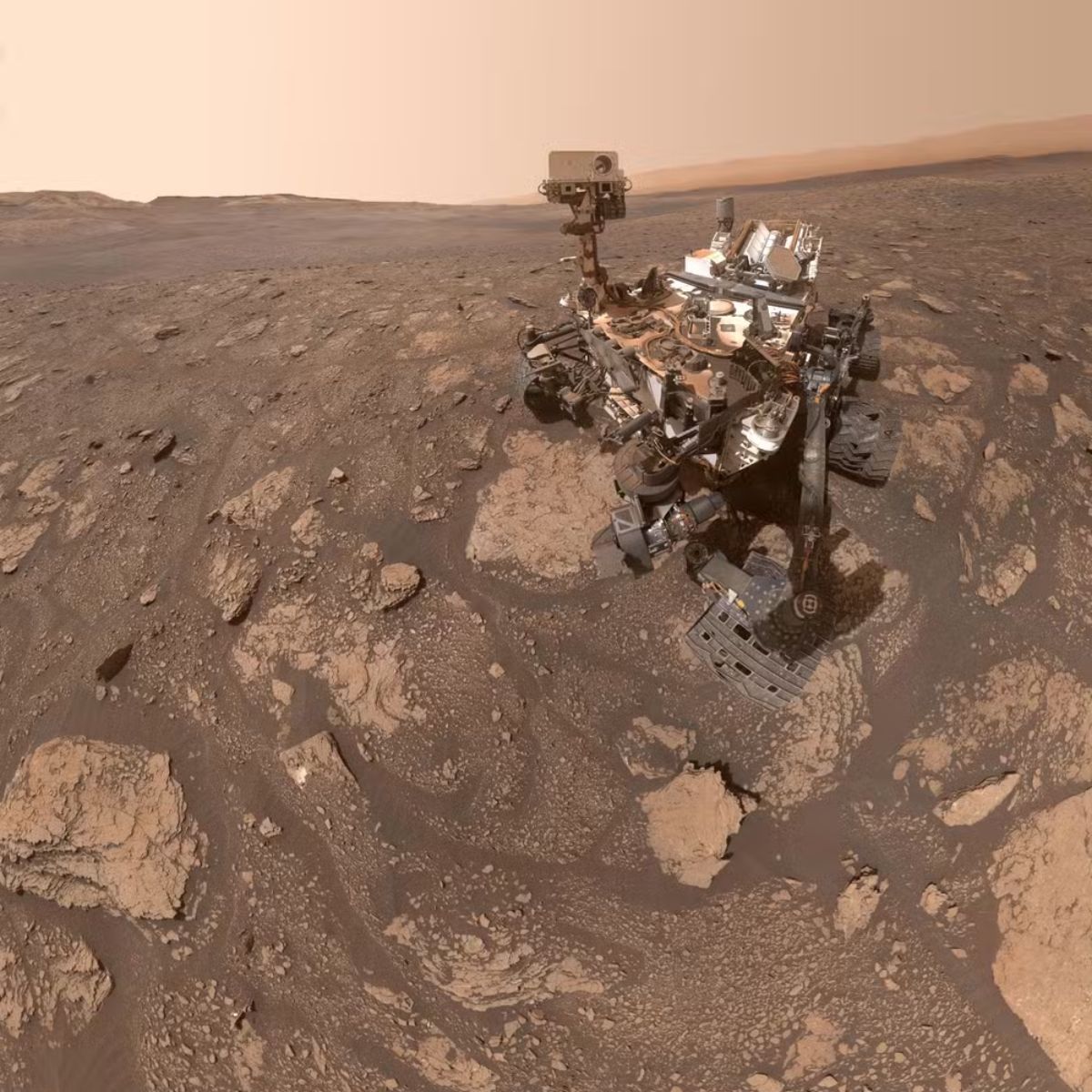
NASA’s Curiosity rover identified a diverse mixture of organic molecules preserved on Mars for billions of years, including a nitrogenous compound with a structure similar to that of DNA precursors, never before found on the red planet, in a groundbreaking chemical experiment published this Tuesday (21) in the journal Nature Communications.
The Curiosity rover has just delivered what may be one of the most significant results of its 13 years of operation on Mars. In a chemical experiment conducted for the first time on another planet, NASA’s robot found organic molecules preserved for approximately 3.5 billion years in Gale Crater, an ancient basin rich in clays. Among the identified compounds is a nitrogen-containing molecule whose structure resembles that of substances that may have given rise to DNA on primitive Earth, something that had never been detected on the Martian surface.
The discovery does not prove that there was life on Mars, but it demonstrates that the planet is capable of preserving exactly the type of molecule that could serve as evidence of ancient life. For astrobiology, this changes the level of discussion: the issue is no longer whether Mars can hold biological clues, but rather developing the right tools to interpret them. Amy Williams, a geological sciences professor at the University of Florida and leader of the study, classified the finding as evidence that ancient organic matter is indeed preserved on the red planet.
What Curiosity found and why these organic molecules matter

The experiment was conducted in 2020 in the Glen Torridon region, within Gale Crater, a site chosen for its richness in clays, minerals known to retain and protect organic compounds better than other geological materials. The rover used a substance called TMAH to fragment larger organic molecules, allowing its instruments to analyze them accurately. Curiosity carried only two containers of this chemical reagent, which required rigorous planning to select the most promising collection point.
-
In Somaliland’s Desert, Greenhouse Uses Sun and Seawater to Grow Lettuce, Cucumbers, and Tomatoes Without Rain: 1-Hectare Project Cools Crops, Desalinates Water, and Converts Brine into Commercial Salt

-
Trump Unveils $400 Million Boeing 747 Donated by Qatar as Temporary Air Force One Amid Boeing Delays, Sparking Debate on National Security, Costs, and Foreign Influence
-
Chinese Company Unveils Robotic Toilet That Comes to You, Featuring Lidar Sensors, Voice Command, Bidet, Hot Air Drying, UV Light, and Self-Cleaning Waste Disposal
-
Rotterdam Develops Floodable Square to Absorb Nearly 2 Million Liters of Rainwater, Doubling as Sports, Theater, and Leisure Space When Dry to Combat Urban Flooding




Two compounds stood out among the results. The first is a nitrogenous molecule with a structure similar to that of precursor substances of DNA, an unprecedented finding on Mars. The second is a chemical compound that typically arrives on planets carried by meteorites, the same type of material that is believed to have helped create the conditions for the emergence of life on Earth. The simultaneous presence of these organic molecules reinforces a connection between the two planets that goes beyond mere geological similarity.
Why the clays of Gale Crater functioned as a time capsule
The fact that these molecules have survived 3.5 billion years on Mars is, in itself, surprising. The planet is bombarded by intense cosmic radiation, has a much thinner atmosphere than Earth, and undergoes extreme temperature variations. Under normal conditions, organic molecules would be destroyed in such a hostile environment in a matter of millions of years, not billions.
The explanation lies in the clays of Gale Crater, which acted as a sort of protective shield. These minerals enveloped the compounds and partially isolated them from radiation and chemical degradation, keeping them intact over entire geological eras. This preservation capability opens an important perspective: if such delicate organic molecules managed to survive for so long, other potentially more revealing substances about Mars’s history may also be preserved somewhere on the Martian surface or subsurface.
What the discovery cannot answer about life on Mars
Despite the relevance of the finding, the experiment has a fundamental limit. It cannot distinguish whether the compounds found came from a possible past life on Mars, from natural geological processes, or from meteorites that collided with the planet throughout its history. All three origins are scientifically plausible, and none can be ruled out with the data available so far.
This ambiguity does not diminish the importance of the discovery, but it limits what it can assert with certainty. The Curiosity rover confirmed that Mars preserves complex organic molecules, but to determine if any of them have a biological origin, it would be necessary to bring Martian rock samples back to Earth. Earth-based laboratories have much more sophisticated instruments than any equipment that can fit inside a rover, and only they could perform the isotopic and structural analyses capable of differentiating organic chemistry of biological origin from that produced by abiotic processes.
The connection between Mars and Earth that the study reinforces
The presence of compounds brought by meteorites both on Mars and on Earth adds a fascinating layer to the discussion. The same material that hit the red planet and was found by Curiosity also reached our planet billions of years ago, and researchers believe that this meteoritic bombardment provided some of the building blocks for life as we know it. In other words, Mars and Earth shared the same chemical raw materials in their first billion years.
The difference is that Earth developed favorable conditions for this chemistry to evolve into biology, while Mars lost its dense atmosphere and surface liquid water, becoming the frozen desert we know today. The question that remains is whether, during the window when Mars had habitable conditions, something akin to life arose before the planet became hostile. Curiosity’s finding does not answer this question, but it shows that the tools to find it may be within reach of upcoming missions.
What lies ahead in the search for evidence of life on Mars
The study published in Nature Communications concludes with a clear message from the team led by Williams: there is now confirmation that large and complex organic molecules are preserved on the surface of Mars, and this is promising for the search for signs of life. The next logical step is the sample return mission, jointly planned by NASA and the European Space Agency for the coming decades, which would bring Martian rocks to Earth laboratories for definitive analysis.
Meanwhile, Curiosity continues to operate in Gale Crater, and the Perseverance rover, which landed on Mars in 2021, is collecting and storing samples in sealed tubes in Jezero Crater for future retrieval. The convergence between what Curiosity has discovered and what Perseverance is storing may, at some point in the next decade, provide the answer that humanity has been seeking since it first looked at the red planet: was there life on Mars, or have we always been alone in this corner of the solar system?
Do you believe that the organic molecules found on Mars could be evidence of ancient life, or do you think it is more likely that they originated from meteorites and geological processes? Leave your opinion in the comments, we want to know what you think about the possibility of life beyond Earth.





-

1 person reacted to this.