






 Portuguese
  Spanish


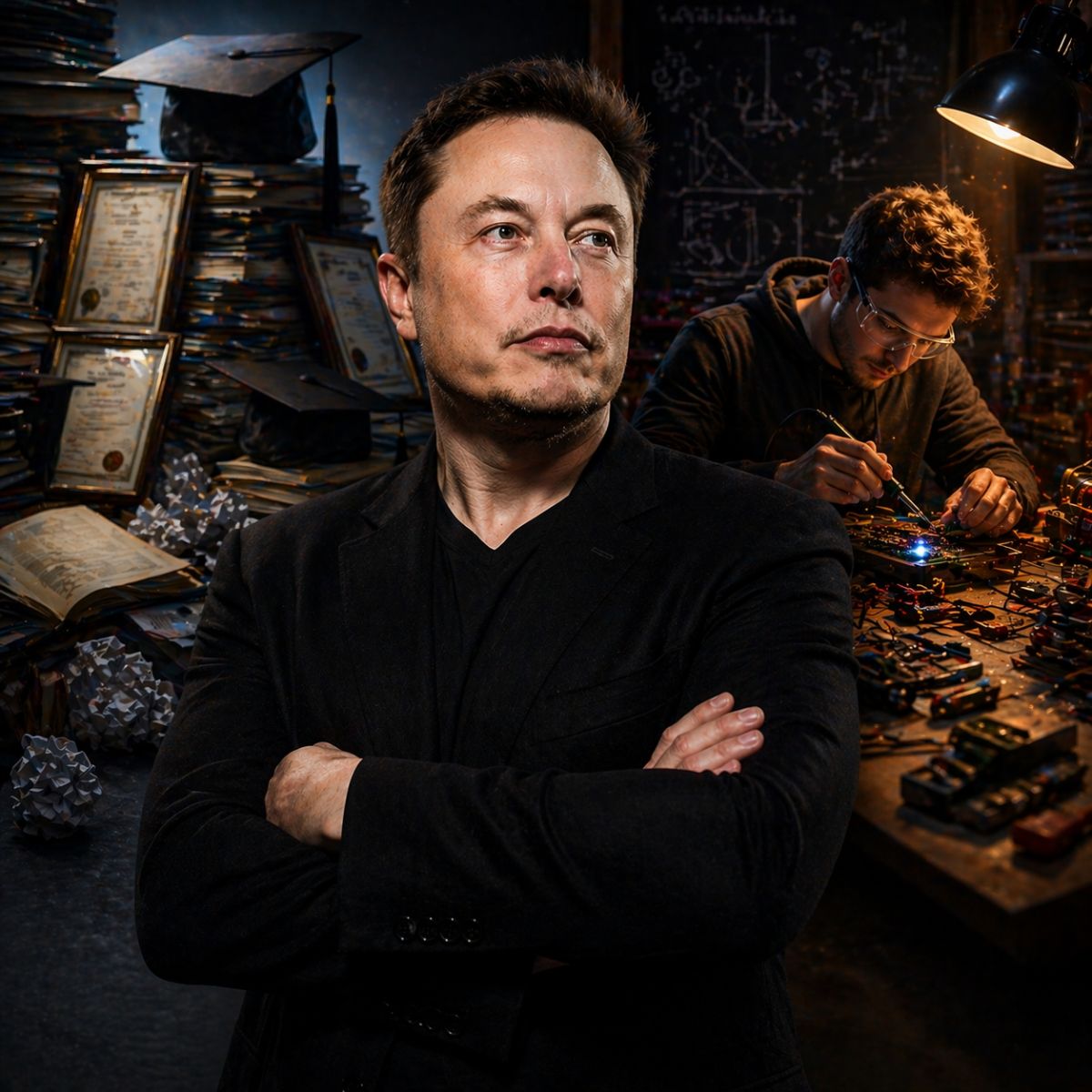

The phrase by Elon Musk, “Do not confuse schooling with education. I did not study at Harvard, but the people who work for me did,” raises a discomforting reflection: degrees prove study, not competence. In a world where access to knowledge has never been so broad, understanding the difference between formal learning and real education can change the way we build careers and make decisions.
The reflection by Elon Musk on schooling and education touches on a point that many prefer to ignore. The founder of Tesla and SpaceX did not attend Harvard, Stanford, or any of the universities that the traditional market venerates, but built companies that employ thousands of professionals who graduated from those very institutions. The phrase is not an attack on formal education, but a reminder that attending a classroom and leaving it with a diploma does not guarantee that someone has learned to think, create, or solve problems.
This distinction matters more today than at any other time in history. Technology has irreversibly democratized access to knowledge. Anyone with an internet connection can study the same content taught at the best universities in the world, often for free. What separates those who evolve from those who stagnate is no longer the name of the institution on the diploma, but the curiosity to go beyond the curriculum and the discipline to apply what is learned in practice.
What Elon Musk meant by separating schooling from education
According to information released by the portal Revista Oeste, schooling is the formal path: attending institutions, following predefined curricula, taking exams, and receiving certificates at the end. Education, in Elon Musk’s understanding, is something much broader. It encompasses lived experiences, mistakes made, problems solved, and the habit of seeking knowledge continuously, regardless of whether there is a teacher, a schedule, or a diploma waiting at the end of the process.
-
From Painting Houses in the U.S. to Producing Beyoncé and Paul McCartney Shows, Entrepreneur Opens Luxury Hotel in Brazil’s Trancoso with $8 Million Revenue Goal

-
Massive 109-Meter, 5,500-Ton Ship Built to Supply Energy in War Crossed the Atlantic, Powered Rio in the 1950s, and Was Sunk in Pará to Protect Tocantins Riverbank

-
Brazilian Domestic Worker Lived 55 Years Without a Salary, Had Welfare Benefits Controlled by Employer
-
Former PE Teacher Turns São Paulo Thrift Store into Online Sensation with 1 Million Followers, Now Earning $50,000 Monthly with Son and Plans to Expand Nationwide




The difference is not abstract. In today’s job market, employers increasingly report difficulty in finding professionals who can apply in practice what they studied in theory. People with impeccable academic resumes freeze when faced with problems that require critical thinking, creativity, or adaptability, skills that rarely appear in multiple-choice tests but determine who delivers results and who merely occupies a seat.
Why degrees have stopped being a guarantee of competence
For decades, the diploma served as a passport to the job market. Having a higher education was synonymous with qualification, and the university of origin functioned as a quality seal that automatically opened doors. This model began to crumble when companies like Google, Apple, and Tesla itself started hiring based on demonstrated skills, not academic credentials. The message from Elon Musk echoes this transformation.
The problem is not in the education itself, but in the confusion between the means and the end. Schooling is a tool, not a destination. Those who treat the diploma as a destination instead of a starting point risk stagnating precisely at the moment when the market demands constant evolution. The knowledge acquired in four or five years of college can become obsolete in a fraction of that time, especially in areas like technology, business, and communication.
How self-learning became more valuable than ever
The advancement of technology has transformed self-learning into a strategic competence. Online learning platforms, digital libraries, specialized podcasts, and practice communities allow anyone to develop skills at their own pace, without relying on enrollment, tuition, or institutional approval. For Elon Musk, who learned rocket engineering by reading books and talking to experts, this model has always made more sense than following a rigid curriculum.
The benefit of self-learning is not just in flexibility. Those who learn on their own develop intellectual autonomy, the ability to filter information, and the habit of seeking solutions before asking for ready-made answers. These skills are exactly what innovative companies look for and what traditional education, with its structure of lectures and standardized assessments, often fails to develop. Real education happens when learning becomes an active process, not a curricular obligation.
The role of curiosity as a driver of continuous learning
Curiosity is the element that Elon Musk considers irreplaceable. It is what makes someone continue studying after receiving their diploma, what transforms a doubt into research, and what drives the pursuit of knowledge beyond what was required in the classroom. Without curiosity, learning stops the moment academic obligation ends. With it, the process has no expiration date.
Curious people tend to explore areas outside their original training, to question established assumptions, and to connect information from different fields to solve problems in unexpected ways. This ability to learn from multiple sources and to adapt to new contexts is what differentiates professionals who grow from those who merely repeat what they already know. True education, in Musk’s view, is not in the certificate hanging on the wall, but in the daily habit of wanting to know more.
Why this reflection on education is so urgent in today’s world
The world changes faster than any university curriculum can keep up with. Entire professions disappear in years, new fields emerge without warning, and skills that were once differentiators become minimum requirements in a matter of months. In this scenario, relying solely on formal education to remain relevant is a risky bet. The statement from Elon Musk gains weight precisely because it describes a reality that millions of professionals face without realizing it.
The message is not that universities are useless or that degrees don’t matter. The point is that learning cannot stop when graduation occurs, and that the ability to continue learning, adapting, and applying knowledge practically is what truly builds careers, companies, and solutions to the problems the world presents. In the end, it is not where you studied that defines your value, but how much you learn, apply, and evolve throughout life.
Do you agree with Elon Musk or do you think he downplays the importance of a degree for those who haven’t had the same opportunities? Leave your opinion in the comments, we want to know if your experience confirms or contradicts the idea that education is worth more than schooling.


