






 Portuguese
  Spanish
  5 min of reading
  0 comments


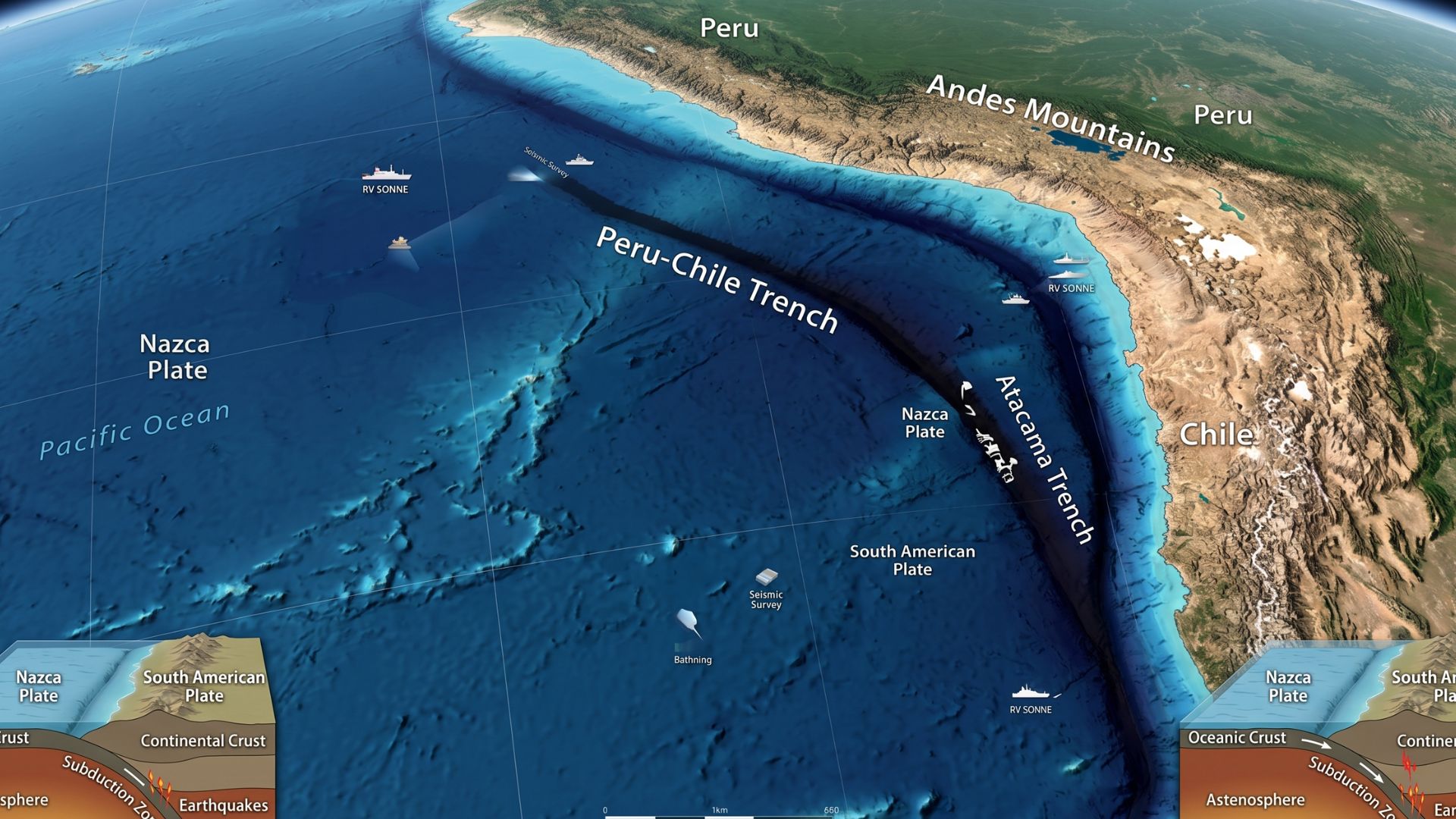
The Peru–Chile Trench is more than twice the size of the Mariana Trench in length and reveals one of the most violent tectonic environments on Earth.
When it comes to oceanic abysses, almost all of the planet’s attention goes to the Mariana Trench in the western Pacific, famous for housing the Challenger Deep, the deepest known point in the oceans, at about 10,935 meters according to modern measurements cited by the NOAA and recent oceanographic studies. But there is a little-known detail outside the scientific community: the Mariana Trench is not the largest oceanic trench on the planet in horizontal extension. That title belongs to the gigantic Peru–Chile Trench, also called the Atacama Trench, a submarine colossus that stretches approximately 5,900 kilometers along the eastern Pacific Ocean, following the coasts of Peru and Chile.
Although it is less deep than the Mariana Trench, the structure impresses with its almost continental scale. It has a length greater than the distance between the north and south of Brazil and forms one of the most violent and active geological environments on Earth, where giant tectonic plates have been slowly colliding for millions of years.
The Peru–Chile Trench is more than twice as long as the Mariana Trench
The comparison between the two structures reveals an impressive contrast. The Mariana Trench is about 2,540 kilometers long, while the Peru–Chile Trench reaches approximately 5,900 kilometers, making it the longest oceanic trench on the planet according to records from the Encyclopaedia Britannica and international geological studies.
-
Survivor of 1966 SS Daniel J. Morrell Shipwreck in Lake Huron Recounts 38-Hour Ordeal in Extreme Cold

-
The Greatest Hoax in World Cup History? The Film That Denied Brazil’s 1958 Victory and Exposed How Fake Evidence Can Seem Convincing on TV
-
Fake South Korean Online Stores Offer Shopping Thrill Without Spending Money or Receiving Products
-
The War of Jenkins’ Ear: How a Severed Ear Sparked One of the 18th Century’s Most Unusual Conflicts


Even so, the maximum depth of the Peru–Chile Trench is much less than that of the Marianas. Its deepest known point, called Richards Deep, reaches about 8,065 meters below sea level.
This means that the Mariana Trench remains the deepest known place on Earth. In some historical surveys, the Challenger Deep was estimated at depths close to 11,034 meters, although more precise modern measurements have refined the values to about 10,935 meters.
The trench accompanies almost the entire west coast of South America
The Peru–Chile Trench runs parallel to the Pacific coast of South America, located about 160 kilometers from the shores of Peru and Chile.
It marks a gigantic subduction zone where the Nazca Plate slowly dives beneath the South American Plate. This geological process releases enormous amounts of accumulated energy and is directly linked to the formation of the Andes Mountains, as well as earthquakes and intense volcanic activity in several South American countries.
Scientists consider this region one of the most tectonically active areas on the planet. It is precisely this continuous collision between oceanic and continental plates that has slowly carved out the enormous underwater trench over millions of years.
The height difference between the trench floor and the Andes is gigantic
One of the most impressive aspects of the Peru–Chile Trench is the extreme vertical contrast between the ocean floor and the nearby Andean mountains.

According to Britannica, the difference between the trench floor and the high Andean peaks exceeds 40,000 feet, equivalent to more than 12 kilometers of elevation change over a relatively short distance.
Few places on the planet concentrate such an abrupt geographical change in so little horizontal space.
Within hundreds of kilometers, the landscape transitions from one of the deepest points in the oceans to some of the highest mountains in the southern hemisphere.
The bottom of these trenches is an almost alien environment
Both the Mariana Trench and the Peru–Chile Trench belong to the so-called hadal zone, a name given to oceanic regions below 6,000 meters in depth.
In these areas, the pressure is extreme, sunlight never reaches, and the water temperature remains near freezing. At Challenger Deep, the pressure can exceed 1,000 atmospheres, enough to crush most conventional structures created by humans.
Even so, life forms manage to survive in these conditions. Oceanographic research has already recorded microorganisms, crustaceans, and organisms adapted to the hadal environment, showing that life can persist even in scenarios considered practically impossible.
The Mariana Trench still remains the greatest symbol of Earth’s extreme limits
Despite the existence of longer trenches, the Mariana Trench continues to hold a unique place in human imagination because of its extreme depth.
The Challenger Deep is so deep that if Mount Everest were placed inside the trench, its peak would still remain below the ocean’s surface.

The region has become synonymous with physical limits because it combines a depth close to 11 kilometers, permanent darkness, and almost unimaginable pressures. Not surprisingly, it remains one of the least explored environments on Earth even after decades of technological advances.
The existence of giant trenches reveals that Earth’s surface is much more extreme than it seems
For many people, the planet seems relatively uniform when viewed from the surface. But ocean trenches show exactly the opposite.

Hidden beneath thousands of meters of water are gigantic underwater canyons, violent tectonic zones, and abysses so deep that they still challenge modern engineering. The comparison between the Mariana Trench and the Peru–Chile Trench shows this clearly: one is the deepest on the planet; the other, the longest.
And perhaps the most impressive thing is realizing that much of these regions still remains little explored.
While humanity has already placed probes on Mars and telescopes millions of kilometers from Earth, vast areas of the deep oceans remain practically unknown.


Be the first to react!