





 Portuguese
  English
  Spanish
  6 min of reading
  0 comments


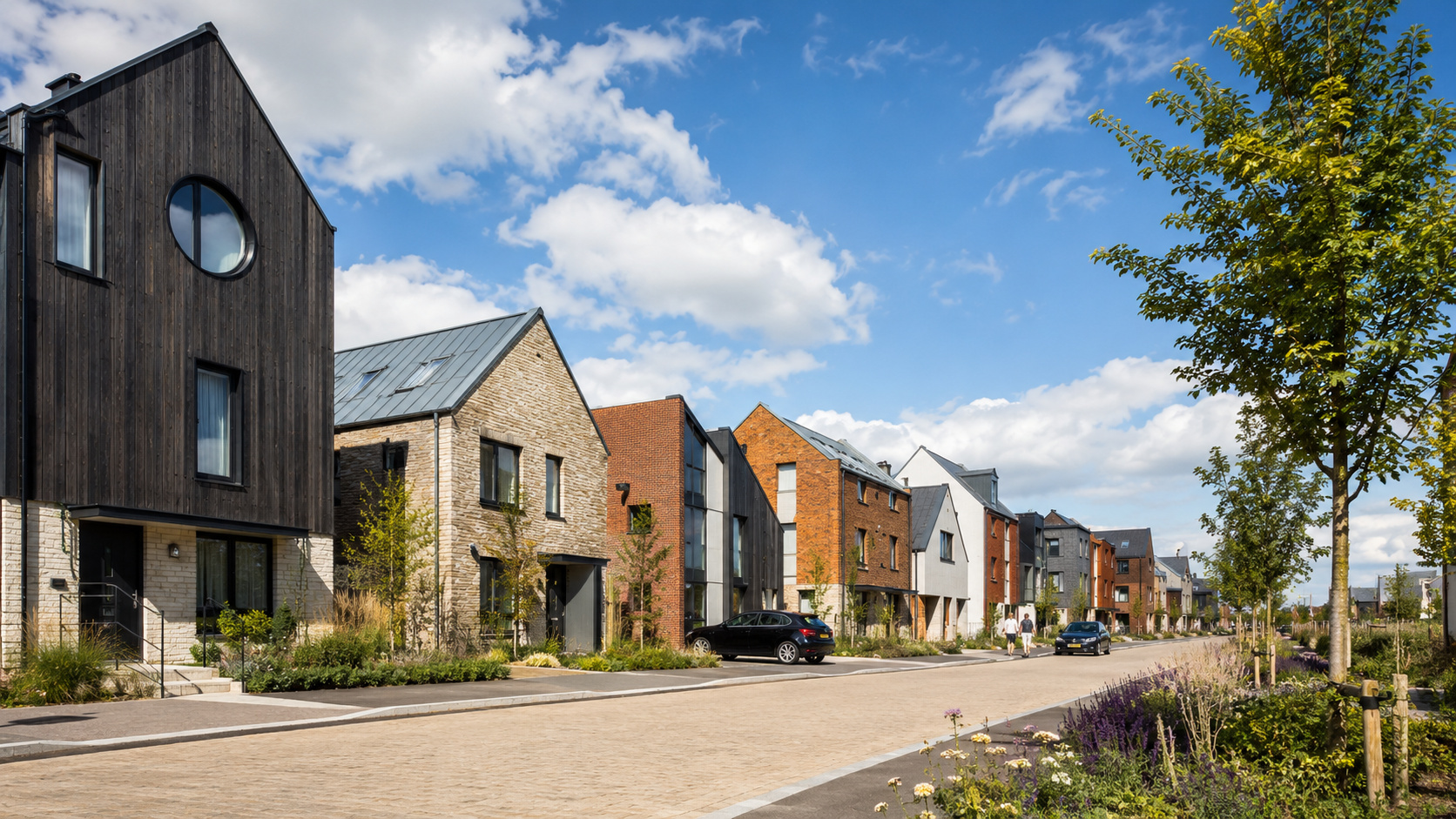
Graven Hill, in Bicester, shows how a self-build neighborhood can replace repetitive facades with customized houses, more curious streets, and rules that still limit each project to avoid urban disorder.
In Bicester, England, a self-build neighborhood became the opposite of streets where all the houses seem to come out the same way. In Graven Hill, residents buy plots, participate in the design of their own homes, and create streets with round windows, sloped roofs, and colorful facades.
The information was published by The Guardian, a British news and reporting newspaper. The report from April 21, 2025 described Graven Hill as the largest self-build experiment in the UK, ongoing for 10 years in the outskirts of Bicester, in Oxfordshire.
The practical impact is in the change of logic. Instead of receiving a ready-made house similar to the neighbor’s, the resident can build a home more connected to their own taste, budget, and family lifestyle.
-
10 million trees transform settlements in the interior of São Paulo into a forest factory; the project reconnects the Atlantic Forest, generates income with agroforestry coffee, and aims to restore an area equivalent to the city of New York.

-
Excavations for a 900 kW solar parking lot on the Italian coast reveal an underground necropolis 2,300 years old with about 100 graves and a bronze belt linked to the elite of a people who inhabited the Adriatic before Rome.

-
To avoid competing for attention with the beach, architects buried part of a house in Bahia, supported the structure with glued laminated timber, and opened the veranda for a direct view of the Atlantic.

-
The “most dangerous hotel in the world” is located in the USA, in the middle of the ocean, accessible only by boat or helicopter; the Frying Pan Tower is a platform in the middle of the Atlantic and offers an experience that few have the courage to live.




How a self-build neighborhood works where the resident participates in the design of their own house
A self-build neighborhood does not mean that each person raises the walls alone. The idea is to give the resident more power over the project, with the choice of plot, participation in the house design, and hiring professionals to execute the work.


In Graven Hill, this model appears in houses very different from each other. There are constructions with wood, glass, stone, brick, and various claddings. There are also roofs with unusual shapes and windows that deviate from the rectangular standard.
The simplest image is that of a planned subdivision where each family has more freedom to create their own home. The street ceases to be a sequence of repetitive facades and becomes a mix of styles.
Even so, this freedom is not total. Each plot must follow construction rules because the neighborhood still needs to have organization, circulation, sidewalks, access, and a minimum relationship between the houses.
Why the model emerged in Bicester and became a reference in the United Kingdom
Graven Hill was born in an area of 188 hectares purchased in 2014 by the Cherwell District Council, the district council responsible for the region. The project was designed to accommodate 2,000 homes, with space for self-build and custom homes.
The difference between these two models is simple. In self-build, the resident participates more in the decisions about the design of the house. In a custom home, part of the project is more defined, but there is still some choice.
The area was organized into 11 character areas. This means that the neighborhood was not designed as a chaotic mess. Each part could have its own guidelines on appearance, materials, and house heights.
This combination helps explain why Graven Hill became known. The neighborhood tries to combine urban planning with individual freedom, something rare in large residential developments.
Round windows, sloped roofs, and colorful facades change the street landscape
The strongest point of Graven Hill is the appearance of the streets. Instead of identical houses in a row, the neighborhood brings together homes with different shapes, colors, and materials. Some attract attention with sloped roofs. Others stand out with round windows, glass balconies, or wooden facades.
This variety creates an unusual landscape for those accustomed to standardized neighborhoods. Each house seems to carry a personal decision from the resident, whether in the shape of the window, the color of the facade, or the type of cladding used.
The visual result can please or annoy. For some, the mix makes the neighborhood lively and creative. For others, the lack of repetition may seem excessive.
Even so, the experience shows something important: when the resident participates more in the project, the house ceases to be just a ready-made product and starts to reflect real choices of those who will live there.
What limits do residents still need to follow before building
The Guardian, a British news and reporting newspaper, detailed that Graven Hill uses rules to guide the projects. These rules appear per plot and help define what can be done on each site.
One of the tools used is the so-called plot passport. In simple language, it works like a sheet with limits for construction. This sheet can address height, materials, house position, and relationship with the street.
This control is necessary because unlimited customization can cause problems. A very tall house can harm the neighborhood. A poorly fitted construction can hinder access. A facade without any criteria can create visual conflict.
Therefore, Graven Hill is not a neighborhood where everyone does whatever they want. It shows a model where the resident gains freedom but still needs to respect rules to maintain collective functioning.
The neighborhood also faced criticism, delays, and demands for promised services
Despite its fame, Graven Hill did not become a perfect example. At the time of the report, 600 homes were already occupied, but residents still complained about the lack of some services. Among the points mentioned were the absence of a minimarket and a community center.
There were also questions about affordable housing. The project required 30% of houses of this type, but some residents criticized the way they were integrated into the neighborhood. The main complaint was the feeling of separation between different groups.
Adrian Unitt, managing director of the Graven Hill Village Development Company, summed up the difficulty of the model with the phrase: “It’s a very difficult model to make stack up.” The statement indicates that balancing lot sales, infrastructure, public rules, and construction at different paces is a complicated task.
This point prevents a naive reading of the project. Customized houses may be more attractive, but they can also bring higher costs, slower construction, and dependence on well-executed urban management.
What could go right or wrong in Brazil with a neighborhood like this
In Brazil, the idea of a neighborhood where residents design their own homes could attract families who do not want to live on completely standardized streets. The desire to build a house with its own identity is common in many Brazilian cities.
What could go right would be the combination of a well-defined lot, simple rules, ready infrastructure, and freedom to customize. Thus, each family would know what they can do before spending money on design and construction.
The risk would be the lack of control. Without clear rules, a neighborhood of very different houses could have poor sidewalks, access problems, unresolved drainage issues, and conflicts between neighbors.
The experience of Graven Hill shows that self-building does not depend solely on creativity. It requires planning, money, technical supervision, and clear limits so that the freedom of a house does not harm life on the entire street.
Graven Hill became a curious example because it swaps the logic of repeated houses for a neighborhood where each resident tries to leave their mark. The mix of facades, windows, and roofs helps explain why the project attracts so much attention.
At the same time, the demands for services and the criticisms about integration show that a beautiful or different neighborhood is not enough. To truly work, it also needs to have coexistence, structure, and understandable rules for everyone.
Would you live on a street where each house has its own style, even with the risk of becoming visually chaotic, or do you prefer more standardized and predictable neighborhoods? Share your opinion and share with someone who dreams of designing their own house.


Be the first to react!